Eevee
Evolution Pokémon
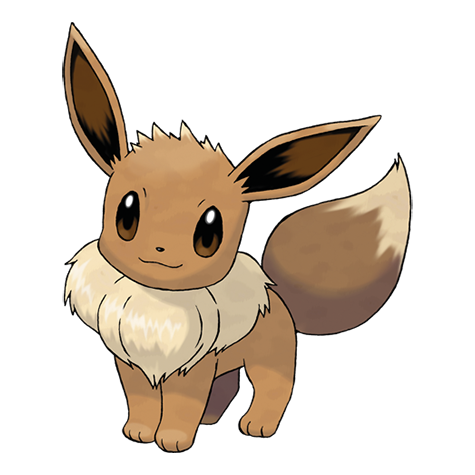
Its genetic code is irregular. It may mutate if it is exposed to radiation from element STONEs.
- Height
- 0.3 m
- Weight
- 6.5 kg
- Base XP
- 65
- Catch
- 45 /255
- Happy
- 70
- Hatch
- 35 steps



- HabitatUrban
- Body shapeQuadruped
- ColourBrown
- Growth rateMedium
- Egg groupsGround
- RarityStandard
Eevee is a Normal-type Pokémon introduced in the first generation of games, widely known under its species classification as the Evolution Pokémon. It takes the form of a small, compact quadruped covered in short, warm brown fur. Its most striking feature is the large, fluffy cream-colored ruff that encircles its neck and chest like a thick collar, giving it a soft and approachable silhouette. Its tail is equally distinctive: bushy and full, tipped in the same pale cream hue. Eevee stands roughly knee-height to an adult human, with large round eyes of a deep brown, wide alert ears that swivel toward sounds, and small, neat paws. Despite its unassuming appearance, Eevee carries within it one of the most remarkable genetic profiles in the known Pokémon world.
Eevee is most commonly found in urban and suburban environments, making its home near human settlements across many regions. In the wild it tends to favor parks, overgrown lots, and the edges of towns where food and shelter are relatively plentiful. While populations exist in Kanto, Johto, Sinnoh, Kalos, and beyond, Eevee is not considered an abundant wild species anywhere and is far more frequently encountered as a companion or partner Pokémon raised in captivity. In the wild, individuals are typically solitary and territorial about their immediate foraging grounds, though pairs or small sibling groups have been observed during warmer seasons. Eevee shows no strong preference for a particular time of day and can be active through morning, afternoon, and evening hours, adjusting its schedule readily to match its environment.
Day to day, Eevee is an adaptable and curious creature. It forages for berries, nuts, and small edible plants, supplementing its diet opportunistically when living near human areas. Eevee communicates through a range of soft vocalizations and through deliberate movements of its large ears and tail. Toward humans it is generally trusting and affectionate when raised from youth, forming deep bonds with regular caregivers. Toward unfamiliar Pokémon it tends toward caution rather than aggression, preferring to retreat and assess a situation before committing to interaction. Field researchers note that Eevee is especially sensitive to its trainer's emotional state, often mirroring moods closely, which has made it a subject of study in Pokémon behavioral science. Its legendary adaptability is not merely physical but psychological as well.
In battle, Eevee occupies a generalist role befitting its Normal typing. Normal-type moves it uses carry no particular offensive advantage against most opponents, though they cannot affect Ghost-type Pokémon at all. Its sole type weakness is to Fighting-type attacks. Eevee's two standard abilities shape how it functions in different contexts. Run Away ensures that Eevee can always successfully flee from a wild encounter, which is of practical value for trainers navigating dangerous territory. Adaptability raises the bonus Eevee receives when using a move that matches its own Normal typing, making those attacks hit noticeably harder than they otherwise would. Its hidden ability, Anticipation, allows it to sense at the moment of entering battle whether an opponent carries a move that would be especially effective against it, a self-destructing attack, or a move capable of causing an instant knockout, giving its trainer critical early information. Eevee's overall stats are modest and balanced, with no single area of overwhelming strength, making it a versatile but rarely dominant battler on its own merits.
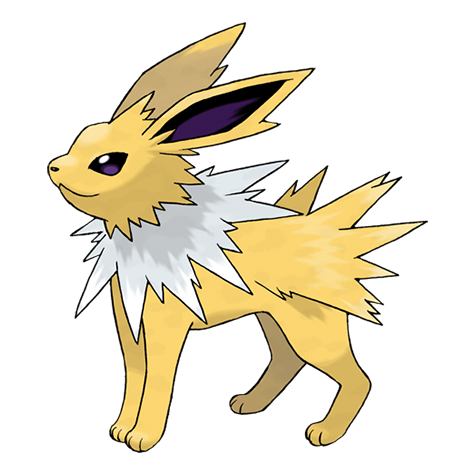
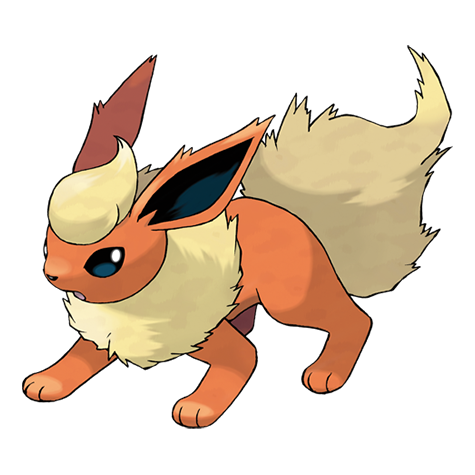
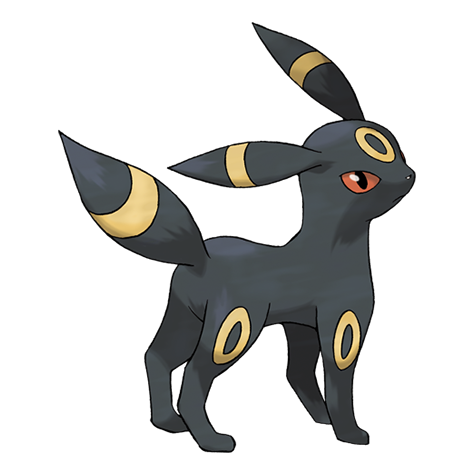
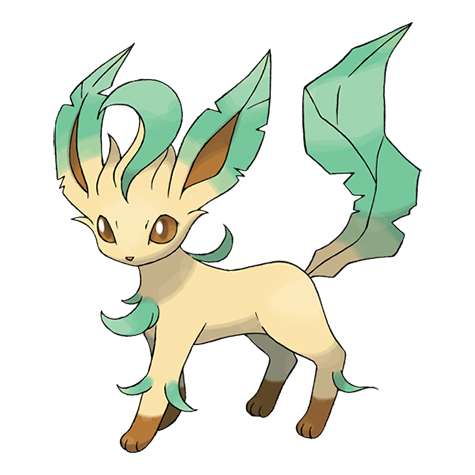
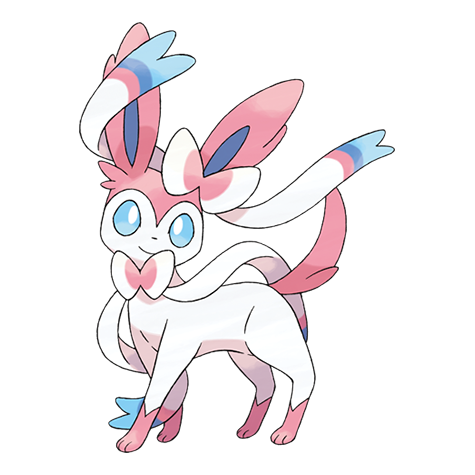
Eevee holds a unique and celebrated position in its evolutionary line. It does not evolve from any prior form, beginning its life as the foundation of a branching path rather than a stepping stone within one. From Eevee, eight distinct evolved forms are currently known, more branching paths than any other Pokémon species. Exposure to a Water Stone produces the Water-type Vaporeon, a Thunder Stone the Electric-type Jolteon, and a Fire Stone the Fire-type Flareon, all three options available since the first generation of games. Leveling with high friendship during the day yields the Psychic-type Espeon, while the same process at night produces the Dark-type Umbreon. A Leaf Stone transforms Eevee into the Grass-type Leafeon, and an Ice Stone into the Ice-type Glaceon. Building a close bond while Eevee knows a Fairy-type move brings forth the Fairy-type Sylveon. For researchers, Eevee represents the clearest example in nature of Pokémon genetic instability as a creative force: a single species that can reshape itself entirely based on external conditions, making it one of the most studied and sought-after Pokémon in the world.