Electrode
Ball Pokémon

It stores electric energy under very high pressure. It often explodes with little or no provocation.
- Height
- 1.2 m
- Weight
- 66.6 kg
- Base XP
- 172
- Catch
- 60 /255
- Happy
- 70
- Hatch
- 20 steps
- HabitatUrban
- Body shapeBall
- ColourRed
- Growth rateMedium
- Egg groupsMineral
- RarityStandard
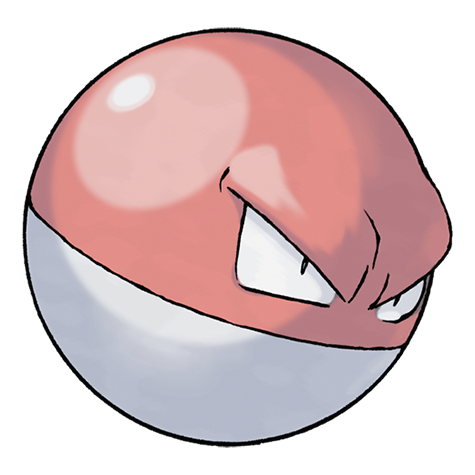
Electrode is the Ball Pokémon, an Electric-type species that first appeared in the original generation of known Pokémon. Its body is a perfect sphere, roughly the size of a large boulder and standing at approximately chest height on an adult human, divided cleanly into two hemispheres by a thin horizontal seam. The lower half is white while the upper half is a vivid red, making Electrode the precise mirror image of its pre-evolved form. It has no visible limbs, though two small slanted eyes and a curved expression lend it a faintly mischievous look. Its entire body functions as a living battery, compressing enormous quantities of electrical energy beneath a smooth, seamless shell.
Electrode is most commonly encountered in urban environments and industrial zones, particularly wherever electricity is generated or transmitted at scale. Power plants rank among its preferred habitats, and field researchers consistently note that it appears drawn to high-voltage equipment and transformer facilities. Populations have been documented in Kanto and Johto, often found lurking around power stations and, on occasion, wandering into the surrounding streets of cities at the grid's edge. The species is predominantly solitary, and sightings of multiple individuals in the same location are uncommon except at large generation facilities where the abundant electrical supply can attract several at once. Electrode shows no strong preference for a particular time of day and has been observed at all hours, though it becomes markedly more agitated during electrical storms when atmospheric charge climbs.
Electrode sustains itself not by consuming organic matter but by absorbing electrical energy directly from its surroundings. It draws power from transmission lines, generators, and the static charge that builds in stormy weather. This absorbed energy is packed under extreme internal pressure, and that pressure lies at the root of its most notorious trait: spontaneous self-detonation. Electrode can explode with very little provocation — a sharp jostle, a sudden loud sound, or an abrupt shift in temperature are all sufficient triggers for a violent discharge. Trainers who spend time near Electrode describe it as volatile in the most literal sense possible, and researchers advise anyone approaching one in the wild to do so with exceptional care. Despite this danger, Electrode does not appear to be intentionally hostile toward humans; the majority of its explosions seem to be involuntary releases of excess pressure rather than deliberate acts of aggression.
In battle, Electrode fills a precise and well-defined role built almost entirely around its extraordinary speed. It moves before virtually any opponent on the field, a quality that makes it valuable for disruption strategies where acting first is decisive. Its special attack capability is solid, making electrical moves like Thunderbolt dependable offensive tools, and it can deliver them before most rivals have the chance to act. Its Soundproof ability renders it completely immune to sound-based moves such as Boomburst, Hyper Voice, and Perish Song, shielding it from a range of disruption tactics that would otherwise threaten faster, frailer Pokémon. The Static ability means that any Pokémon striking Electrode with a direct physical contact move risks being left paralyzed on the spot, turning defensive moments into potential turning points. Its hidden Aftermath ability ensures that an opponent who knocks Electrode out with a contact move pays a steep price in lost health, making it a dangerous target to remove carelessly. As an Electric type it carries a single weakness, to Ground-type attacks, giving it a notably clean defensive profile that trainers find easy to play around.
Electrode is the evolved form of Voltorb, a smaller and nearly identical spherical Pokémon that bears such a close resemblance to a standard Poké Ball that it regularly deceives trainers and bystanders. Voltorb gains enough experience to evolve into Electrode through accumulated battle and growth, emerging as a larger, faster, and far more energetically charged entity. Electrode represents the final stage of this two-member evolutionary line and develops no further. Within the broader Pokédex it occupies a genuinely singular niche as a living explosive, a creature whose primary survival mechanism appears to hinge on the credible threat of self-destruction. Researchers study it with sustained interest both for the physiological systems that allow its body to contain such intense electrical charge without constant detonation and for what those explosive tendencies reveal about energy regulation in Electric-type biology more broadly. For trainers, Electrode remains a useful and frequently underestimated choice whenever speed and the capacity to disrupt an opponent's tempo are the defining priorities of a battle.