Gligar
Fly Scorpion Pokémon
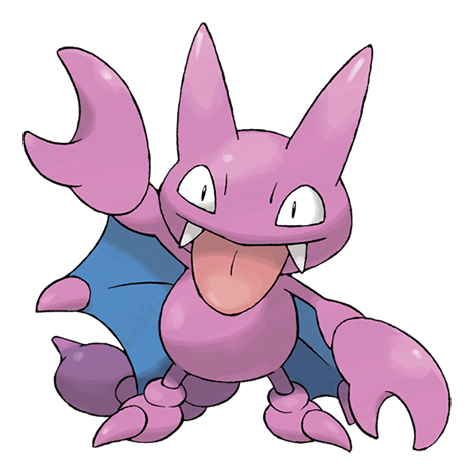
It flies straight at its target's face then clamps down on the star tled victim to inject poison.
- Height
- 1.1 m
- Weight
- 64.8 kg
- Base XP
- 86
- Catch
- 60 /255
- Happy
- 70
- Hatch
- 20 steps
- HabitatMountain
- Body shapeWings
- ColourPurple
- Growth rateMedium Slow
- Egg groupsBug
- RarityStandard
Gligar is the Fly Scorpion Pokémon, a dual Ground and Flying type introduced in the second generation of Pokémon games. Its silhouette is immediately distinctive: a compact, purple-bodied creature that merges the anatomy of a scorpion with the gliding structure of a bat. Large membranous wings extend from either side of its rounded torso, oversized clawed pincers project forward from its forelimbs, and a long flexible tail curves upward behind it to end in a prominent triangular stinger. Wide, pale eyes are set flat against its face, giving it an unblinking and somewhat unsettling fixed gaze. When resting on a cliff face with wings folded and body pressed close to the rock, it blends remarkably well into the stone and is difficult to spot from any distance. In body alone it is roughly the size of a medium dog, but the full spread of its wings makes it appear considerably larger in flight, and its overall build communicates both aerial agility and armored physical toughness.
Gligar favors mountainous terrain above nearly any other environment. It roosts along sheer cliff faces and canyon walls, where its claws anchor firmly to exposed rock and the elevation provides ready access to thermal updrafts that make sustained gliding effortless. It shows a strong preference for arid and semi-arid highland zones, and in the Johto region it is most reliably encountered along rugged routes that combine steep descents with wide open sky. Its populations are naturally sparse, each individual holding an exclusive territory along its stretch of cliff. Gligar is crepuscular and nocturnal by habit, growing active at dusk and spending much of the night on low-altitude gliding patrols above its roosting ground. Outside of breeding season it is almost entirely solitary, though newly independent young have been observed forming loose informal groups during the first weeks after they begin flying on their own.
Gligar's hunting method is one of the most precisely documented attack patterns in field research. It launches silently from its resting position, dives directly toward the face of its target, and clamps on with its forward claws to restrict movement and startle the prey. At the moment of contact it drives the tail stinger in to deliver a venomous injection, relying on the combination of shock and toxin to subdue the victim before a response is possible. Field researchers note that targeting the face proves effective against prey considerably larger than Gligar itself, because the sudden impact produces an involuntary flinching response that prevents any immediate counterattack. Despite this precisely aimed ambush strategy, Gligar shows curiosity rather than hostility toward humans passing peacefully through its territory, and experienced trainers report that unhurried observation from a distance rarely triggers aggression. It feeds mainly on insects and small arthropods, and juveniles spend weeks practicing the dive-and-clamp motion against boulders and tree trunks before they attempt live quarry.
In battle, Gligar draws on two standard abilities and one hidden ability. Hyper Cutter prevents opponents from reducing its Attack stat through moves or passive effects, ensuring that defensive plays cannot erode its damage output across a prolonged exchange. Sand Veil, the alternative standard ability, raises its evasion during a sandstorm and also protects it from that sandstorm's residual damage, making Gligar a natural fit for sand-oriented team compositions. Its hidden ability, Immunity, prevents it from ever being poisoned, a notable irony for a Pokémon that hunts by delivering venom. The Ground and Flying type combination grants two important defensive immunities: the Flying typing removes the threat of Ground-type moves entirely, while the Ground typing cancels any damage from Electric-type attacks. Ice-type moves interact poorly with both typings at once and represent the most serious threat Gligar faces in battle; Water-type and Rock-type attacks also present consistent challenges. Its physical Defense is exceptional for an unevolved form, its Speed is high enough to act before many opponents, and every competitive strength it possesses runs through physical rather than special attacks.
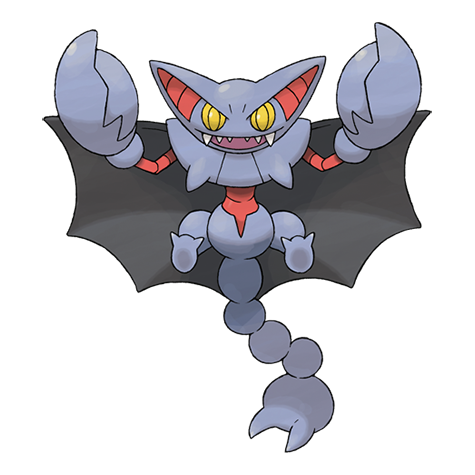
Gligar is the foundational member of a two-stage evolutionary line with no prior form of its own. It evolves into Gliscor, a larger and more powerful Ground and Flying type introduced in the fourth generation, which means Gligar spent one full generation as an evolutionary dead end before gaining a continuation. The evolution is triggered by leveling up at night while holding a Razor Fang, a condition that mirrors the nocturnal behavior Gligar displays in the wild. Gliscor retains the same typing and core body plan but grows into a significantly more durable and threatening form widely respected in competitive play. Within the broader Pokédex, Gligar is notable as a second-generation species that gained new relevance when its evolution arrived two generations later. Researchers find the line compelling because it presents a genuine convergence of arachnid body structure with the gliding membrane system more typically associated with mammals, realized in a single cohesive Pokémon. Trainers seek it out not only as a path to Gliscor, but because its defensive resilience, dual immunities, and reliable physical offense make it a genuinely capable partner well before evolution becomes a consideration.