Golem
Megaton Pokémon
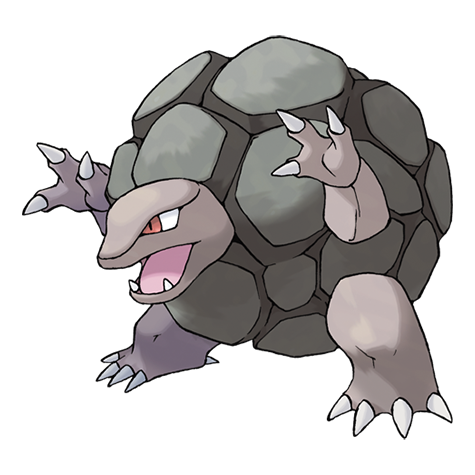
Its boulder-like body is extremely hard. It can easily withstand dynamite blasts without damage.
- Height
- 1.4 m
- Weight
- 300.0 kg
- Base XP
- 223
- Catch
- 45 /255
- Happy
- 70
- Hatch
- 15 steps
- HabitatMountain
- Body shapeHumanoid
- ColourBrown
- Growth rateMedium Slow
- Egg groupsMineral
- RarityStandard
Golem is the Megaton Pokémon, a dual Rock and Ground type that originated in the first generation of Pokémon. Its body is built around a massive, roughly spherical shell of layered stone, with its head, arms, and short legs emerging from the rock as though the creature were half-formed from the mountain itself. The outer shell is a deep brownish-gray, textured with interlocking rocky plates, while the exposed skin of its face and limbs carries a warmer, earthier brown tone. In terms of scale, Golem stands considerably larger and heavier than an average human, and its sheer mass gives it a presence that is difficult to ignore even at a distance. The face is rugged and angular, framed by the thick rim of the shell, with small deep-set eyes and a wide, flat mouth. Four thick fingers end each hand, suited for gripping stone and delivering crushing blows. Every physical detail of Golem speaks to a creature optimized for structural resilience above all else.
Golem inhabits mountainous terrain throughout many regions, favoring high elevations, sheer cliff faces, and boulder-scattered slopes where it blends naturally into the surrounding geology. It has been documented across the mountain ranges of Kanto, Johto, and several other regions wherever rugged highland environments exist. Individual Golem are largely solitary and territorial, each claiming a defined section of rocky hillside and patrolling it slowly but consistently. They are diurnal, most active during daylight hours, and are frequently observed resting motionless against large boulders in a way that makes them nearly indistinguishable from the surrounding rock. Once per year, Golem sheds the outer layer of its shell, and the discarded fragments accumulate along the slopes of its territory. Population density for Golem is relatively sparse, as it represents the fully evolved final stage of a three-part line, and the social requirement for its evolution further limits how commonly wild Golem appear compared to the younger members of its lineage.
On a day-to-day basis, Golem is unhurried and largely self-contained, moving slowly across its territory in search of rocks and mineral-rich soil, which form the bulk of its diet. It consumes these materials to replenish the minerals in its shell, and older individuals tend to have noticeably denser and harder outer layers than younger ones as a result of years of accumulated growth. It communicates through deep, resonant vocalizations that produce vibrations strong enough to be felt through the ground by nearby observers. Toward humans and non-threatening Pokémon it is generally indifferent, but when it feels threatened or has its territory encroached upon, it curls into a compact ball and rolls downhill at high speed, a defensive behavior known to cause significant rockslides and terrain damage. Experienced trainers who have built a bond with their Golem describe it as steady and dependable, a quiet partner with considerable patience. Field researchers note that the annual shed shell, due to its exceptional mineral density, is highly sought by geologists and materials scientists alike.
In battle, Golem functions primarily as a physical powerhouse with formidable defensive capabilities. Its Rock Head ability eliminates any recoil damage it would normally sustain from particularly punishing moves, allowing it to use attacks like Head Smash at full effectiveness without wearing itself down in the process. Its Sturdy ability serves as a last-resort survival mechanism, ensuring that no single attack can reduce Golem from full health to zero in one blow, and it additionally renders Golem immune to the category of instant-knockout moves regardless of its current health. Its hidden Sand Veil ability, active only during a sandstorm, increases its evasiveness and grants it protection from the ambient damage that sandstorms ordinarily inflict on most Pokémon. Offensively, its Rock and Ground typing provides strong coverage against Fire, Electric, Poison, Rock, and Flying type opponents, and its Ground typing grants a complete immunity to Electric type attacks. Defensively, it must contend with weaknesses to Fighting, Ground, Steel, Water, Grass, and Ice type moves, and its low speed typically means it absorbs a hit before striking back, making it best deployed in matchups where those vulnerabilities can be anticipated and controlled.
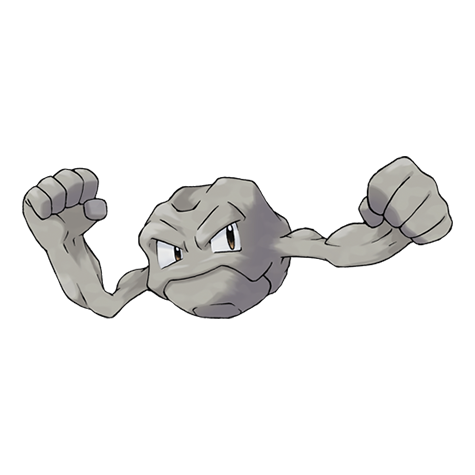
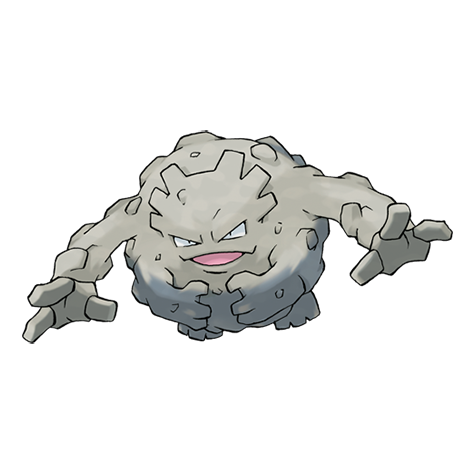
Golem stands at the end of the evolutionary line that begins with Geodude and continues through Graveler. Geodude begins evolving into Graveler at level twenty-five, and Graveler evolves into Golem not through further leveling but through being traded to another trainer, a mechanic introduced in the first generation that made Golem one of the more distinctive species in terms of the cooperative effort required to obtain it. This trade-based evolution was among the earliest examples of the series actively encouraging collaboration between players. Within the broader Pokédex, Golem holds significance both as one of the original trade evolutions and as a defining example of the physical Rock and Ground archetype that has continued to influence the design of similar species in later generations. Researchers study its molting cycle and shell composition for insights into biological mineral processing, while trainers continue to prize Golem for its combination of defensive resilience and offensive output, a reputation it has maintained consistently since its very first appearance.