Heracross
Single Horn Pokémon
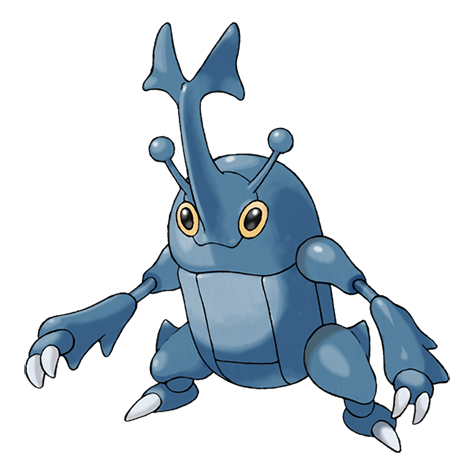
It is usually docile, but if it is disturbed while sipping honey, it chases off the intruder with its horn.
- Height
- 1.5 m
- Weight
- 54.0 kg
- Base XP
- 175
- Catch
- 45 /255
- Happy
- 70
- Hatch
- 25 steps
- HabitatForest
- Body shapeHumanoid
- ColourBlue
- Growth rateSlow
- Egg groupsBug
- RarityStandard
Heracross is the Single Horn Pokémon, a dual Bug and Fighting type that made its debut in the second generation of games set in the Johto region. Its body is encased in a deep cobalt blue exoskeleton, giving it an immediately striking silhouette among the forest dwellers it shares territory with. Standing roughly to the height of a small adult human, Heracross carries a sturdy, upright, humanoid build with powerful arms and legs shaped for gripping tree bark and driving forward in close combat. The most defining feature of this species is the large cross-shaped horn rising from the center of its forehead, a structure of exceptional density and strength that serves both as a feeding implement and as its primary weapon. Two smaller rounded protrusions flank the base of that central horn, and its warm amber eyes give the Pokémon a resolute, earnest expression even when at rest.
Heracross makes its home in dense temperate and subtropical forests wherever broad-leaved trees produce sap or attract honeydew-secreting insects. The species has been recorded across Johto, Kanto, Sinnoh, and several other regions, appearing consistently wherever old-growth woodland remains largely undisturbed. Within those forests it gravitates toward trees damaged by storms or burrowing insects, since exposed wood yields the richest flow of sap. Population density varies: in protected reserves individuals sometimes share overlapping feeding territories with low friction, while in fragmented woodlands each Heracross tends to range alone across a wider area. The species is diurnal, most active from morning through late afternoon as it moves through the understory and lower canopy with agility that belies its robust frame. After dark it retreats to hollows and sheltered root systems, and nighttime encounters in the field are uncommon.
The central occupation of Heracross in the wild is locating and consuming tree sap and the honey produced by forest-dwelling insect colonies. It uses its cross-shaped horn to lever open tree bark with considerable force, prying into the wood to access the sweet fluid beneath. This habit puts it in direct competition with species such as Pinsir, and the two are frequently observed contesting the same feeding sites at the forest edge. Away from those disputes, Heracross is widely regarded as a gentle and curious Pokémon. Field researchers consistently note that it will approach unfamiliar humans without aggression, investigating with a calm attentiveness so long as no interference occurs. When a rival or intruder disrupts an active feeding session, however, the response is immediate and forceful: Heracross lowers its head and launches its horn forward, catapulting the offending party away before returning to its meal. That sharp contrast between general docility and explosive defensive action has drawn sustained interest from researchers who study the behavioral ecology of insect-type Pokémon.
In battle, Heracross operates as a powerhouse physical attacker whose raw offensive output rivals that of many larger and more conspicuous species. Its standard ability Swarm causes its Bug-type attacks to surge in power when it has absorbed heavy damage, converting a desperate situation into a final burst of destructive force. The alternate standard ability Guts converts any major status condition such as burn, paralysis, or poison from a handicap into a substantial boost to physical attack power, rewarding opponents who try to wear it down with precisely the outcome they hoped to prevent. Its hidden ability Moxie builds momentum across a battle by raising its attack each time it defeats an opponent, making it increasingly dangerous as a fight extends. The Bug and Fighting typing combines well on offense against Dark, Rock, Normal, Steel, and Grass type opponents, while defensively it carries meaningful vulnerabilities to Flying, Rock, Fire, Psychic, and Fairy type attacks that well-prepared opponents can exploit. Its speed falls in a moderate range, enough to act ahead of slower tanks and walls but not sufficient to reliably outpace the fastest sweepers in a competitive field.
Heracross occupies a singular position in the Pokédex as a standalone species with no conventional evolutionary chain: it does not develop from a smaller pre-evolution and it does not transform further through leveling, trading, or the use of a stone. It arrived in the second generation as a fully realized Pokémon, and that completeness has always been part of its appeal. Trainers and researchers prize it for the rare pairing of exceptional physical capability with a temperament that remains manageable for those who learn to respect its feeding habits and approach its prominent horn with care. Its design draws directly from the rhinoceros and hercules beetles of the real world, insects that carry deep cultural significance across East Asia as symbols of strength and that have long been subjects of traditional fighting competitions. That grounding in genuine natural history gives Heracross a resonance beyond its role as a battle companion, cementing it as one of the most beloved and enduring species introduced in the Johto era.