Magcargo
Lava Pokémon

The shell on its back is just skin that has cooled and hardened. It breaks easily with a slight touch.
- Height
- 0.8 m
- Weight
- 55.0 kg
- Base XP
- 151
- Catch
- 75 /255
- Happy
- 70
- Hatch
- 20 steps
- HabitatMountain
- Body shapeSquiggle
- ColourRed
- Growth rateMedium
- Egg groupsIndeterminate
- RarityStandard
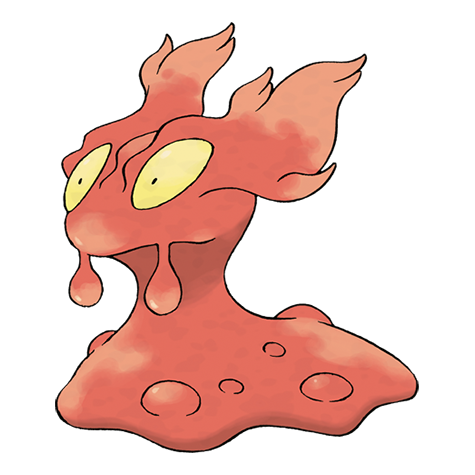
Magcargo is known as the Lava Pokémon, a dual Fire and Rock type that made its first appearance in the second generation of Pokémon. Its silhouette is immediately recognizable: a slow-moving creature shaped like an enormous land snail, with a rounded, flame-streaked body composed almost entirely of molten magma. Its outer form glows in deep oranges and reds, and flames flicker constantly from the top of its head and around its body, giving it an appearance of being perpetually alight. The most distinctive feature of Magcargo is the shell it carries on its back, a swirling, rocky structure that has formed from its own skin as the surface cooled and hardened over time. Despite its imposing appearance, that shell is surprisingly brittle, liable to crack at even a light touch. Compared to a human adult, Magcargo stands at roughly waist height, though its broad, low-slung posture and luminous body make it appear larger than it actually is.
Magcargo is found predominantly in mountainous regions and volcanic environments, where the extreme heat of the surrounding terrain offers conditions close to its own body temperature. It favors areas near active volcanoes, lava flows, and rocky highland terrain that retains warmth long after the sun has set. Populations have been observed in several regions across the Pokémon world, including the volcanic slopes of Hoenn and the heat-scorched routes near thermal vents in other territories. Magcargo tends to be solitary, moving alone through rocky landscapes rather than gathering in groups. It does not migrate in any documented pattern, preferring instead to stake out a small territory in an area of consistent geothermal heat and remain there indefinitely. Because of its extremely slow movement, it rarely ventures far from its home ground, and encounters in the wild are most common for those who explore elevated volcanic terrain during the warmer hours of the day.
Magcargo moves at a very deliberate, unhurried pace, leaving a scorched trail along any surface it crosses. Its body generates extraordinary heat, sufficient to cause water to instantly evaporate on contact and to set flammable materials alight simply by proximity. Despite this, Magcargo is generally regarded as a calm and unaggressive Pokémon, unlikely to pursue or threaten others unless provoked. It feeds primarily on minerals and rocky material it absorbs from the ground, extracting heat and nutrients from the volcanic soil around it. Field researchers note that Magcargo appears to enter a state of reduced activity during cooler periods, pressing its body close to warm rock surfaces to maintain its internal temperature. Trainers who have kept Magcargo report that it can serve an unusual domestic function: in cold climates, it acts as a reliable and extraordinarily efficient heat source, though handling it directly is impossible without specialized protective equipment.
In battle, Magcargo brings a combination of Fire and Rock typing that gives it meaningful offensive reach across a variety of opponents, though it also carries a notably wide array of vulnerabilities. Ground, Rock, Water, Fighting, Steel, and Grass type moves can all exploit weaknesses in its defenses, making type coverage from opponents a significant concern. Its defensive profile is anchored by an exceptionally sturdy physical constitution, making it capable of absorbing a great deal of punishment from direct blows, though its special defense is more modest and its movement speed is among the slowest of any known Pokémon. Magcargo may carry the Magma Armor ability, which reflects its volcanic nature by rendering it completely immune to the frozen condition, an appropriate trait for a creature whose body is composed of superheated molten rock. Its alternative standard ability, Flame Body, radiates such intense heat that any Pokémon making physical contact with it risks being burned, turning its passive presence into an active deterrent. A hidden ability known as Weak Armor shifts its approach under pressure: each time a physical strike connects, Magcargo sheds some of its outer rocky crust, becoming more agile but considerably less physically resilient.
Magcargo is the final form of a two-stage evolutionary line that begins with Slugma, a pure Fire type resembling a free-flowing body of magma without any hardened shell or exterior. As Slugma gains experience and reaches a certain level of maturity, its outer layer cools and crystallizes into the rocky shell that defines Magcargo, a process that also introduces the Rock typing distinguishing the evolved form from its pre-evolution. Magcargo does not evolve further, representing the complete and stable end state of this line. Within the broader Pokédex, it occupies a unique niche as a Pokémon whose body is composed almost entirely of living magma contained within a mineral shell, a combination that has made it an object of significant interest to researchers studying geothermal biology and the intersection of Pokémon physiology with volcanic environments.