Magikarp
Fish Pokémon
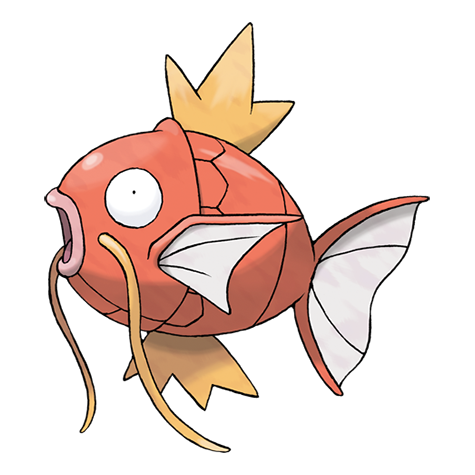
In the distant past, it was somewhat stronger than the horribly weak descendants that exist today.
- Height
- 0.9 m
- Weight
- 10.0 kg
- Base XP
- 40
- Catch
- 255 /255
- Happy
- 70
- Hatch
- 5 steps
- HabitatWaters Edge
- Body shapeFish
- ColourRed
- Growth rateSlow
- Egg groupsWater2, Dragon
- RarityStandard
Magikarp is the Fish Pokémon, a pure Water type first encountered in the original generation of Pokémon. It closely resembles a common carp, with a compact, rounded body dressed in bright reddish-orange scales and a pale cream underbelly. Two thin whiskers extend from either side of its small, downturned mouth, and its wide yellow eyes carry a perpetually blank expression. Measuring roughly two and a half feet from snout to tail, it is small compared to a human, with modest pectoral fins along its flanks and a broad, forked caudal fin. Despite this unremarkable physical profile, Magikarp holds a singular place in Pokémon lore: it is perhaps the most well-known example in the entire Pokédex of apparent frailty concealing extraordinary dormant potential, and its reputation is recognized in virtually every region where trainers are found.
Magikarp is among the most widely distributed Pokémon in the world, appearing in rivers, lakes, ponds, ocean shallows, and almost any body of water across all known regions. It is especially notable for tolerating degraded water conditions: historical records describe it thriving in polluted, nutrient-depleted water that would be lethal to most other aquatic species. Large schools gather in calm, shallow areas and are frequently seen breaching the surface in bouts of apparently spontaneous leaping. Magikarp does not follow a strict activity schedule, though it surfaces most visibly during daylight hours. It is a social creature, rarely found in isolation, and population densities tend to be highest in slow-moving or still freshwater habitats, where food drifts readily to it without requiring any effort to chase.
Magikarp's daily behavior is famously sparse. It feeds passively on algae, microscopic organisms, and organic debris carried by the current, exerting almost no active effort to sustain itself. Outside of feeding, most of its visible activity consists of leaping from the water and flopping across surfaces, behavior that appears entirely instinctive rather than purposeful. It shows no aggression toward humans or other Pokémon and has no meaningful predatory drive to speak of. Trainers who have worked with Magikarp report that it responds to conventional training methods at a pace so gradual as to be nearly imperceptible for extended periods. This experience has given rise to a piece of trainer folklore held in every region: that patiently raising a Magikarp through its early stages is one of the most demanding tests of perseverance the world of Pokémon can offer.
As a pure Water type, Magikarp is vulnerable to both Grass- and Electric-type attacks, and its offensive output in battle is effectively negligible. Its physical defense is reasonable relative to its size, but it is the Pokémon's speed that stands out as its one genuinely impressive baseline quality. The Swift Swim ability amplifies this further during rainy weather, doubling Magikarp's speed and making it, however briefly, one of the fastest moving Pokémon on the field, a quality that sits in sharp contrast to its inability to use that speed offensively. Its hidden ability, Rattled, triggers when it is struck by a Dark-, Ghost-, or Bug-type move, producing an immediate burst of speed from what appears to be a fear response. In practical battle terms, both abilities remain largely theoretical curiosities, and any competitive value Magikarp contributes rests almost entirely on what it is about to become.
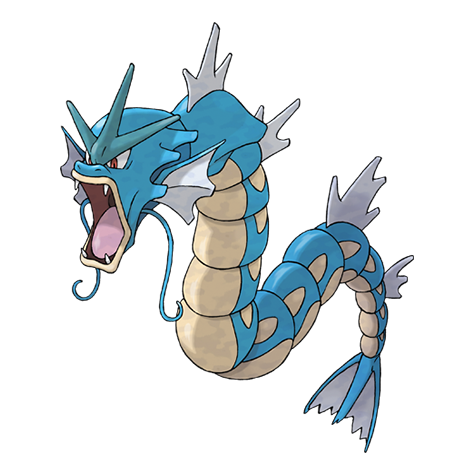
Magikarp is the first stage in one of the most celebrated evolutionary lines in the Pokédex. After accumulating enough battle experience, it evolves into Gyarados, a colossal serpentine Pokémon of the Water and Flying types recognized throughout the world for its power and volatility. The difference between the two forms is so extreme that early researchers questioned whether they could share any evolutionary relationship at all. Magikarp's own Pokédex records note that ancient specimens of the species were considerably stronger than the modern form, suggesting that today's familiar, flopping fish is the product of a very long decline from a once sturdier ancestor. Despite this, or perhaps because of it, Magikarp is studied with great interest by trainers and researchers alike, not only as a biological curiosity, but as the Pokémon world's most enduring argument that patience and persistence, applied even to the most unlikely of beginnings, can yield something truly extraordinary.