Nidorina
Poison Pin Pokémon
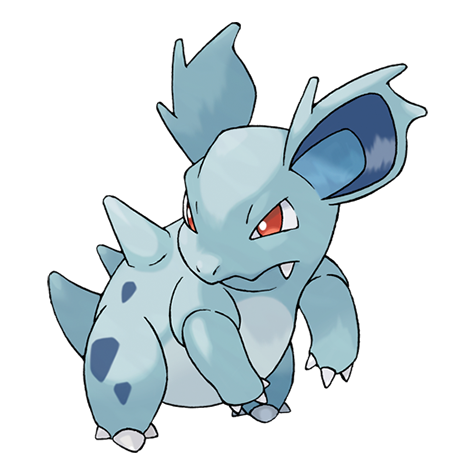
The female's horn develops slowly. Prefers physical attacks such as clawing and biting.
- Height
- 0.8 m
- Weight
- 20.0 kg
- Base XP
- 128
- Catch
- 120 /255
- Happy
- 70
- Hatch
- 20 steps
- HabitatGrassland
- Body shapeQuadruped
- ColourBlue
- Growth rateMedium Slow
- Egg groupsNo Eggs
- RarityStandard
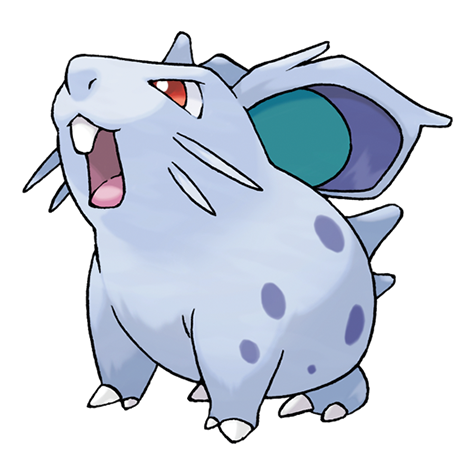
Nidorina is the Poison Pin Pokémon, a pure Poison-type species introduced in the first generation. She is the female-exclusive middle stage of the Nidoran evolutionary line, a low-slung, quadrupedal creature with a blue-violet hide that deepens to a richer, darker shade along her spine. Standing roughly knee-height to an adult human, she carries a compact, muscular build suited for quick movement and close-quarters engagement. A row of darkened ridges runs along her back, each one a hardened protrusion capable of releasing toxins on contact, and a small horn protrudes from the tip of her snout. That horn develops noticeably more slowly in females than in the males of the Nidoran line, a trait that has made Nidorina a subject of sustained interest among researchers studying Pokémon sexual dimorphism. Her large, rounded ears rotate independently, and her alert, cautious eyes convey the social intelligence she relies on to navigate life in the wild.
Nidorina favors open grasslands and transitional scrub zones, gravitating toward areas where meadow grades into low brush, terrain that provides both the open sightlines needed to detect approaching threats and patches of cover that shelter her from intense midday heat. In Kanto, populations are well established across the plains stretching east and south of Cerulean City, and researchers have documented comparable communities in warm, firm-soiled grassland biomes across other regions. She avoids dense woodland and high elevation. Within her range, Nidorina is notably social, forming loose groups of females that frequently share territory with clusters of younger female Nidoran. Senior members of these groups take an active role in threat monitoring, positioning themselves to alert or shield younger companions when danger approaches. She remains active well past dusk, her large ears providing a distinct advantage in low-light foraging and patrol.
Day to day, Nidorina forages steadily for roots, tubers, seeds, and occasional small insects, moving with a purposeful economy of motion that conserves energy for defensive bursts. She is not an innately aggressive species, but she is a committed and effective defender of her group. When threatened, she favors direct physical engagement over ranged venom projection: clawing with her forefeet and biting with a powerful jaw are her preferred responses to danger. Any opponent that strikes her directly, however, risks making contact with the toxin-laden ridges along her back. Field researchers consistently note her heightened vigilance compared to the smaller female Nidoran; she reads incoming threat signals faster and broadcasts low-frequency growls and body postures that her whole group responds to almost immediately. A biological curiosity that researchers have long studied is that Nidorina, uniquely among Pokémon this active, does not lay eggs at this stage of her development, a phenomenon thought to relate to the hormonal demands of ongoing physical maturation.
In battle, Nidorina has access to three distinct abilities. Her most commonly observed ability, Poison Point, turns her dorsal ridges into a passive hazard: any Pokémon that strikes her with a direct physical move risks leaving the exchange poisoned, which discourages repeated close-quarters pressure. Rivalry channels competitive aggression into raw output; when facing an opponent of the same gender, Nidorina strikes harder and with greater force, though this same focus creates a slight reduction in effectiveness against opponents of the opposite gender. Her hidden ability, Hustle, is the most dramatic in effect, pushing the raw power of her physical attacks well beyond their normal ceiling at the cost of some accuracy, making her a high-risk, high-reward attacker in sustained exchanges. As a pure Poison type, she resists Poison, Grass, Fighting, Bug, and Fairy moves and deals super-effective damage against Fairy-type opponents. Ground and Psychic attacks represent her clearest vulnerabilities. Her overall profile leans toward physical durability and steady, grinding attrition rather than speed or explosive special power.
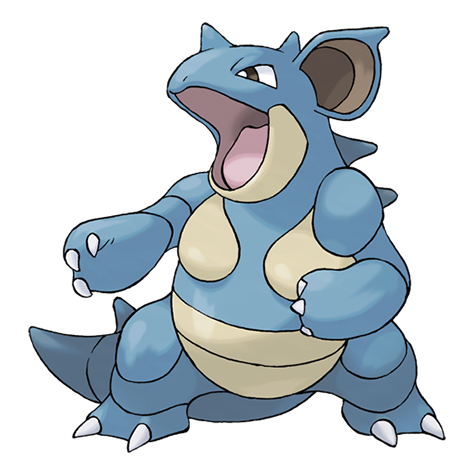
Nidorina occupies the center of a three-stage evolutionary line, connecting the smaller female Nidoran to the formidable Nidoqueen. She evolves from female Nidoran beginning at level sixteen, gaining the deeper blue coloration, sturdier build, and heightened group awareness that define this stage. Her final evolution into Nidoqueen requires exposure to a Moon Stone rather than further leveling, using the same luminous mineral that drives several other stone-based evolutions from the first generation. That transformation adds the Ground type alongside her existing Poison typing, substantially widening her offensive and defensive coverage and making Nidoqueen one of the more versatile Pokémon of the original generation. The Moon Stone requirement gives trainers a deliberate strategic choice: evolve early to access Nidoqueen's expanded typing and movepool, or develop Nidorina's natural moveset a while longer first. In the broader history of Pokémon research, the Nidoran family holds a special place as one of the earliest documented lines in which male and female individuals were catalogued as entirely separate Pokédex entries, an acknowledgment of genuine biological dimorphism that made Nidorina a landmark subject in early studies of Pokémon biodiversity.