Piloswine
Swine Pokémon
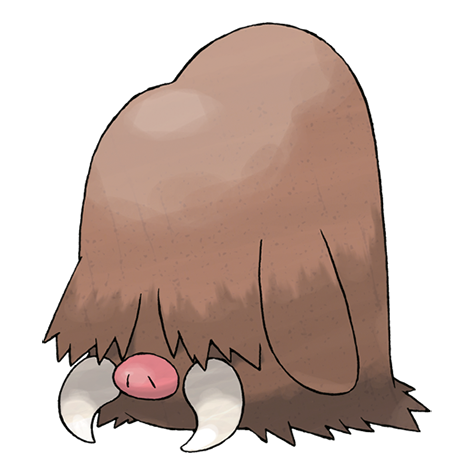
Because the long hair all over its body obscures its sight, it just keeps charging repeatedly.
- Height
- 1.1 m
- Weight
- 55.8 kg
- Base XP
- 158
- Catch
- 75 /255
- Happy
- 70
- Hatch
- 20 steps

- HabitatCave
- Body shapeQuadruped
- ColourBrown
- Growth rateSlow
- Egg groupsGround
- RarityStandard
Piloswine is the Swine Pokémon, a dual Ice and Ground type that made its first appearance in the second generation of games alongside the Johto region. It is a large, powerfully built quadruped whose most immediately striking feature is the extraordinary volume of long, shaggy brown fur that envelops nearly its entire body, draping from its back and flanks all the way down to the ground and giving it the silhouette of a moving mound of coarse hair. Beneath that dense coat, Piloswine carries considerable mass on a low, barrel-shaped frame that stands roughly knee-height on a full-grown adult human but weighs a great deal more than its compact proportions might imply. Two pale, curved tusks project forward from the lower half of its face, sharp-tipped and sturdy, serving both as digging tools and as forward-facing weapons. Its wide, round pink snout is exceptionally sensitive, a necessary compensation for the curtain of fur that falls across its eyes and permanently reduces its vision to almost nothing. That obscured sight is not the result of neglect but of biology — Piloswine has simply evolved to navigate its frozen world through smell rather than sight, a trait that shapes nearly every aspect of how it lives and fights.
Piloswine inhabits cold, subterranean environments, preferring icy cave systems and frost-covered mountain corridors where temperatures stay well below freezing throughout the year. Within Johto it is strongly associated with the Ice Path, the glacial cave network that cuts through the mountains connecting the inland highlands to the eastern coast, and populations have been documented in similar cold-climate cave systems elsewhere across the Pokémon world. Once Piloswine establishes a territory within a suitable cave, it tends to remain there for long periods rather than migrating, emerging onto the frozen surface primarily to forage when interior food sources run low. The species is neither strictly solitary nor meaningfully social — small clusters of individuals sometimes share the same cave network, but they do not form cooperative herds and largely ignore one another outside of the breeding season. Piloswine is most comfortable in dim, low-light conditions and is well adapted to the perpetual twilight of deep glacial tunnels, making it far less active during the brightest portions of the day and more likely to be encountered moving through caves at dawn or in the evening hours.
Piloswine's behavior is dominated by a single powerful instinct: when in doubt, charge. Because the long fur across its face blocks its line of sight almost completely, it lacks the visual feedback that would normally allow an animal to reassess a threat mid-encounter. Instead, Piloswine lowers its head and drives forward with its tusks, repeating the motion as many times as its body demands, guided entirely by its keen sense of smell rather than anything it can see. This makes it predictable in direction but formidable in force, and it is a pattern that catches both inexperienced trainers and wild opponents off guard with some regularity. Its diet centers on whatever it can excavate from beneath frozen ground — buried roots, cold-stored berries, and burrowing prey — with its tusks doing most of the work of breaking through ice and compacted earth. Trainers who have spent time with Piloswine describe an animal that is not naturally hostile toward people once a working relationship is established, but one that demands patient, consistent handling given how poorly it reads visual cues from its environment.
In battle Piloswine functions as a physically oriented attacker and durable anchor, relying on its high hit points and strong physical Attack rather than speed or special power. Its primary ability, Oblivious, insulates it against infatuation and certain moves that exploit a Pokémon's emotions or attention, reflecting the single-mindedness of a creature that simply charges through whatever is in front of it. The secondary ability, Snow Cloak, becomes relevant during hailstorms, granting Piloswine an evasion advantage that makes it harder to land moves against it while simultaneously shielding it from the passive damage hail deals to most Pokémon. Its hidden ability, Thick Fat, is arguably the most strategically significant of the three, cutting the damage it receives from Fire-type and Ice-type moves in half — meaningfully blunting two of the type vulnerabilities that its Ice and Ground combination would otherwise expose. On offense, Ice and Ground together cover a wide range of common targets, threatening Grass, Flying, Ground, Dragon, and Electric types with strong neutral or super-effective hits. Defensively, however, the typing carries a long list of weaknesses, and Piloswine's low speed means it nearly always moves after faster opponents, making it better suited to absorbing punishment and retaliating heavily than to controlling the pace of a fight.
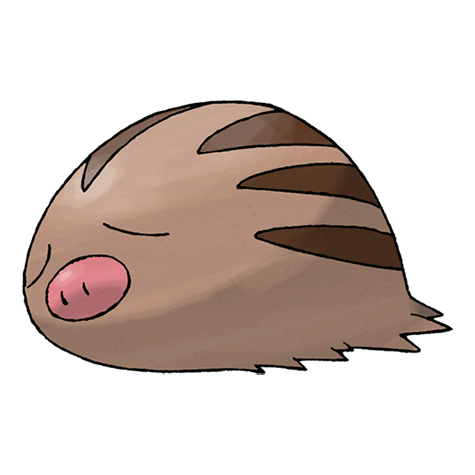
Piloswine sits in the middle of a three-stage evolutionary line. It develops from Swinub, the diminutive Ice and Ground type that resembles a small furry pig, beginning that transformation at level thirty-three, at which point it gains its substantial size, its tusks, and the shaggy coat that defines its adult form. The path forward to its final stage, Mamoswine, is gated by an additional condition — Piloswine must have learned the move Ancient Power before a level gain will trigger the evolution into that massive twin-tusked form, which was itself introduced in the fourth generation. For two full generations Piloswine therefore served as the terminus of its line and held a notable place among Ice-type options available to serious trainers of the era. Its design draws clearly from the woolly mammoth and other prehistoric megafauna, a connection that deepens with the Ancient Power requirement tying it symbolically to the deep past. Field researchers studying populations in the Ice Path have found that Piloswine preserves foraging and charging behaviors that likely trace back to a significantly colder period in the Pokémon world's history, making it of interest not only to competitive trainers but to naturalists studying how ancient species adapt across geological time.