Quilava
Volcano Pokémon
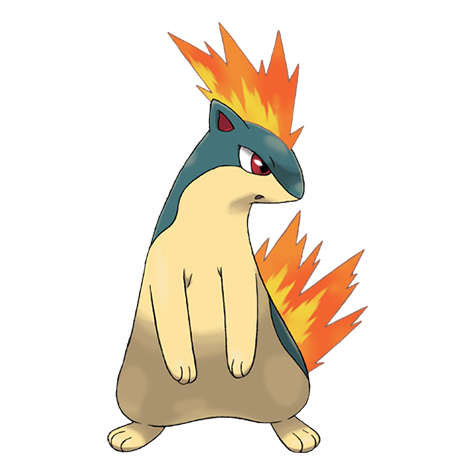
Be careful if it turns its back during battle. It means that it will attack with the fire on its back.
- Height
- 0.9 m
- Weight
- 19.0 kg
- Base XP
- 142
- Catch
- 45 /255
- Happy
- 70
- Hatch
- 20 steps


- HabitatGrassland
- Body shapeQuadruped
- ColourYellow
- Growth rateMedium Slow
- Egg groupsGround
- RarityStandard
Quilava is the Volcano Pokémon, a pure Fire-type introduced in the second generation, originating from the Johto region. It is the middle stage of its evolutionary line and carries a noticeably more confident physical presence than its smaller predecessor. Quilava is quadrupedal, its slender body colored in warm cream-yellow across most of its surface, accented by dark blue-gray patches along the crown of its head and across its back. The most defining feature is a pair of flame vents positioned at the top of its head and near the base of its lower back, producing intense jets of fire on command. Though small by human standards — standing roughly knee-high to an adult trainer — Quilava moves with a lean, muscular efficiency that hints at the considerable volcanic power still developing within.
Quilava lives primarily in open grasslands and the gentle foothills bordering mountainous terrain, where sunlit rock provides warmth and open ground enables its favored speed-based lifestyle. In Johto, sightings cluster in the wilder countryside stretching between Violet City and Ecruteak City, though comparable habitats elsewhere in the Pokémon world support similar populations. Wild individuals are not especially common, partly because most Quilava that trainers encounter were raised from Cyndaquil starter Pokémon rather than caught independently. Naturally occurring groups are small and spread out, as the species is largely solitary outside mating season. Quilava shows a strong preference for low-humidity environments, since moisture in the air interferes with the clean ignition of its flame vents. It is active during daylight hours and retires to sheltered grassy patches or shallow burrows after dark.
Quilava feeds on berries, seeds, and the occasional insect, favoring nutrient-dense foods that sustain the considerable metabolic demands of maintaining an internal flame. Compared to its timid pre-evolution, Cyndaquil, it is markedly more assertive, testing boundaries and projecting confidence as its strength matures. When confronted by a threat, it does not immediately retreat; instead it raises the flames at its head and back to full intensity, radiating heat as a clear warning before committing to attack. The species is especially known for a specific combat posture: when Quilava turns its back toward an opponent, it is not withdrawing but positioning its rear flame vents for a concentrated burst. Trainers who mistake this movement for retreat do so at their peril. Among its own kind, Quilava communicates partly through the height and rhythm of its flames, signaling mood and intention without vocalization.
In battle, Quilava operates as a fast, specially oriented attacker, combining solid Special Attack with good Speed to strike before most opponents can respond effectively. Its primary ability, Blaze, activates automatically when its health drops to a critical threshold, sharply boosting the power of all Fire-type moves it uses and turning a seemingly losing exchange into a dangerous final surge. Its hidden ability, Flash Fire, offers a different strategic dimension: incoming Fire-type moves are fully absorbed without dealing damage, and that absorption simultaneously powers up Quilava's own Fire attacks for the remainder of the battle. This makes Flash Fire particularly effective against Fire-heavy opponents or those relying on type symmetry. Offensively, the Fire typing gives Quilava clean advantages against Grass, Ice, Bug, and Steel opponents, while its notable vulnerabilities to Water, Ground, and Rock attacks represent the clearest avenues through which opponents can shut it down before it builds momentum.
Quilava occupies the midpoint of a three-stage evolutionary line that begins with Cyndaquil and culminates in Typhlosion. Cyndaquil evolves into Quilava at level fourteen, gaining in size, temperament, and flame output. Quilava then evolves into Typhlosion at level thirty-six, a transformation that substantially increases both its physical mass and its battle capabilities. As the iconic Fire-type starter of the Johto region, the Cyndaquil line carries considerable cultural significance, and Quilava represents the critical middle stage where the bond between trainer and Pokémon is most directly tested. Researchers studying Fire-type physiology regard Quilava as a productive subject because its flame vents are sufficiently developed for detailed examination while remaining far less hazardous than those of the fully evolved Typhlosion. The progression from Quilava to Typhlosion is frequently cited in developmental literature as a model example of how flame-generation capacity scales with physical maturation in volcanic Fire-type Pokémon.