Rattata
Mouse Pokémon
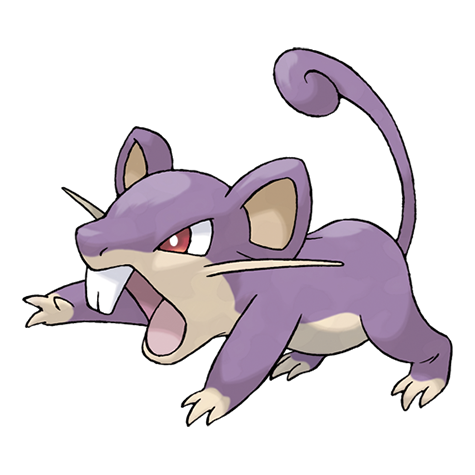
Bites anything when it attacks. Small and very quick, it is a common sight in many places.
- Height
- 0.3 m
- Weight
- 3.5 kg
- Base XP
- 51
- Catch
- 255 /255
- Happy
- 70
- Hatch
- 15 steps

- HabitatGrassland
- Body shapeQuadruped
- ColourPurple
- Growth rateMedium
- Egg groupsGround
- RarityStandard
Rattata is a Mouse Pokémon of the Normal type, introduced in the first generation of Pokémon. It is a small, quadrupedal rodent standing only a few inches tall, roughly ankle height on an average adult human. Its body is covered in short purple fur with a cream-colored underbelly running from chin to the base of its long, curling tail. Rattata has large round red eyes, prominent incisors that curve downward and remain visible even when its mouth is closed, and broad rounded ears that swivel with each sound. Its small paws end in short claws suited for gripping and digging. Despite its diminutive frame, Rattata carries itself with a twitchy, vibrating alertness that signals constant readiness to bolt or bite at a moment's notice.
Rattata is among the most widely distributed Pokémon known to researchers, found across grasslands, plains, farmland, urban outskirts, and the edges of dense forests. It thrives in temperate climates and is especially common in regions where human settlements are nearby, because proximity to towns and cities provides reliable access to stored grain and discarded food. Rattata populations tend to be dense wherever food is abundant, and the species organizes itself into large colonies that share burrow networks dug into soft earth or tucked beneath buildings and other structures. Within those colonies the animals are highly social, communicating through rapid sequences of squeaks and body postures. Toward larger Pokémon and unfamiliar humans, however, Rattata is notably skittish, preferring to scatter and outrun a threat rather than hold its ground.
Rattata is primarily nocturnal, emerging after dark to forage and returning to its burrow before dawn. Its diet is famously indiscriminate: it consumes grains, berries, seeds, insects, and virtually any edible scraps it can locate. Field researchers consistently note that Rattata has a powerful instinct to gnaw, driven in part by the biological need to keep its ever-growing incisors worn to a manageable length. It will bite nearly anything it encounters, from food to wooden objects, and it may nip out of curiosity or defensiveness even when it is not hungry. Rattata is territorial about its food caches, and confrontations within a colony over stored resources are common enough that experienced observers use them to map social hierarchies within a group. Trainers who raise Rattata from a young age often describe it as energetic and spirited, though it tends to retain a wariness toward strangers that rarely fully disappears.
Rattata can possess one of three abilities, each meaningfully shaping how it performs in a fight. Its first standard ability, Run Away, ensures it can always flee from a wild encounter without failure, a trait that mirrors its survival instinct perfectly but offers limited tactical advantage once a trainer is directing it in a formal battle. Its second standard ability, Guts, is considerably more interesting in a competitive setting: when Rattata is afflicted with a major status condition such as a burn or paralysis, its physical attack power rises sharply, turning an apparent disadvantage into genuine offensive pressure. Its hidden ability, Hustle, pushes its physical strikes even harder at the cost of some accuracy, making it a high-risk and high-reward option best used by trainers who can plan around imperfect hit rates. As a Normal-type Pokémon, Rattata neither resists nor hits hard against most opposing types, but it is entirely immune to Ghost-type attacks. Its vulnerability lies in Fighting-type moves, which strike it with devastating force. In battle its most notable quality is sheer speed, as it consistently acts before most Pokémon of comparable overall strength, letting it land a hit before the opponent can respond.
Rattata occupies an early position in the regional Pokédex and is one of the quintessential Pokémon that new trainers encounter almost immediately after beginning their journey. It does not evolve from any prior form, making it the base of its line, and it evolves into Raticate upon reaching a sufficient level of experience, at which point it gains considerably greater bulk, power, and an imposing physical presence. In the broader context of Pokémon research, Rattata holds genuine scientific value as a case study in adaptability: its ability to thrive across nearly every terrestrial environment, its omnivorous diet, and its rapid reproductive cycle make it a model organism for understanding how Pokémon colonize and establish themselves in new habitats. Population ecologists frequently cite Rattata colonies as accessible and reproducible subjects for field study. For trainers, it represents an early test of attentive care, offering a reminder that even an unassuming Pokémon, given time and patience, can develop into a reliable and surprisingly swift companion.