Spinarak
String Spit Pokémon
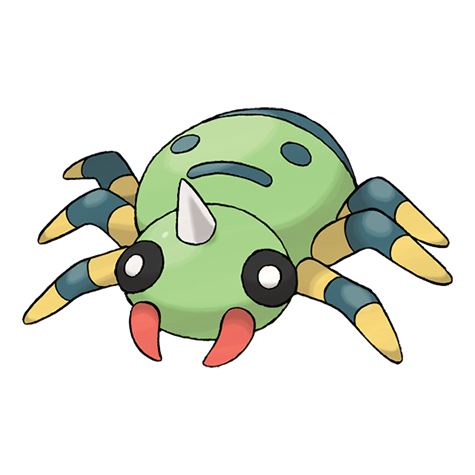
It lies still in the same pose for days in its web, waiting for its unsuspecting prey to wander close.
- Height
- 0.5 m
- Weight
- 8.5 kg
- Base XP
- 50
- Catch
- 255 /255
- Happy
- 70
- Hatch
- 15 steps
- HabitatForest
- Body shapeArmor
- ColourGreen
- Growth rateFast
- Egg groupsBug
- RarityStandard
Spinarak is the String Spit Pokémon, a dual Bug and Poison type that made its debut in the second generation of Pokémon. Small and compact, its body is roughly the size of a large fist, encased in a vivid lime-green exoskeleton that serves both as camouflage among forest foliage and as a faint visual signal of its toxic nature. Eight stubby legs radiate outward from a rounded, low-slung abdomen, giving Spinarak a squat, armored silhouette that sits close to whatever surface it occupies. The most arresting feature on this Pokémon is the bold, face-like marking on its back — a dark pattern that resembles an angry countenance, complete with what appear to be wide eyes and a broad, jagged mouth. This striking design functions as both a startle display toward predators and a disorienting lure for curious prey. A pale spinneret at its rear produces the fine, adhesive silk thread from which its species name is drawn.
Spinarak is found predominantly in forested regions, where it claims territory among dense undergrowth and the lower branches of trees. It is particularly well documented throughout the Johto region, though populations have been recorded in humid temperate and tropical forests in other parts of the world as well. It favors environments with high moisture and a reliable abundance of flying and crawling insects, which form the core of its diet. Spinarak is a solitary creature, each individual staking out a web territory it rarely abandons once established. It is most active after dark, when the insects it hunts are plentiful and low ambient light renders its silk nearly invisible. Through the daylight hours it remains almost perfectly motionless, blending into branches and leaves so convincingly that casual observers frequently walk past without noticing it. Population density varies across forests, but individuals tend to space themselves widely enough that territorial conflict is uncommon.
The most defining trait in Spinarak's behavior is its remarkable patience. Documented field observations confirm that it can hold a fixed position within its web for multiple consecutive days at a stretch, conserving energy while waiting for prey to make contact with the silk. The moment a victim brushes against a strand, Spinarak responds with surprising speed, surging forward to deliver a venomous bite before the prey can free itself. Its diet consists chiefly of small insects, though it will take any creature small enough to subdue. The silk it produces carries a mild paralytic compound on contact, meaning prey that struggles in the web is steadily weakened even before Spinarak arrives. Communication between individuals is accomplished not through sound but through precise vibrations transmitted along web threads, allowing Spinarak to signal territorial boundaries without ever breaking cover. Toward human trainers it is generally wary rather than aggressive, retreating when disturbed unless it finds itself cornered with no clear avenue of escape.
In battle, Spinarak can call upon one of two primary abilities. Swarm amplifies its Bug-type attacks when it has taken heavy damage, converting a precarious, low-health situation into one final burst of heightened offensive power. Insomnia, its second standard ability, makes Spinarak entirely immune to sleep-inducing moves — a valuable defensive trait against opponents who rely on putting smaller Pokémon to sleep before finishing them off. Its hidden ability, Sniper, dramatically increases the damage dealt by critical hits, raising them well beyond the normal bonus, which rewards any strategy built around boosting the critical hit rate. As a Bug and Poison type, Spinarak resists Fighting, Poison, Grass, and Fairy-type attacks. It must be handled carefully against Flying, Rock, Fire, Ground, and Psychic moves, all of which land with particular force against its dual typing. Spinarak favors physical offense over special attacks, and its low speed means it will frequently take a hit before it can strike back, so survivability planning matters more for this Pokémon than raw power.
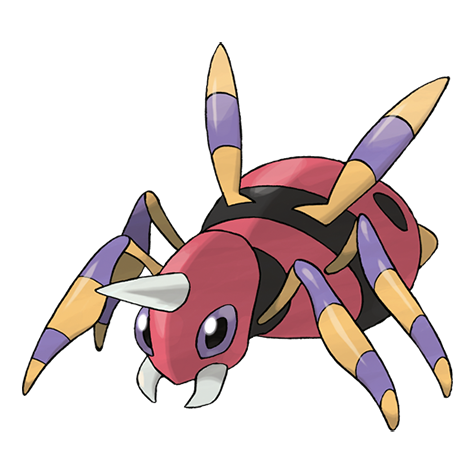
Spinarak stands at the base of a two-stage evolutionary line. With sufficient experience it evolves into Ariados, gaining considerable size, improved resilience, and a more elaborate silk-spinning toolkit, while retaining the core identity of the line — venomous thread, ambush predation, and methodical patience. Within the broader Pokédex, Spinarak occupies a representative role among the Bug and Poison types introduced in the second generation, reflecting real-world spider biology more directly than many of its contemporaries. Researchers who study it have drawn particular attention to the composition of its silk, which combines adhesive and mild paralytic properties in a ratio unlike that found in any other web-spinning species known to science. For trainers, Spinarak is an approachable early acquisition with a deceptively high long-term ceiling, especially for those willing to cultivate its hidden ability and build around the precise, patient style of combat that mirrors everything this small green hunter does in the wild.