Tentacruel
Jellyfish Pokémon
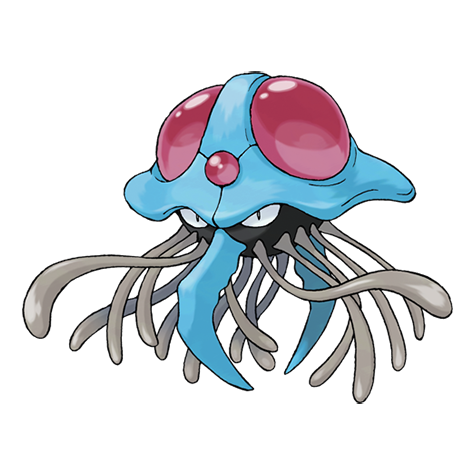
The tentacles are normally kept short. On hunts, they are extended to ensnare and immobilize prey.
- Height
- 1.6 m
- Weight
- 55.0 kg
- Base XP
- 180
- Catch
- 60 /255
- Happy
- 70
- Hatch
- 20 steps
- HabitatSea
- Body shapeTentacles
- ColourBlue
- Growth rateSlow
- Egg groupsWater3
- RarityStandard
Tentacruel is the Jellyfish Pokémon, catalogued as a dual Water and Poison type among the first generation of documented species. Its body is a wide, soft dome of translucent blue, through which the faint outlines of its internal structures are dimly visible, lending it an almost luminescent quality in the depths of the ocean. Atop that dome sit two prominent red spheres, one positioned on either side, which serve as the most recognizable visual feature of the species and are thought to function both as sensory organs and as a means of signaling to other members of the same kind. Below the dome, up to eighty long and slender tentacles hang loosely in the water, though under ordinary circumstances these are kept coiled close to the body, giving the Pokémon a considerably more compact silhouette than its full dimensions would suggest. When fully extended, those tentacles can reach outward across a wide radius, transforming what appears to be a drifting mass of gel into a formidable predatory net. Alongside an adult human, a mature Tentacruel stands at a roughly comparable height, though its boneless, rippling form is otherwise nothing like a terrestrial creature.
Tentacruel inhabits the seas found across nearly every documented region, with the strongest populations occurring in warm temperate ocean zones where slow currents concentrate prey. It is an open-water species by preference and rarely lingers in shallow coastal zones without a reason, such as the movement of a prey population or the influence of storm-driven currents. Sailors and researchers operating in the seas around Kanto have documented particularly dense congregations of Tentacruel along certain stretches of open ocean, and biologists attribute this to the rich, relatively sluggish water masses that accumulate nutritious material from surrounding seafloor upwellings. The species is neither sharply solitary nor truly social; loose groups of individuals often drift together within the same current without forming any discernible hierarchy or coordinated structure. Encounters near shorelines are unusual and are generally explained by seasonal current shifts or by individuals pursuing prey closer to land than their typical range. No strong preference for day or night has been observed in this species, as hunting appears to take place at any hour.
Tentacruel feeds by extending its tentacles outward in a wide sweep and waiting for smaller Pokémon, fish, and marine invertebrates to drift or swim within reach. When contact is made, the tentacles coil rapidly around the prey and deliver a fast-acting paralytic venom produced in specialized cells distributed along each tentacle's length. This venom is potent enough to immobilize most prey almost immediately, after which the prey is drawn toward the dome for digestion. The two red orbs on the dome have been observed to pulse or glow with increased intensity when the Pokémon is agitated, distressed, or preparing to hunt, and experienced trainers navigating open water regard this brightening as a useful early warning. Toward humans Tentacruel is generally indifferent rather than hostile, and unprovoked attacks, though part of popular maritime legend, are statistically rare. It reacts strongly, however, to direct interference with its dome and to any Pokémon it perceives as a territorial intruder. Accounts from sailors describe the unsettling sight of dozens of tentacles breaking the surface of a calm sea at night, which researchers interpret as coordinated drift feeding in low-light conditions.
In battle, Tentacruel may operate through one of two primary abilities. Clear Body prevents opposing Pokémon from using moves or effects that would reduce its combat statistics, neutralizing strategies that depend on whittling down its speed or defenses before landing a decisive blow. Liquid Ooze reverses the benefit of leeching attacks entirely, so any Pokémon that attempts to drain health from Tentacruel instead suffers damage equal to what it would have recovered, punishing one of the most common approaches used against bulky Water types. The hidden ability Rain Dish restores a modest portion of Tentacruel's health at the end of each turn while rain falls, making it a natural fit for team compositions built around sustained rain. As a Water and Poison type, Tentacruel resists a broad spread of attack types including Fighting, Poison, Steel, Fire, Ice, Fairy, Bug, and Water, which makes it surprisingly durable against a wide field of opponents. Its most dangerous incoming threats come from Grass, Electric, Ground, and Psychic type attacks. The defining trait in battle is its exceptional special defense, which places it among the sturdiest Water types when facing specially oriented opponents, and its solid speed lets it act before many of the threats it needs to answer. Tentacruel excels as a defensive pivot and status spreader, using poison-inflicting moves to grind down opposing teams over time.
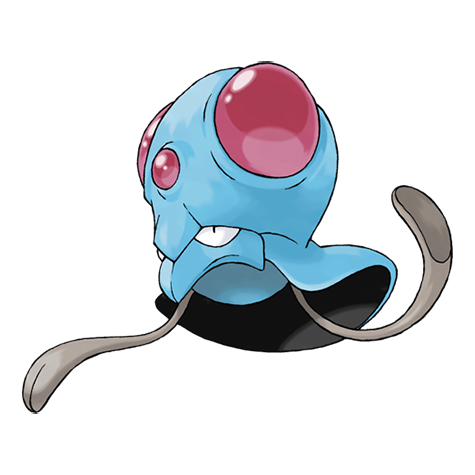
Tentacruel is the evolved form of Tentacool, a considerably smaller and more fragile Jellyfish Pokémon that drifts near the ocean surface. Tentacool reaches this final stage beginning at level thirty, at which point its body expands substantially, its tentacles multiply and lengthen, and its resilience increases to a degree that marks a genuine transition in ecological role. Where Tentacool is largely a passive surface drifter, Tentacruel is a capable and deliberate predator of the open ocean. Within the broader catalog of documented species, Tentacruel holds a recognized place in marine ecology as a regulator of smaller Pokémon populations, and researchers studying the food webs of Kanto and Johto coastal waters consistently identify it as a species of genuine ecological significance. For competitive trainers, its combination of broad resistances, outstanding special defense, reliable speed, and ability options that punish common counter strategies make it one of the most dependable Water types available. The chemistry of its venom, which differs in meaningful ways from that of other Poison type species, remains an active subject of research by biologists interested in paralytic compounds and their potential applications.