Tyranitar
Armor Pokémon
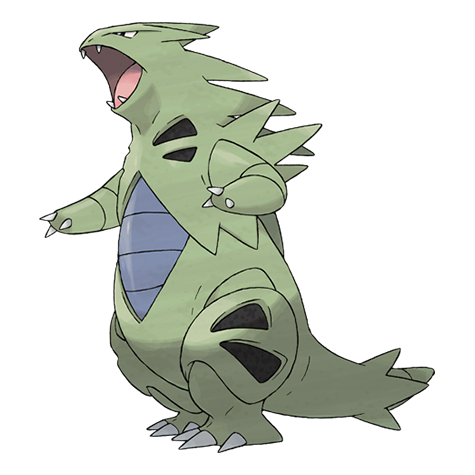
Its body can't be harmed by any sort of attack, so it is very eager to make challenges against enemies.
- Height
- 2.0 m
- Weight
- 202.0 kg
- Base XP
- 270
- Catch
- 45 /255
- Happy
- 35
- Hatch
- 40 steps
- HabitatMountain
- Body shapeUpright
- ColourGreen
- Growth rateSlow
- Egg groupsMonster
- RarityStandard
Tyranitar is the Armor Pokémon, a dual Rock and Dark type introduced in the second generation of discoveries originating from the Johto region. It stands well over two meters in height and carries a build that places it among the largest and most physically imposing creatures known to trainers and researchers alike. Its body is armored in a thick, dark green hide punctuated by blue, diamond-shaped markings distributed across its torso and limbs. A row of jagged spikes runs along its back from neck to tail, and its broad, angular head features a wide jaw and deeply set eyes that convey a settled, unhurried confidence. Tyranitar moves on two legs in an upright posture, and its silhouette, massive and roughly humanoid in proportion, tends to evoke comparisons with the great reptilian titans of ancient legend. Its tail is thick and muscular, its clawed hands capable of immense destructive force, and the overall impression it gives, even at rest, is one of absolute physical authority.
Tyranitar is found in mountainous regions, favoring rugged highland terrain, steep rocky slopes, and the interiors of remote mountain ranges that see little human activity. Within the Johto region it is most reliably encountered at high elevations, though similar environments elsewhere have yielded occasional sightings. The species is resolutely solitary outside of mating season, claiming and patrolling large territories across difficult terrain with a slow and deliberate regularity that field researchers describe as almost ceremonial in character. It shows no strong migratory tendency but may move to lower elevations during exceptional weather. Population densities across its entire range remain very low, and a wild encounter is considered genuinely rare even among experienced mountaineers. No other wild Pokémon reliably shares Tyranitar's territory for long, as the landscape itself tends to change around a resident individual over time.
Tyranitar is an apex predator and broad omnivore, consuming large prey animals, dense vegetation, and mineral matter from the rock formations it inhabits. It is primarily diurnal but does not keep a strict schedule, spending significant periods resting in caves or against large outcroppings. Its temperament is defined by an aggressive confidence rooted in the fact that it has no natural predators and appears fully aware of this. It does not yield ground to other Pokémon and will demolish surrounding terrain during confrontations without apparent concern for the aftermath. Field accounts describe individual Tyranitar toppling cliff faces and burying entire valleys over the course of a single dispute. Toward humans it is generally indifferent until provoked, at which point it becomes extremely dangerous. Trainers who have raised Tyranitar from an early stage report that it develops a measured loyalty over years, though it remains proud and responds poorly to coercion.
In battle Tyranitar is defined above all by its standard ability, Sand Stream, which summons a powerful sandstorm the instant it enters the field. This sandstorm persists for as long as Tyranitar remains in play, steadily wearing down any opposing Pokémon that lacks Rock, Steel, or Ground typing, while also bolstering the special defense of Rock-type Pokémon on its side. Its hidden ability, Unnerve, serves a more tactical function by preventing opposing Pokémon from consuming held berries during battle, pre-emptively cutting off a common recovery mechanism before it can be used. Tyranitar's physical attack strength is exceptional among fully evolved Pokémon of its era, and it is backed by solid defensive bulk in both physical and special categories. Its speed is a genuine limitation, leaving it vulnerable to faster opponents who can strike before it acts. The Rock and Dark typing carries a substantial list of weaknesses including Fighting moves, which exploit both types simultaneously and represent the most significant threat it faces. Tyranitar excels as a weather setter and powerful physical attacker against slower or frailer opponents, with the sandstorm providing sustained passive pressure across the course of a battle.
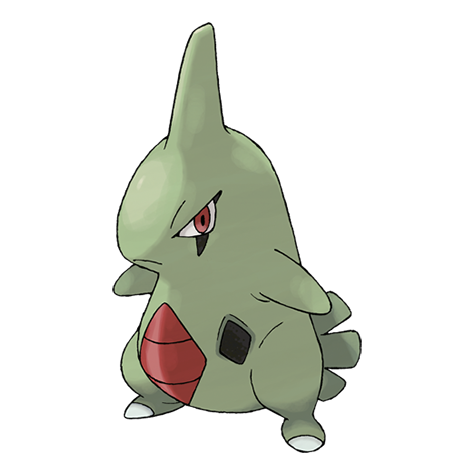
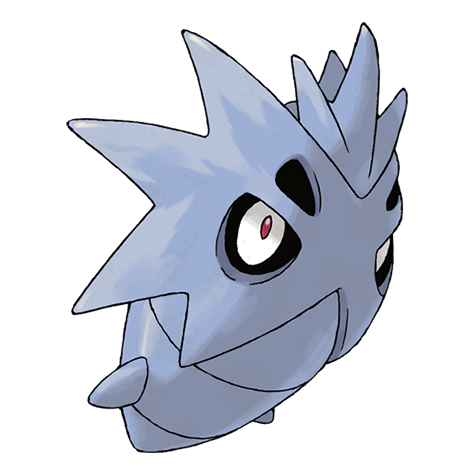
Tyranitar is the final form in a three-stage line beginning with Larvitar, a small, ground-dwelling larva that feeds on soil and rock beneath the earth's surface. Larvitar evolves into Pupitar, a rigid, cocoon-like intermediate that generates enormous internal pressure to fuel its transformation, at around level thirty. Pupitar then completes its metamorphosis into Tyranitar at around level fifty-five, one of the most dramatic transformations in the known Pokémon world, turning a modest burrowing larva into a creature of near-legendary physical stature. Within the broader Pokédex, Tyranitar holds the distinction of being among the handful of species designated as pseudo-legendary in its generation, a category defined by exceptional base stats distributed across a slow growth rate and a demanding three-stage evolution. Researchers are drawn to the species both for its extraordinary physical durability, with its armored body reportedly capable of withstanding virtually any known form of attack without meaningful harm, and for what it reveals about apex predation in isolated high-altitude ecosystems. For competitive trainers, Tyranitar has remained a consistently relevant and highly sought partner since the moment it was first discovered.