Venomoth
Poison Moth Pokémon
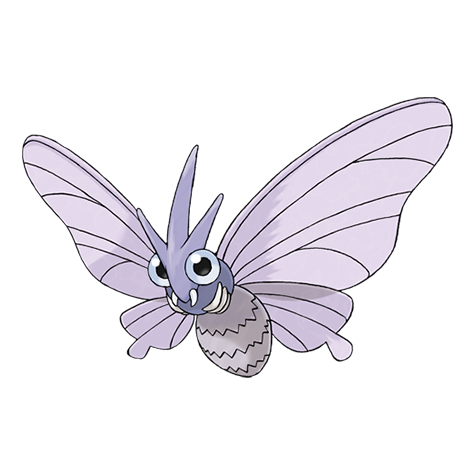
The dustlike scales covering its wings are color-coded to indicate the kinds of poison it has.
- Height
- 1.5 m
- Weight
- 12.5 kg
- Base XP
- 158
- Catch
- 75 /255
- Happy
- 70
- Hatch
- 20 steps
- HabitatForest
- Body shapeBug Wings
- ColourPurple
- Growth rateMedium
- Egg groupsBug
- RarityStandard
Venomoth is the Poison Moth Pokémon, a dual Bug and Poison type that made its debut among the original species catalogued in Kanto. In form it resembles a large, fantastical moth: its body is deep blue-violet and densely furred, its compound eyes gleam pale white, and two feathery antennae curl upward from its broad head. Four wide, predominantly purple wings give it a wingspan that comfortably exceeds its body length, making it noticeably imposing for a flying insect Pokémon. The defining characteristic of this species is the layer of microscopic scales that dust every surface of its wings. These scales are color-coded according to the specific toxins they carry, with some shades signaling a paralytic agent, others a soporific compound, and others an outright poison, making them function simultaneously as a biological warning system and the primary mechanism of this Pokémon's defense and offense.
Venomoth inhabits temperate forests, preferring regions where the tree canopy is thick enough to provide shelter through daylight hours. It is most reliably found in the forested zones of Kanto, particularly along wooded trails, in old-growth groves, and in the dense undergrowth near mountain foothills, though it has also been recorded in humid lowland forests. It is a solitary species and almost entirely nocturnal, emerging after sunset to forage and patrol its territory. True to its moth heritage, Venomoth is strongly attracted to artificial light sources on warm evenings, and campers who set bright lights in forested areas routinely find it circling overhead in the late hours of the night. During daylight it rests motionless on bark or beneath broad leaves, relying on its subdued coloration to blend with the forest backdrop.
Venomoth feeds primarily on plant material, including leaves, flower petals, and tender bark, supplementing its diet with smaller insects when vegetation is sparse. As it moves through forest undergrowth or hovers near flowers, it continuously sheds fine scales from its wings into the surrounding air. The effect of this invisible scale dust on nearby creatures varies with the pigment: certain colors carry sedative compounds that induce drowsiness or sleep, others carry paralytic agents, and still others deliver poison. Even a trainer who does not directly provoke Venomoth can inadvertently wander into this settling cloud. Despite the passive hazard it creates, the species is not aggressive. Field observers consistently note that Venomoth attempts to avoid confrontation, fluttering away at the first sign of a threat. When escape is impossible, it fans its wings to release a concentrated burst of scales as a final deterrent.
In battle, Venomoth offers considerably more depth than its reputation as a gentle forest moth implies. Its first ability, Shield Dust, neutralizes the secondary effects of opposing moves, stripping away burn or freeze chances and leaving only raw damage to contend with, which makes it unusually reliable against strategies that depend on chipping through incidental effects. Its second ability, Tinted Lens, is the more dangerous option, as it doubles the power of moves that would normally be resisted by the target, effectively negating the penalty of attacking into an unfavorable type matchup. Paired with strong Special Attack and high Speed, this positions Venomoth as an aggressive special sweeper capable of pressuring a wide range of opponents. Its hidden ability, Wonder Skin, cuts the accuracy of incoming status moves in half, making conventional sleep and paralysis techniques unreliable against it. Its Bug and Poison typing carries notable vulnerabilities to Fire, Flying, Rock, Ground, and Psychic attacks, and trainers must build their strategy carefully around those weaknesses.
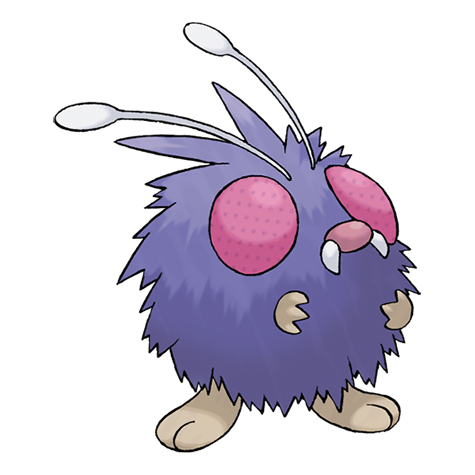
Venomoth is the final form of a two-stage evolutionary line, developing from Venonat, a small, round, heavily furred Bug and Poison type, upon reaching level thirty-one. That transformation brings a dramatic increase in size, wingspan, and special capability, but the line ends there, as Venomoth undergoes no further evolution. Within the broader Pokédex it is among the earlier entries catalogued from Kanto and is a species many trainers first encounter on forested routes at the beginning of their journey. Researchers in Pokémon entomology regard it as one of the most chemically complex insect-type species yet studied, noting that its wing scales house multiple distinct toxic compounds each encoded by pigment, raising significant questions about how these substances are biosynthesized and stored within a living organism. That chemical complexity, combined with its surprising competitive viability, ensures Venomoth remains a subject of genuine interest to scientists and trainers alike.