Design a YouTube-Style Video Platform
A video platform at YouTube scale handles massive upload volumes, transcoding across dozens of resolution/codec combinations, and global delivery to billions of daily viewers. This design covers the upload pipeline, transcoding infrastructure, adaptive streaming delivery, and metadata/discovery systems—focusing on the architectural decisions that enable sub-second playback start times while processing 500+ hours of new video every minute.

Abstract
A video platform’s architecture is shaped by three fundamental constraints:
-
Video is computationally expensive: A single 10-minute 4K upload generates 50+ output files (resolutions × codecs × bitrates). Transcoding must parallelize across chunked segments to complete in minutes rather than hours.
-
Latency tolerance varies by phase: Uploads tolerate multi-second latencies; playback start must be < 2 seconds. This asymmetry justifies aggressive CDN caching and segment-level prefetching.
-
Traffic follows extreme power laws: ~10% of videos receive 90% of views. Hot/warm/cold storage tiering and origin shield caching exploit this distribution.
The core mechanisms:
- Resumable chunked uploads (tus protocol) handle unreliable connections and multi-gigabyte files
- Segment-parallel transcoding splits videos into 2-second chunks, transcodes in parallel, reassembles
- Multi-codec encoding (H.264 for reach, VP9/AV1 for efficiency) optimizes bandwidth vs. compatibility
- Adaptive Bitrate Streaming (HLS/DASH) with hybrid ABR algorithms balances quality and rebuffering
- Origin shield + edge caching achieves 95%+ cache hit rates, reducing origin egress dramatically
Requirements
Functional Requirements
| Requirement | Priority | Notes |
|---|---|---|
| Video upload | Core | Resumable, chunked, up to 256GB files |
| Video playback | Core | Adaptive streaming, multiple quality levels |
| Transcoding pipeline | Core | Multi-resolution, multi-codec output |
| Video metadata (title, description, tags) | Core | Editable, searchable |
| Video search | Core | Full-text + filters (duration, date, category) |
| Thumbnails (auto-generated + custom) | Core | Multiple sizes for different contexts |
| View counting | Core | Near real-time, deduplicated |
| Comments and engagement | Extended | Threaded, moderation |
| Recommendations | Extended | Personalized, contextual |
| Live streaming | Out of scope | Different latency requirements |
| Monetization/Ads | Out of scope | Separate ad-tech stack |
Non-Functional Requirements
| Requirement | Target | Rationale |
|---|---|---|
| Upload availability | 99.9% | Tolerate brief maintenance windows |
| Playback availability | 99.99% | Revenue-critical, user experience |
| Upload processing time | < 2× video duration | User expectation for availability |
| Playback start latency | p99 < 2s | Industry benchmark for abandonment |
| Rebuffering ratio | < 0.5% of playback time | Quality threshold |
| Video quality | VMAF > 93 at target bitrate | Perceptual quality standard |
| Storage efficiency | 30% bandwidth savings via modern codecs | Cost optimization |
Scale Estimation
YouTube-scale baseline:
Daily active users: 2.5 billionHours uploaded per minute: 500+Daily video views: 5 billion
Upload traffic:- 500 hours/min × 60 min × 24 hours = 720,000 hours/day- Average raw file: 2 GB/hour (1080p)- Daily upload ingestion: ~1.4 PB/day
Storage growth:- Per video: 50 output files (resolutions × codecs)- Storage multiplier: ~5x original (transcoded variants)- Daily storage growth: ~7 PB/day- Annual growth: ~2.5 EB/year
Playback traffic:- 5 billion views/day- Average view duration: 10 minutes- Average bitrate: 4 Mbps (mixed quality)- Peak concurrent viewers: 500M (estimate)- Daily egress: ~150 PB/dayCDN efficiency impact:
Without CDN: 150 PB/day from originWith 95% cache hit rate: 7.5 PB/day from originCost reduction: 20x origin egress savingsDesign Paths
Path A: Centralized Transcoding (Traditional)
Best when:
- Smaller scale (< 10K uploads/day)
- Predictable traffic patterns
- Cost-sensitive (avoid distributed infrastructure)
Architecture:
- Single transcoding cluster per region
- Queue-based job scheduling
- Linear processing (full video at once)
Trade-offs:
- ✅ Simpler operations
- ✅ Lower infrastructure cost at small scale
- ❌ Transcoding time = video duration × quality ladder size
- ❌ Single failure domain per region
- ❌ Cannot scale transcoding speed for viral uploads
Real-world example: Vimeo (pre-2020) used centralized transcoding. Acceptable for professional content with predictable upload patterns.
Path B: Distributed Chunk-Based Transcoding (YouTube/Netflix Model)
Best when:
- Massive scale (millions of uploads/day)
- Need fast turnaround for time-sensitive content
- Global upload sources require regional processing
Architecture:
- Videos split into 2-second chunks
- Chunks transcoded in parallel across distributed workers
- Reassembled into final output streams
- Custom hardware (ASICs) for encoding efficiency
Trade-offs:
- ✅ Transcoding time independent of video length (parallelized)
- ✅ Elastic scaling for traffic spikes
- ✅ Fault isolation (failed chunk retries, not full video)
- ❌ Complex orchestration layer
- ❌ Chunk boundary artifacts require careful handling
- ❌ Higher infrastructure complexity
Real-world example: YouTube’s Video Coding Unit (VCU) ASIC achieves 20-33x efficiency over software encoding. Netflix processes 250,000 jobs per 30-minute episode.
Path Comparison
| Factor | Centralized | Distributed Chunk-Based |
|---|---|---|
| Processing latency | O(video duration) | O(1) with enough workers |
| Scalability | Vertical (bigger machines) | Horizontal (more workers) |
| Failure blast radius | Full video re-encode | Single chunk retry |
| Infrastructure cost | Lower at small scale | Lower at large scale |
| Operational complexity | Simple | High |
| Best for | < 10K uploads/day | > 100K uploads/day |
This Article’s Focus
This article focuses on Path B (Distributed Chunk-Based) because:
- YouTube-scale requires parallelization to meet processing SLAs
- The chunking approach enables interesting optimizations (per-shot quality, scene detection)
- Modern ABR streaming (HLS/DASH) is segment-native, aligning with chunk-based encoding
High-Level Design
Component Overview

Upload Flow
- Client initiates resumable upload → receives upload URI and session token
- Client uploads in chunks (5MB default) → server tracks received ranges
- On completion: validate checksum, store original, queue for processing
- Metadata extracted (duration, resolution, codec) and stored immediately
- Video becomes searchable before transcoding completes (thumbnail + metadata)
Processing Flow
- Segmentation: Split video into 2-second GOP-aligned chunks
- Analysis: Scene detection, shot boundaries, content classification
- Parallel encoding: Each chunk transcoded to all target formats
- Quality validation: VMAF score per segment, re-encode if below threshold
- Assembly: Concatenate chunks into continuous streams
- Manifest generation: Create HLS/DASH manifests pointing to segments
Playback Flow
- Client requests manifest → CDN serves cached or origin-fetched manifest
- ABR algorithm selects initial quality based on estimated bandwidth
- Segments fetched from nearest edge → playback begins
- Continuous adaptation: Quality switches based on buffer level and throughput
- Metrics collected: Startup time, rebuffering events, quality switches
Video Upload Service
Resumable Upload Protocol
The tus protocol provides HTTP-based resumable uploads, critical for large files over unreliable networks.
Protocol flow:
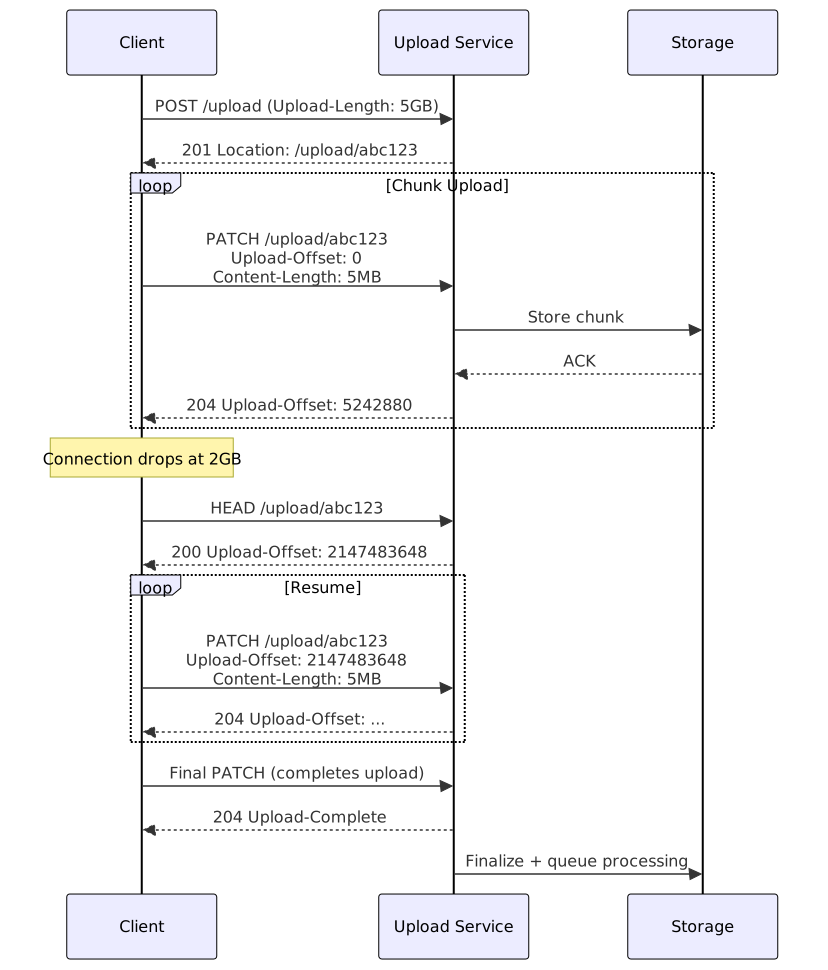
Key protocol headers:
| Header | Purpose |
|---|---|
Upload-Length | Total file size (optional for streaming) |
Upload-Offset | Byte position for this chunk |
Tus-Resumable | Protocol version (1.0.0) |
Upload-Metadata | Base64-encoded key-value pairs (filename, content-type) |
Chunk size considerations:
| Chunk Size | Pros | Cons |
|---|---|---|
| 1 MB | Fine-grained resume | Higher overhead (more requests) |
| 5 MB (default) | Balanced | Good for most networks |
| 25 MB | Lower overhead | Larger retransmission on failure |
Upload Processing Pipeline

Validation checks:
- File format: Supported containers (MP4, MOV, MKV, WebM, AVI)
- Duration: Maximum 12 hours (configurable per channel)
- Resolution: Up to 8K (7680×4320)
- File size: Up to 256 GB
- Audio tracks: Maximum 8 tracks
Thumbnail Generation
Automated thumbnails:
- Extract frames at 25%, 50%, 75% of duration
- Run scene detection, select visually distinct frames
- Apply quality scoring (sharpness, face detection, composition)
- Generate sprite sheet for scrubbing preview (every 10 seconds)
Output formats:
| Use Case | Dimensions | Format |
|---|---|---|
| Search results | 320×180 | WebP/JPEG |
| Watch page | 640×360 | WebP/JPEG |
| Large player | 1280×720 | WebP/JPEG |
| Scrub preview | 160×90 (sprite) | WebP |
Transcoding Pipeline
Encoding Architecture

Codec Selection
| Codec | Compression vs H.264 | Browser Support | Encode Complexity | Use Case |
|---|---|---|---|---|
| H.264 (AVC) | Baseline | Universal | 1x | Default fallback |
| H.265 (HEVC) | 50% better | Safari, iOS, some Android | 2-4x | Apple ecosystem |
| VP9 | 50% better | Chrome, Firefox, Edge, Android | 2-3x | YouTube default |
| AV1 | 30-50% vs VP9 | Chrome, Firefox, Edge, Safari 17+ | 5-10x | Bandwidth-critical |
Encoding strategy:
- Always encode H.264: Universal fallback for all devices
- Default to VP9: Primary codec for modern browsers (Chrome 80%+ market share)
- AV1 for popular content: Encode after 1000+ views (amortize high encode cost)
- HEVC for Apple devices: Safari/iOS don’t support VP9
Bitrate Ladder
Per-title encoding optimizes bitrate per content type. Action films need higher bitrates than static presentations.
Standard ladder (VP9):
| Resolution | Bitrate Range | FPS | Notes |
|---|---|---|---|
| 4K (2160p) | 12-20 Mbps | 30/60 | High motion: 20 Mbps |
| 1440p | 6-10 Mbps | 30/60 | Gaming content default |
| 1080p | 3-6 Mbps | 30/60 | Most common |
| 720p | 1.5-3 Mbps | 30 | Mobile default |
| 480p | 0.5-1 Mbps | 30 | Bandwidth constrained |
| 360p | 0.3-0.5 Mbps | 30 | Minimum viable |
| 240p | 0.15-0.3 Mbps | 30 | Extreme constraints |
| 144p | 0.05-0.1 Mbps | 30 | Audio-focused content |
Per-title optimization:
Standard approach: Fixed bitrate ladder (same for all videos)Per-title approach: Analyze content complexity, adjust bitrates
Example - Documentary vs Action Movie at 1080p:- Documentary (low motion): 2.5 Mbps achieves VMAF 95- Action movie (high motion): 5 Mbps needed for VMAF 95
Result: 50% bandwidth savings on documentaries without quality lossNetflix reported 20% average bandwidth savings from per-title encoding, with some titles achieving 50%+ reductions.
Chunk-Based Parallel Encoding
Segmentation strategy:
- GOP alignment: Split at keyframe boundaries (every 2-4 seconds)
- Scene boundaries: Prefer splits at scene changes
- Uniform chunks: Maintain consistent segment duration for ABR
Parallel encoding flow:
Input: 10-minute video (300 seconds)Chunk duration: 2 secondsTotal chunks: 150
Without parallelization:- Encode time per codec/resolution: ~video duration- Total variants: 8 resolutions × 3 codecs = 24- Serial time: 24 × 10 min = 240 minutes (4 hours)
With parallelization (150 workers):- Each worker encodes 1 chunk × 24 variants- Per-chunk encode time: ~2 seconds × 24 = 48 seconds- Total time: 48 seconds + assembly overhead- Speedup: ~300xBoundary handling:
Chunks must overlap slightly to prevent artifacts at boundaries:
- Include 1-2 frames of context from adjacent chunks
- Trim overlap during assembly
- Validate continuous motion across boundaries
Quality Control
VMAF (Video Multimethod Assessment Fusion):
Netflix’s open-source perceptual quality metric, correlating strongly with human perception.
| VMAF Score | Quality Level |
|---|---|
| 93+ | Excellent (target) |
| 85-93 | Good |
| 70-85 | Fair |
| < 70 | Poor (re-encode) |
QC pipeline:
- Compute VMAF score per segment (source vs. encoded)
- Flag segments below threshold (< 93)
- Re-encode flagged segments at higher bitrate
- Iterate until quality target met or max bitrate reached
Adaptive Bitrate Streaming
HLS vs DASH
| Feature | HLS | DASH |
|---|---|---|
| Standard body | Apple proprietary (RFC 8216) | ISO/IEC 23009-1 |
| Manifest format | M3U8 (text playlist) | MPD (XML) |
| Segment format | TS or fMP4 | fMP4, WebM |
| Apple support | Full | Not supported (Safari) |
| DRM | FairPlay | Widevine, PlayReady |
| Low-latency variant | LL-HLS (2-5s) | LL-DASH (2-5s) |
YouTube’s approach: DASH for most browsers, HLS for Safari/iOS. Manifest generator outputs both formats from same encoded segments (CMAF).
Manifest Structure
HLS Multivariant Playlist:
#EXTM3U#EXT-X-VERSION:7#EXT-X-INDEPENDENT-SEGMENTS
#EXT-X-STREAM-INF:BANDWIDTH=5000000,RESOLUTION=1920x1080,CODECS="avc1.640028,mp4a.40.2"1080p/playlist.m3u8
#EXT-X-STREAM-INF:BANDWIDTH=2500000,RESOLUTION=1280x720,CODECS="avc1.64001f,mp4a.40.2"720p/playlist.m3u8
#EXT-X-STREAM-INF:BANDWIDTH=1000000,RESOLUTION=854x480,CODECS="avc1.64001e,mp4a.40.2"480p/playlist.m3u8Media Playlist (per quality):
#EXTM3U#EXT-X-VERSION:7#EXT-X-TARGETDURATION:4#EXT-X-MEDIA-SEQUENCE:0
#EXTINF:4.000,segment_0001.m4s#EXTINF:4.000,segment_0002.m4s#EXTINF:4.000,segment_0003.m4s#EXT-X-ENDLISTABR Algorithm
Three algorithm families:
-
Throughput-based: Select bitrate based on measured download speed
estimated_bandwidth = bytes_downloaded / download_timesafe_bitrate = estimated_bandwidth × 0.7 (safety margin)select: highest quality where bitrate < safe_bitrate -
Buffer-based (BOLA): Select based on buffer occupancy
if buffer > 30s: select highest qualityif buffer < 10s: select lowest qualitylinear interpolation between thresholds -
Hybrid (industry standard): Combine throughput + buffer
throughput_bitrate = estimate from recent segmentsbuffer_factor = buffer_level / target_buffer (0.0 to 1.0)selected_bitrate = throughput_bitrate × buffer_factor
Startup behavior:
- Start at conservative quality (720p or lower)
- Prefetch multiple segments before playback
- Ramp up quality as buffer builds
Quality switch constraints:
- Minimum dwell time: 10 seconds at current quality
- Maximum quality drop: 2 levels per switch (prevent oscillation)
- Buffer emergency threshold: Drop to lowest immediately if < 5 seconds
Segment Duration Trade-offs
| Duration | Pros | Cons |
|---|---|---|
| 2 seconds | Lower latency, faster adaptation | More requests, higher overhead |
| 4 seconds | Balanced | Standard choice |
| 6 seconds | Fewer requests, better compression | Slower adaptation |
| 10 seconds | Best compression efficiency | Too slow for ABR |
YouTube uses 2-4 second segments; Netflix uses 4-6 seconds. Lower durations improve responsiveness but increase CDN request volume.
CDN and Delivery
Multi-Tier Caching Architecture

Cache hit rate targets:
| Tier | Hit Rate | Purpose |
|---|---|---|
| Edge | 90-95% | Serve most requests from nearest PoP |
| Origin Shield | 95-99% | Catch edge misses, protect origin |
| Origin | ~1% requests | Serve long-tail content |
Origin Shield Benefits
Without origin shield:
100 edge PoPs × 10% miss rate = 10% of total traffic to origin per PoPIf 1000 concurrent requests per PoP for same video: 100 × 100 = 10,000 origin requestsWith origin shield:
100 edge PoPs → 5 shield regions → 1 originShield consolidates: 10,000 potential requests → 5 requests (one per shield)Origin load reduction: 2000xAWS reports 95% origin egress reduction with CloudFront Origin Shield for video workloads.
Cache Key Design
Optimal cache key structure:
/{video_id}/{quality}/{codec}/{segment_number}.m4s
Example: /abc123/1080p/vp9/segment_0042.m4sWhat to exclude from cache key:
- Session tokens
- User-specific parameters
- Timestamp-based cache busters (use segment number instead)
- Analytics parameters
Multi-CDN consistency:
When using multiple CDN providers, normalize cache keys:
- Same path structure across all CDNs
- Consistent query parameter handling (strip or include)
- Standardized Cache-Control headers
Multi-CDN Strategy
Routing decision factors:
| Factor | Implementation |
|---|---|
| Geographic proximity | DNS-based geo routing |
| CDN availability | Health checks, automatic failover |
| Cost optimization | Route to cheapest CDN per region |
| Performance | Real-user metrics, synthetic monitoring |
Failover architecture:

Video Storage
Storage Tiering
| Tier | Access Pattern | Storage Type | Cost | Latency |
|---|---|---|---|---|
| Hot | Recent uploads, trending | SSD/NVMe | $$$ | < 10ms |
| Warm | Moderate views (1-100/day) | HDD | $$ | 50-100ms |
| Cold | Long-tail (< 1 view/day) | Object storage | $ | 100-500ms |
| Archive | Original raw files | Glacier-class | ¢ | Hours |
Lifecycle policy:
Upload: → Hot tier (30 days) → Warm tier (views > 10/day) OR Cold tier → Archive (raw originals after 90 days) → Delete cold if views = 0 for 365 daysStorage Scale Estimation
Per-video storage:
Input: 10-minute 1080p video (original: 500 MB)
Transcoded outputs:- 8 resolutions × 3 codecs × average segment count- Plus: thumbnails, sprite sheets, manifests
Typical expansion:- H.264 variants: 800 MB- VP9 variants: 500 MB- AV1 variants: 400 MB (if encoded)- Thumbnails/metadata: 10 MB
Total: ~1.7 GB (3.4x original)With original retention: ~2.2 GB (4.4x)Fleet sizing for 1 EB storage:
1 EB = 1,000 PB = 1,000,000 TB
Using 18 TB HDDs:- Raw capacity needed: 1,000,000 TB- With replication (3x): 3,000,000 TB- Drives needed: 166,667 drives- Drives per server (12): 13,889 serversReplication Strategy
Multi-region replication:
| Content Type | Replication | Rationale |
|---|---|---|
| Hot (popular) | 3 regions | Low latency globally |
| Warm | 2 regions | Cost vs. latency balance |
| Cold | 1 region + archive | Cost optimization |
| Original | 2 regions + archive | Disaster recovery |
Metadata and Search
Video Metadata Schema
-- Core video recordCREATE TABLE videos ( video_id UUID PRIMARY KEY, channel_id UUID NOT NULL REFERENCES channels(id), title VARCHAR(100) NOT NULL, description TEXT, duration_seconds INTEGER NOT NULL, upload_timestamp TIMESTAMPTZ NOT NULL, publish_timestamp TIMESTAMPTZ,
-- Processing state status VARCHAR(20) NOT NULL DEFAULT 'processing', -- processing, ready, failed, deleted
-- Computed metrics (denormalized) view_count BIGINT DEFAULT 0, like_count BIGINT DEFAULT 0, comment_count INTEGER DEFAULT 0,
-- Content signals category_id INTEGER, language VARCHAR(10), age_restricted BOOLEAN DEFAULT false,
-- Indexes CONSTRAINT valid_status CHECK (status IN ('processing', 'ready', 'failed', 'deleted')));
CREATE INDEX idx_videos_channel ON videos(channel_id, publish_timestamp DESC);CREATE INDEX idx_videos_category ON videos(category_id, publish_timestamp DESC);CREATE INDEX idx_videos_trending ON videos(view_count DESC) WHERE status = 'ready' AND publish_timestamp > NOW() - INTERVAL '7 days';Search Index Design
Elasticsearch mapping:
{ "mappings": { "properties": { "video_id": { "type": "keyword" }, "title": { "type": "text", "analyzer": "standard", "fields": { "exact": { "type": "keyword" }, "autocomplete": { "type": "search_as_you_type" } } }, "description": { "type": "text" }, "channel_name": { "type": "text", "fields": { "exact": { "type": "keyword" } } }, "tags": { "type": "keyword" }, "category": { "type": "keyword" }, "duration_seconds": { "type": "integer" }, "view_count": { "type": "long" }, "publish_date": { "type": "date" }, "language": { "type": "keyword" },
"transcript": { "type": "text", "analyzer": "standard" } } }}Search query example:
{ "query": { "bool": { "must": [ { "multi_match": { "query": "kubernetes tutorial", "fields": ["title^3", "description", "tags^2", "transcript"] } } ], "filter": [{ "term": { "language": "en" } }, { "range": { "duration_seconds": { "gte": 300, "lte": 1800 } } }] } }, "sort": [{ "_score": "desc" }, { "view_count": "desc" }]}View Count System
Challenge: Accurate, near-real-time view counting at billions of views/day while preventing fraud.
Architecture:

Deduplication strategy:
- Bloom filter per video_id (1-hour window)
- Key: hash(video_id + user_id + IP + user_agent)
- False positive rate: 1% (acceptable, slightly undercounts)
Fraud signals:
- View duration < 30 seconds: Don’t count
- Same IP, many views, short intervals: Rate limit
- Suspicious patterns: ML-based fraud detection
Recommendation System
Overview
Recommendations drive 70%+ of YouTube watch time. The system balances:
- Relevance: Content similar to current video
- Personalization: User’s historical preferences
- Exploration: Expose users to new content
- Freshness: Boost recent uploads
Recommendation Architecture

Signal Types
| Signal | Source | Weight |
|---|---|---|
| Watch time | Playback events | High |
| Likes/dislikes | Explicit feedback | High |
| Comments | Engagement | Medium |
| Shares | Social signals | Medium |
| Search history | Intent signals | Medium |
| Subscriptions | Long-term preference | Medium |
| Video co-watch | Collaborative filtering | Medium |
| Content similarity | Video embeddings | Low-Medium |
Frontend Considerations
Video Player Architecture
Core responsibilities:
- Manifest parsing: HLS/DASH support
- ABR algorithm: Quality selection logic
- Buffer management: Segment prefetching
- Codec negotiation: Select supported codec/container
- DRM handling: License acquisition, key rotation
- Metrics collection: QoE telemetry
Buffer strategy:
Target buffer: 30 secondsMinimum for playback start: 5 secondsLow watermark (quality down): 10 secondsHigh watermark (quality up): 25 secondsMaximum (cap prefetch): 60 secondsPlayback Start Optimization
Time-to-first-byte targets:
| Phase | Target | Optimization |
|---|---|---|
| DNS resolution | < 50ms | DNS prefetch |
| TLS handshake | < 100ms | TLS 1.3, session resumption |
| Manifest fetch | < 200ms | CDN edge cache |
| First segment | < 500ms | Preload hint, small init segment |
| Total startup | < 2000ms | End-to-end target |
Preload strategies:
<!-- DNS prefetch for CDN --><link rel="dns-prefetch" href="//cdn.example.com" />
<!-- Preconnect to establish TLS --><link rel="preconnect" href="https://cdn.example.com" />
<!-- Preload manifest --><link rel="preload" href="/video/abc/manifest.m3u8" as="fetch" />Mobile Considerations
| Constraint | Mitigation |
|---|---|
| Battery drain | Prefer hardware decode (H.264/HEVC) |
| Data usage | Default to 480p on cellular |
| Memory limits | Limit buffer to 30 seconds |
| Background restrictions | Pause prefetch when backgrounded |
| Network variability | More conservative ABR |
Infrastructure Design
Cloud-Agnostic Components
| Component | Purpose | Options |
|---|---|---|
| Object storage | Raw + encoded videos | S3, GCS, Azure Blob, MinIO |
| Transcoding compute | Encoding workers | VMs, Containers, GPU instances |
| CDN | Global delivery | CloudFront, Fastly, Akamai, Cloudflare |
| Message queue | Job scheduling | Kafka, SQS, Pub/Sub, RabbitMQ |
| Metadata DB | Video records | PostgreSQL, MySQL, CockroachDB |
| Search | Discovery | Elasticsearch, OpenSearch, Meilisearch |
| Cache | Hot metadata | Redis, Memcached |
| Metrics | Telemetry | Prometheus, InfluxDB, Datadog |
AWS Reference Architecture

Service selection:
| Service | Use Case | Why |
|---|---|---|
| S3 + S3 Glacier | Video storage | Tiered cost, 11 nines durability |
| MediaConvert | Managed transcoding | No infrastructure management |
| AWS Batch + GPU | Custom transcoding | Full control, custom codecs |
| CloudFront | CDN | Origin Shield, Lambda@Edge |
| RDS PostgreSQL | Metadata | Managed, Multi-AZ |
| OpenSearch | Search | Managed Elasticsearch |
| ElastiCache Redis | Caching | Sub-ms latency |
Self-Hosted Alternative
| Managed Service | Self-Hosted | When to Self-Host |
|---|---|---|
| MediaConvert | FFmpeg + custom workers | Custom codecs, cost at scale |
| CloudFront | Nginx + Varnish | Multi-CDN, specific routing |
| OpenSearch | Elasticsearch | Plugin requirements |
| ElastiCache | Redis OSS | Redis modules, specific configs |
Conclusion
Designing a YouTube-scale video platform requires optimizing for fundamentally different access patterns across the pipeline:
Key architectural decisions:
- Resumable chunked uploads handle multi-GB files over unreliable networks
- Segment-parallel transcoding achieves O(1) processing time regardless of video length
- Multi-codec strategy (H.264 + VP9 + selective AV1) balances reach and bandwidth efficiency
- Per-title encoding saves 20-50% bandwidth by adapting bitrate ladders to content complexity
- Origin shield caching reduces origin egress by 95%+, critical for cost and scale
- Hybrid ABR algorithms balance quality maximization with rebuffering prevention
What this design optimizes for:
- Fast upload processing (minutes, not hours)
- Sub-2-second playback start
- Minimal rebuffering (< 0.5% of playback time)
- Efficient bandwidth usage (modern codecs for capable devices)
What this design sacrifices:
- Low-latency live streaming (different architecture needed)
- Simple operations (distributed transcoding adds complexity)
- Storage efficiency vs. compatibility (multiple codec variants)
When to choose this design:
- User-generated video platforms at scale
- VOD streaming services
- Any system where upload volume justifies parallel transcoding
Appendix
Prerequisites
- Video encoding concepts: codecs, containers, bitrate
- Streaming protocols: HLS, DASH fundamentals
- CDN architecture: edge caching, origin shield
- Distributed systems: message queues, eventual consistency
Terminology
| Term | Definition |
|---|---|
| ABR | Adaptive Bitrate—dynamically selecting video quality based on network conditions |
| GOP | Group of Pictures—sequence of frames starting with a keyframe |
| HLS | HTTP Live Streaming—Apple’s adaptive streaming protocol |
| DASH | Dynamic Adaptive Streaming over HTTP—ISO standard streaming protocol |
| VMAF | Video Multimethod Assessment Fusion—perceptual quality metric |
| Transcoding | Converting video from one format/resolution/codec to another |
| Manifest | Playlist file describing available streams and segments (M3U8 or MPD) |
| Segment | Chunk of video (typically 2-6 seconds) for ABR streaming |
| Origin shield | Intermediate cache layer protecting origin from edge cache misses |
| Bitrate ladder | Set of quality levels (resolution + bitrate combinations) |
| Per-title encoding | Customizing bitrate ladder based on content complexity |
| VCU | Video Coding Unit—custom ASIC for hardware-accelerated encoding |
Summary
- Video platforms require three distinct subsystems: upload/processing, storage/delivery, metadata/discovery
- Chunk-based parallel transcoding enables processing speed independent of video duration
- Multi-codec encoding (H.264 + VP9 + AV1) trades storage for bandwidth efficiency
- Origin shield + edge caching achieves 95%+ cache hit rates, reducing origin load 20x+
- Hybrid ABR algorithms (throughput + buffer) provide best quality-of-experience
- Per-title encoding saves 20-50% bandwidth by adapting to content complexity
- Hot/warm/cold storage tiering exploits power-law view distribution
References
- YouTube Video Processing Architecture - Upload and transcoding pipeline
- Reimagining video infrastructure (YouTube Blog) - VCU custom silicon
- Rebuilding Netflix Video Processing Pipeline - Microservices transcoding architecture
- High Quality Video Encoding at Scale (Netflix) - Per-title encoding
- tus - Resumable Upload Protocol - Upload protocol specification
- HLS Specification (RFC 8216) - HTTP Live Streaming standard
- DASH Specification (ISO/IEC 23009-1) - MPEG-DASH standard
- Amazon CloudFront Origin Shield - CDN architecture
- Google Media CDN Overview - CDN caching behavior
- VMAF - Perceptual Quality Metrics - Netflix’s quality metric
- Inside Facebook’s Video Delivery System - Meta’s video infrastructure