Bulbasaur
Seed Pokémon
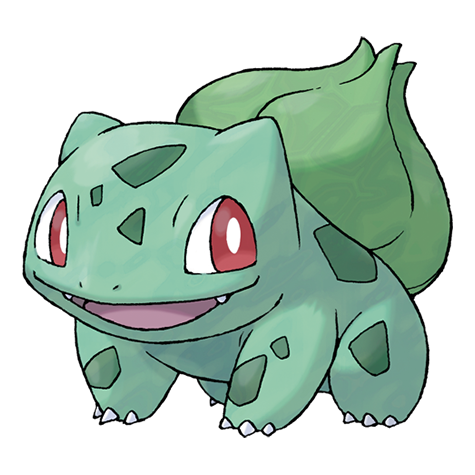
A strange seed was planted on its back at birth. The plant sprouts and grows with this POKéMON.
- Height
- 0.7 m
- Weight
- 6.9 kg
- Base XP
- 64
- Catch
- 45 /255
- Happy
- 70
- Hatch
- 20 steps

- HabitatGrassland
- Body shapeQuadruped
- ColourGreen
- Growth rateMedium Slow
- Egg groupsMonster, Plant
- RarityStandard
Bulbasaur is known as the Seed Pokémon, a small and sturdy quadruped that belongs to both the Grass and Poison types, a dual combination that was among the first introduced in the original generation of Pokémon discoveries. Standing at roughly knee height to a young child, it has a compact, well-grounded body covered in blue-green skin marked with faint teal patches across its surface. Its blunt, broad snout, wide reddish eyes, and short powerful legs give it an endearingly solid profile. The most defining feature of Bulbasaur is the large bulb planted firmly on its back, a structure that has been present since birth and is so thoroughly woven into the creature's biology that it cannot be separated from it. This bulb is not a burden; it is an integral part of Bulbasaur, growing as the Pokémon grows, and it serves functions that touch every aspect of the creature's daily existence.
Bulbasaur inhabits open grasslands and the sun-drenched fringes of temperate forests, seeking out environments where light reaches the ground in abundance. It gravitates toward warm meadows and clearings, avoiding dense canopy cover that would deprive its back-mounted plant of the solar energy it requires. Wild populations are notably sparse and tend to cluster near reliable water sources, particularly during extended dry periods when the soil moisture needed to supplement its photosynthetic diet becomes harder to find. Bulbasaur is primarily a solitary creature in the wild, staking out a modest home range that it inhabits with quiet consistency rather than wandering widely. Because many trainers receive a Bulbasaur directly from researchers who maintain careful breeding programs, true wild encounters are rare even within the grassland habitats it prefers, lending the species an air of scarcity despite its enduring fame.
Bulbasaur sustains itself chiefly through photosynthesis, the bulb on its back absorbing sunlight and converting solar energy into the nutrition its body requires. This makes it a primarily diurnal species, most active during the brightest parts of the day when it can bask in open light with its back turned toward the sun. It supplements its solar diet with water drawn from the soil and trace minerals it absorbs by resting against damp earth, a behavior field researchers describe as a kind of slow, deliberate charging. In temperament, Bulbasaur is remarkably calm, patient by nature, slow to aggress, and inclined to observe new situations carefully before committing to any response. Trainers who have raised it from early life consistently describe a deeply loyal and emotionally steady companion. It communicates with low resonant calls and subtle shifts in the fragrance that emanates from its bulb, a chemical vocabulary that other members of its species can read with precision.
In battle, Bulbasaur relies on one of two possible abilities. Its standard ability, Overgrow, causes its Grass-type attacks to strike with considerably greater force when it has taken heavy damage, a fitting trait for a Pokémon whose calm composure under pressure is one of its most noted qualities, rewarding the trainer who holds steady rather than switching out too early. Its hidden ability, Chlorophyll, works differently; under strong sunlight, Bulbasaur's speed doubles, which can transform what is ordinarily a measured and deliberate combatant into a surprisingly quick threat. The Grass and Poison combination provides solid offensive coverage against Water, Ground, and Rock type opponents, while leaving Bulbasaur exposed to Fire, Ice, Flying, Psychic, Poison, Bug, and Ground attacks, a broad array of vulnerabilities that calls for thoughtful team support. Its battling strengths lean toward special attacks rather than physical ones, and its relatively balanced defensive profile gives it reasonable staying power once it finds the right matchup.
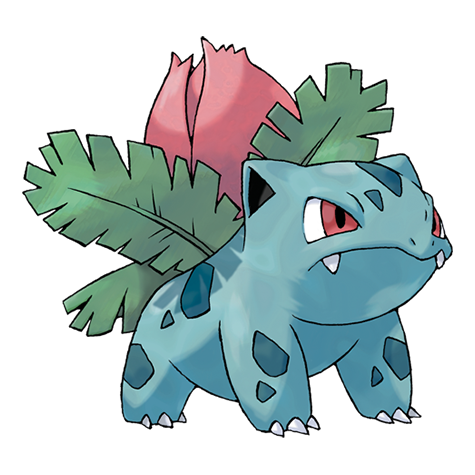
Bulbasaur stands at the beginning of a three-stage evolutionary line. Starting at level sixteen, it evolves into Ivysaur, a form in which the bulb on its back has opened into a recognizable flower bud and its overall build grows noticeably more powerful. A second evolution at level thirty-two produces Venusaur, a large and commanding Pokémon whose back bears a fully opened flower capable of generating and storing tremendous solar energy. Beyond its evolutionary journey, Bulbasaur holds a singular place in the history of Pokémon research as the very first entry in the original National Pokédex, a designation that has made it one of the most studied and recognized species in the world. The living symbiosis between Bulbasaur and the plant it carries on its back, each sustaining the other across a shared lifetime, remains one of the most compelling biological mysteries that researchers in the field continue to investigate.