Caterpie
Worm Pokémon
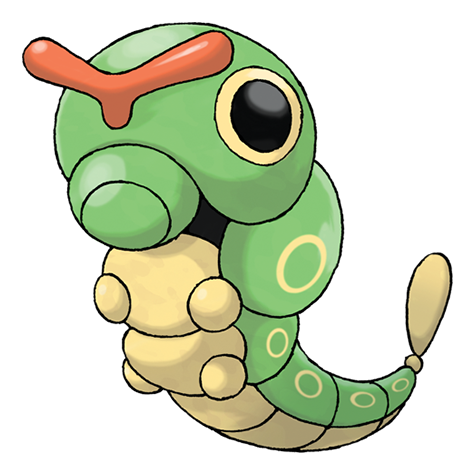
Its short feet are tipped with suction pads that enable it to tirelessly climb slopes and walls.
- Height
- 0.3 m
- Weight
- 2.9 kg
- Base XP
- 39
- Catch
- 255 /255
- Happy
- 70
- Hatch
- 15 steps
- HabitatForest
- Body shapeArmor
- ColourGreen
- Growth rateMedium
- Egg groupsBug
- RarityStandard
Caterpie is the Worm Pokémon, a pure Bug-type species introduced in the first generation of Pokémon alongside the founding roster of Kanto. Its body is small and cylindrical, roughly thirty centimetres long, clothed in smooth bright green scales that provide natural camouflage among leaves and grass. The underside of each of its short, stubby legs is tipped with a powerful suction pad, allowing Caterpie to scale vertical surfaces and overhanging branches with effortless persistence. Atop its rounded head sit two large, yellow-ringed markings that mimic the appearance of eyes, a deterrent meant to alarm smaller predators. Its most distinctive anatomical feature is a bright red, forked osmeterium just behind the head, a soft fleshy organ that emits a repellent odor when Caterpie perceives danger.
Caterpie is a forest dweller, preferring the cool, shaded interior of temperate woodlands where broad-leafed trees grow in abundance. Throughout Kanto it appears on the earliest forested routes and pathways, and within Viridian Forest in particularly high numbers, making it among the most commonly encountered wild Pokémon for new trainers. It tends to remain close to its food sources, rarely wandering more than a few metres from a productive leaf cluster. Caterpie can be found at almost any time of day clinging to bark, crawling along branches, or suspended from leaf undersides, though its activity peaks during the warmer, brighter hours of morning and midday. It is largely solitary by nature but not aggressive toward others of its kind, and several individuals can often be found feeding side by side on the same plant without any sign of territorial dispute.
Caterpie is an almost entirely leaf-eating Pokémon, consuming plant matter voraciously and nearly continuously throughout its larval stage. This constant feeding is not mere appetite but biological necessity: Caterpie must accumulate enough energy to fuel a rapid metamorphosis, and it accomplishes this with remarkable speed. Field researchers have noted that a well-fed Caterpie can shed its skin multiple times over a very short period before entering its pupal stage. When threatened by a predator or a human hand it cannot escape, Caterpie deploys its osmeterium, releasing a pungent chemical that most larger Pokémon find deeply unpleasant. Outside of this defensive reflex, Caterpie is docile and non-aggressive, showing neither a tendency to flee nor to fight unless circumstances demand it. Trainers who have handled young Caterpie describe them as gentle and easy to calm, responding well to patient handling and plentiful leaf offerings.
In battle, Caterpie carries two abilities that reflect its status as a prey species rather than a predator. Its standard ability, Shield Dust, coats its body with fine powdery scales that neutralize the secondary effects of incoming moves, preventing conditions such as paralysis, flinching, or stat drops that many attacks would otherwise inflict alongside their primary damage. This ability does nothing to reduce the direct force of a strike, but it meaningfully limits an opponent's capacity to stack additional harm. Its hidden ability, Run Away, ensures that Caterpie can always retreat from a wild encounter without being blocked by a trapping move or ability, a practical advantage for a creature whose survival depends on avoidance rather than confrontation. As a Bug type, Caterpie is vulnerable to Flying, Rock, and Fire moves, all of which deal it increased damage. Its statistics lean toward modest endurance rather than offense, with a speed that, while not outstanding, allows it to act ahead of slower opponents. Caterpie is rarely featured in competitive play, but its Shield Dust ability makes it a surprisingly stubborn target for opponents relying on moves with disabling secondary effects.
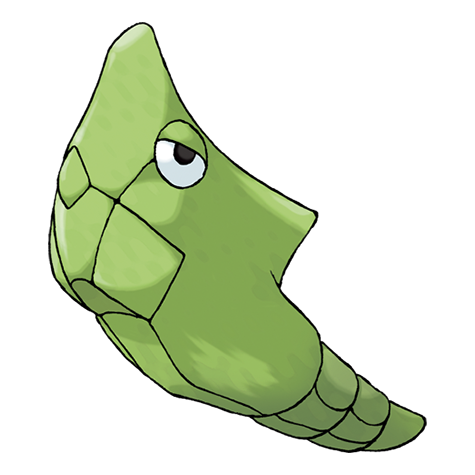
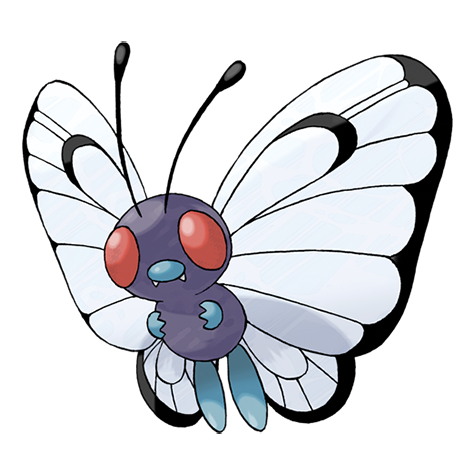
Caterpie occupies the opening position of one of the most recognizable evolutionary lines in the Pokédex. It evolves into Metapod at a remarkably low level through ordinary experience gain, a transition that arrives faster than almost any comparable evolution, mirroring the biological urgency of a larva racing toward metamorphosis. Metapod then evolves into Butterfree, a fully evolved Bug and Flying type, also through levelling up but at a somewhat higher threshold. The entire line from freshly hatched egg to final form can be completed more swiftly than almost any other three-stage sequence, which is one reason the line attracts sustained interest from researchers studying developmental biology in Pokémon. For trainers beginning their journey, Caterpie offers a vivid first lesson in metamorphic evolution, showing how completely a species can transform through growth alone. It holds an enduring place in the culture of Pokémon training as a symbol of quiet potential, a creature that appears fragile and unremarkable at first glance yet carries within its small green body the blueprint for something far more remarkable.