Metapod
Cocoon Pokémon
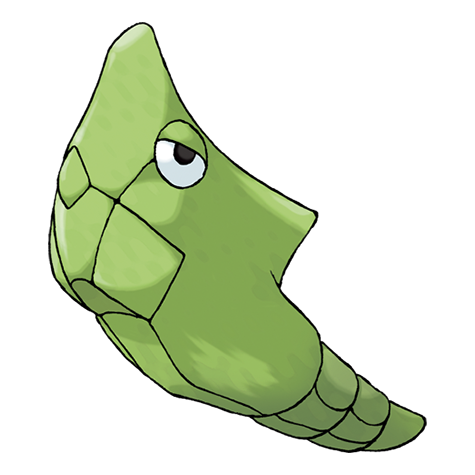
This POKéMON is vulnerable to attack while its shell is soft, exposing its weak and tender body.
- Height
- 0.7 m
- Weight
- 9.9 kg
- Base XP
- 72
- Catch
- 120 /255
- Happy
- 70
- Hatch
- 15 steps
- HabitatForest
- Body shapeSquiggle
- ColourGreen
- Growth rateMedium
- Egg groupsBug
- RarityStandard
Metapod is the Cocoon Pokémon, a pure Bug-type species introduced in the very first generation of Pokémon games. It represents the intermediate stage of a three-part evolutionary line, existing in a state of profound biological transformation. In physical form, Metapod resembles a large green chrysalis, roughly the size of a young child's torso when upright. Its outer shell is a deep, matte green, shaped like an elongated teardrop or a smooth, slightly curved pod. The surface is hard and segmented, giving it the appearance of an insect casing mid-pupation. A pale, face-like marking is visible on the front of the shell, offering the only outward suggestion of the creature living within. The body inside is described in Pokédex records as soft and tender, entirely dependent on the rigid exterior for protection.
Metapod inhabits forested regions, particularly the dense, temperate woodlands of Kanto, most famously the sprawling Viridian Forest. It tends to settle in areas where tree cover is thick and canopy shade is plentiful, as direct sunlight and dry air can be detrimental during its delicate transformation. Metapod is almost always found clinging to tree branches or nestled against the bark of large trunks, choosing positions that provide both concealment and structural support for its heavy shell. It is a solitary creature by nature, selecting its resting site independently after completing its prior larval stage. Population density can be surprisingly high in certain forest zones, particularly during warmer months when Caterpie are abundant and pupation rates climb. Metapod does not migrate; once it selects a perch and hardens its outer casing, it remains fixed in that spot until its metamorphosis is complete.
During the pupal stage, Metapod does not feed. All of its nutritional energy was stored during the Caterpie phase, and it now draws on those reserves to fuel the dramatic internal changes taking place within its shell. From the outside, Metapod appears almost entirely motionless. It does not vocalize, does not seek social interaction, and responds to threats not through aggression or flight but through stillness and the passive toughness of its casing. Field researchers note that Metapod occasionally shifts its position very slightly, presumably to manage temperature or orientation, but these movements are so slow and subtle they can be easy to overlook. Trainers who observe Metapod closely sometimes report a faint internal tremor when the Pokémon is disturbed, suggesting an awareness of its surroundings even in its dormant state. Folklore among younger trainers holds that speaking encouragingly to a Metapod helps it through its transformation, though no scientific basis for this claim has been established.
Metapod's only known ability is Shed Skin, a passive regenerative trait that gives the Pokémon a recurring chance after each turn to recover from major status ailments such as poisoning, paralysis, or deep sleep. This reflects the biological reality of its pupating form, which periodically renews the layers of its protective casing from within. In battle, Metapod is one of the most defensively passive Pokémon in existence. Its shell provides a meaningful degree of physical resilience, making it somewhat harder to knock out than its frail appearance might suggest, but its offensive output is essentially nonexistent. It cannot strike back with any meaningful force, and its speed is among the lowest of any Pokémon seen in active training. As a Bug type, it is vulnerable to Fire, Flying, and Rock-type attacks, all of which can bypass or overwhelm its shell with relative ease. Trainers who field Metapod in battle are almost always doing so strategically, stalling for time or outlasting opponents through repeated use of Harden, the move that progressively raises its already considerable defensive shell.
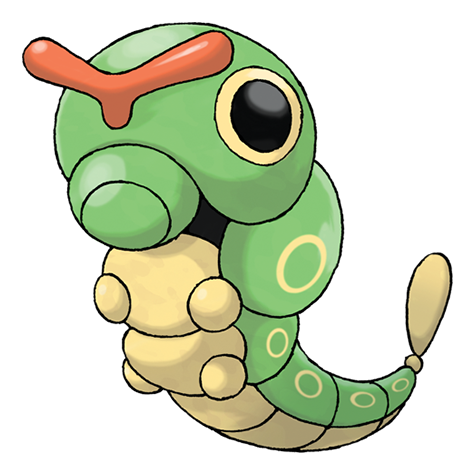
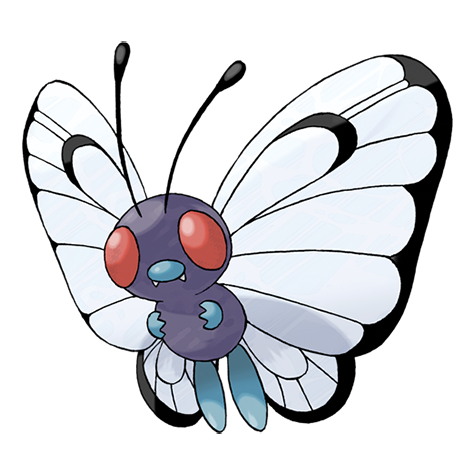
Metapod sits squarely in the middle of one of the most iconic three-stage evolutionary lines in Pokémon history. It evolves from Caterpie at a very low level, making it one of the earliest evolutionary transitions new trainers witness on their journey. It then evolves into Butterfree at an equally early stage, completing the metamorphosis into a graceful, fully capable Bug and Flying-type Pokémon. This rapid arc means that Metapod's time in the spotlight is brief by design. For researchers, Metapod is of considerable interest as a study in biological transformation: the speed at which its outer shell hardens after pupation is remarkable even by insect standards, and the internal restructuring occurring within its casing is considered one of the most dramatic examples of metamorphosis documented in the Pokémon world. For trainers, Metapod is often the first Pokémon that teaches patience — requiring them to continue a journey even when a team member can barely contribute to battle, trusting that something extraordinary waits on the other side of stillness.