Croconaw
Big Jaw Pokémon
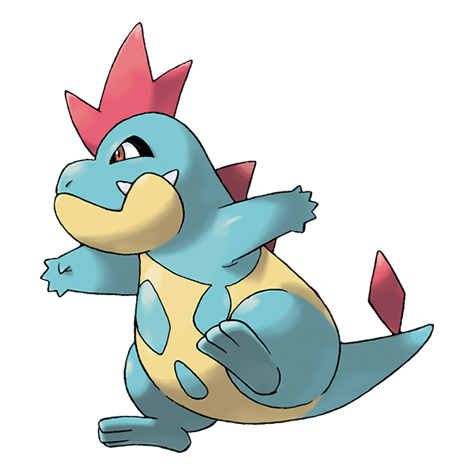
If it loses a fang, a new one grows back in its place. There are always 48 fangs lining its mouth.
- Height
- 1.1 m
- Weight
- 25.0 kg
- Base XP
- 142
- Catch
- 45 /255
- Happy
- 70
- Hatch
- 20 steps
- HabitatWaters Edge
- Body shapeUpright
- ColourBlue
- Growth rateMedium Slow
- Egg groupsMonster, Water1
- RarityStandard
Croconaw is the Big Jaw Pokémon, a pure Water type introduced in the second generation of the Pokémon world. It stands at roughly waist height on an adult human, with a stout, upright build supported on two powerful legs. Its body is primarily blue, accented by a pale yellow belly and a distinctive red fringe that runs across the top of its head and neck, giving it an almost wild, crested appearance. The most striking feature of Croconaw is its enormous mouth, perpetually open or curled in a way that shows off the rows of fangs lining its jaw. Those fangs are not merely decorative. Croconaw maintains exactly forty-eight of them at any given time, and should one fall out during a fierce struggle, a replacement grows in quickly to fill the gap. This remarkable dental regeneration is central to its identity and its fearsome reputation.
Croconaw inhabits freshwater and coastal zones along the edges of rivers, lakes, and tidal flats, preferring areas where the water is clear and the banks are rich with undergrowth for cover. It is commonly found in temperate and subtropical regions, making its home in places like the wetlands and river margins of Johto, where it was first catalogued. Population density tends to be moderate, as Croconaw is neither particularly rare nor exceptionally common in the wild. It is largely a solitary creature outside of the breeding season, staking out a stretch of shoreline as its own and driving off rivals who venture too close. Most active at dawn and dusk, it takes advantage of low light when hunting is most productive and competition from other predators is reduced.
In its daily behaviour, Croconaw is patient and deliberate. It waits near the waterline, often crouched low among reeds or partially submerged, watching for fish and other aquatic prey to drift within striking range. When it lunges, those curved fangs lock onto prey with remarkable grip, and the forward-facing hooks on the teeth make escape nearly impossible once contact is made. Trainers and field researchers note that Croconaw can become genuinely affectionate with humans who earn its trust, though it tests boundaries through rough, jaw-snapping play that requires a confident hand. Toward unfamiliar Pokémon it is territorial and assertive, vocalizing with low hisses and displays of open-mouthed warning before escalating to physical confrontation. During the breeding period it is known to gather in small groups near riverbanks, engaging in ritualized jaw-wrestling to establish hierarchy.
In battle, Croconaw is built around physical offense. Its attack and defense are balanced and solid, giving it durability alongside real hitting power. It leans into its Water typing with moves that punish opponents who rely on Fire or Rock, while trainers must be cautious against Grass and Electric opponents, which exploit its single-type coverage. Its standard ability, Torrent, is a hallmark of Water-type starters: when Croconaw is pushed close to its limit with very little health remaining, its Water moves surge in power, giving it a meaningful comeback potential in desperate situations. Its hidden ability, Sheer Force, takes a different approach entirely, amplifying the raw power of moves that would normally carry secondary effects but stripping out those additional effects in exchange. This makes Croconaw hit considerably harder on certain moves and rewards trainers who build around raw damage rather than chip effects. Its speed is modest, so it functions best in a role where it absorbs hits and answers back with heavy Water or physical strikes rather than racing to move first.
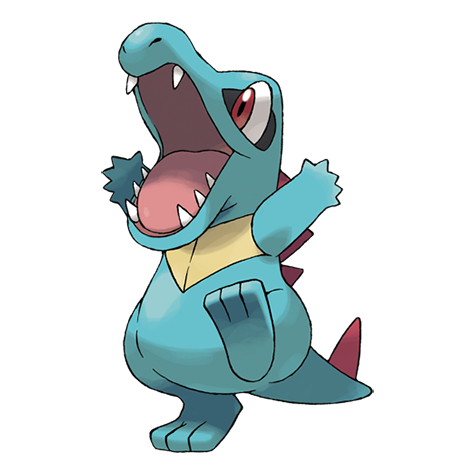
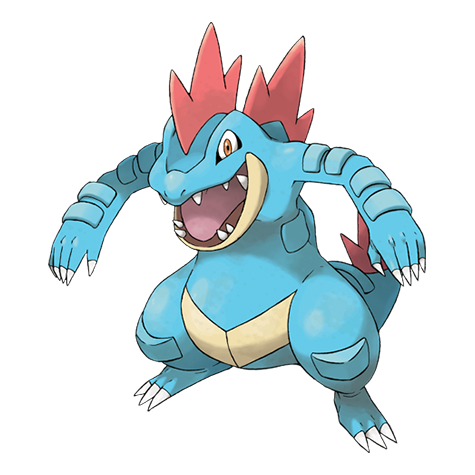
Croconaw sits at the middle stage of one of Johto's most celebrated starter lines, evolving from Totodile beginning around level eighteen and continuing to its final form, Feraligatr, around level thirty. Totodile is obtained as a starter Pokémon offered to new trainers setting out from New Bark Town, and Croconaw represents the first major surge in that line's power and presence. Researchers find Croconaw particularly interesting because of its dental biology, which has drawn comparisons to certain real-world crocodilians and sparked ongoing study into how Pokémon physiology supports continuous tissue regeneration. For trainers, it occupies the sweet spot of a middle evolution: strong enough to carry through the middle chapters of a journey, dependable in gym battles requiring Water coverage, and a clear sign of the formidable Feraligatr waiting just ahead.