Cubone
Lonely Pokémon
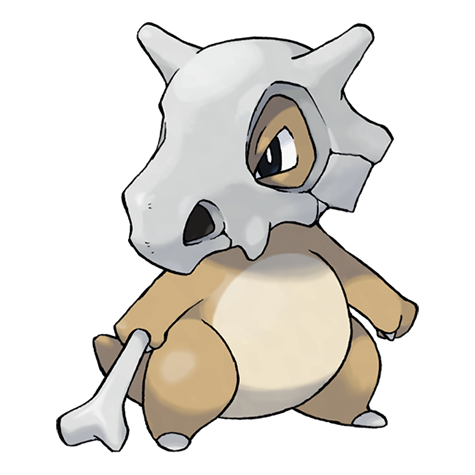
Because it never removes its skull helmet, no one has ever seen this POKéMON's real face.
- Height
- 0.4 m
- Weight
- 6.5 kg
- Base XP
- 64
- Catch
- 190 /255
- Happy
- 70
- Hatch
- 20 steps
- HabitatMountain
- Body shapeUpright
- ColourBrown
- Growth rateMedium
- Egg groupsMonster
- RarityStandard
Cubone is the Lonely Pokémon, a Ground-type species introduced in the first generation of Pokémon games. It stands upright on two stout legs, presenting a compact build that reaches roughly to the waist of a young child. Its body is covered in brown, scale-like hide, and its most immediately striking feature is the bleached skull it wears over its head at all times. This skull helmet conceals its face entirely, and no trainer or researcher has ever documented what lies beneath. From each side of the skull hang flat, tab-like ornaments that frame its face and add to its haunting silhouette. In one hand it carries a thick bone club, worn smooth at the grip by constant use, which serves both as a walking aid and as a weapon in moments of conflict. The overall impression is of a small creature permanently draped in mourning, armored not only by nature but by grief made physical.
Cubone is most commonly found in mountainous terrain, favoring rocky slopes, cave systems, and arid highlands where sparse vegetation offers little cover. In the Kanto region it is closely associated with areas surrounding Lavender Town, a place known for its deep connection to departed Pokémon, which suits this species particularly well. It also appears in desert-adjacent environments and has been observed at high altitude where the nights grow especially cold. Cubone is a solitary creature, rarely seen alongside others of its kind, and typically shelters within cave alcoves or beneath rocky overhangs. It is most active during the evening and through the night, and it does not appear to migrate seasonally. Population density tends to be low wherever it lives, and sightings are often sparse enough that encountering one in the wild carries something of the feeling of intruding on private grief.
Cubone is known above all for its sorrow. Field researchers and trainers who have spent time near mountainsides consistently report hearing a mournful cry rising in the night, especially when the moon is full. Cubone is believed to gaze at the moon because its glow recalls the face of its deceased mother, and the weeping that follows can last for hours. It is slow to trust humans and keeps its distance from most other Pokémon, earning its classification as the Lonely Pokémon not merely as a taxonomic label but as an accurate description of its daily existence. When threatened, it swings its bone club with surprising force or hurls it at a target from a distance. Despite its melancholy, Cubone is tenacious and does not retreat easily when cornered. Trainers who earn its trust describe it as fiercely loyal, as though that bond partly fills the absence it has carried since birth.
In battle, Cubone's greatest asset is its physical durability. Its dense hide and the thick bone it wears allow it to absorb hits that would incapacitate lighter opponents, and its defensive capability is by far its highest attribute. Its standard ability Rock Head prevents recoil damage, allowing Cubone to use heavy physical moves without paying the usual cost in returned damage. Its other standard ability, Lightning Rod, does more than redirect incoming Electric attacks away from teammates; it also lets Cubone absorb those moves entirely and convert them into a boost to special attack, which proves especially useful in double battles. The hidden ability Battle Armor ensures that no incoming strike can land as a critical hit, adding another layer of reliable protection. As a Ground type, Cubone is fully immune to Electric moves and takes reduced damage from Rock and Poison attacks. However, Water, Grass, and Ice moves all strike it with extra force, and its low speed means faster opponents almost always act first, making it better suited to absorbing punishment than to dictating the pace of a fight.
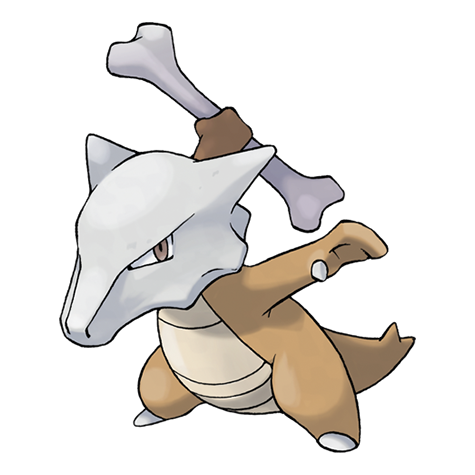
Cubone occupies the first stage of a two-Pokémon evolutionary line. When it gains sufficient experience, typically in its later stages of development, it evolves into Marowak, a larger and more battle-hardened Pokémon that channels the same inherited grief into focused, controlled aggression. Marowak trades some of Cubone's raw resilience for greater offensive output and stands as one of the more recognizable evolutions of the original generation. Cubone itself holds a distinctive place in Pokémon research, as it represents one of the clearest documented cases of emotional loss shaping a species' physical identity. Scholars studying the relationship between a Pokémon's psychology and its outward form frequently cite Cubone as a foundational subject. For trainers, it remains a reminder that endurance and loyalty do not always announce themselves loudly, and that some of the most steadfast companions are those who have already learned to carry great loss.