Dragonair
Dragon Pokémon
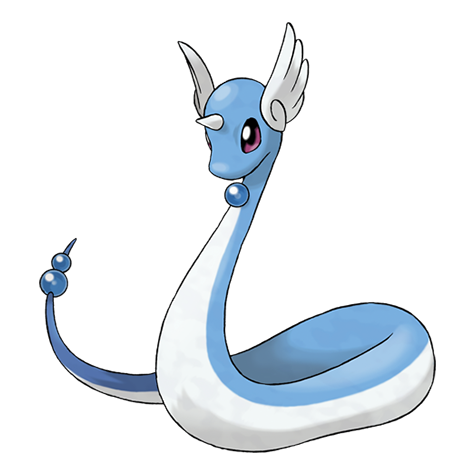
A mystical POKéMON that exudes a gentle aura. Has the ability to change climate conditions.
- Height
- 4.0 m
- Weight
- 16.5 kg
- Base XP
- 147
- Catch
- 45 /255
- Happy
- 35
- Hatch
- 40 steps
- HabitatWaters Edge
- Body shapeSquiggle
- ColourBlue
- Growth rateSlow
- Egg groupsWater1, Dragon
- RarityStandard
Dragonair is a pure Dragon-type Pokémon introduced in the first generation of games, classified formally as the Dragon Pokémon. It presents as a long, sinuous serpent, its body covered in smooth scales of a soft, luminous blue that shimmers faintly in reflected light. It lacks limbs entirely, save for two small fin-like appendages that flare from either side of its neck, giving it an appearance at once aquatic and airborne. Three crystalline orbs are set along its body, one near the throat and one on each side where the neck fins emerge, with a larger orb crowning the curled tip of its tail. All four orbs glow with a pale inner light that intensifies perceptibly when the creature is agitated or in a heightened state. Fully grown, Dragonair stretches to roughly four metres in length, considerably longer than a human adult, yet its slender build lends it an appearance of near-weightlessness.
Dragonair inhabits the edges of calm freshwater environments, favouring the still margins of deep mountain lakes, wide and gently flowing rivers, and occasionally sheltered coastal areas where freshwater outlets meet the sea. It is strongly associated with undisturbed, pristine water and retreats from areas of heavy human activity, making confirmed sightings uncommon even in regions where the species is known to persist. Within Kanto, historical records place Dragonair most reliably in the deep waters of the Safari Zone lake and the underground reservoir beneath Cerulean Cave. It is a solitary creature in all but the shortest breeding periods, and each individual holds a large, loosely defined territory centred on a preferred resting pool or deep channel. Activity peaks in the early morning hours and on overcast days, when mist and low light appear to suit its temperament most naturally.
Field researchers describe Dragonair as one of the calmest presences in the wild. It radiates an aura that has a measurably soothing effect on nearby Pokémon and animals, and trainers report that even high-strung partners become noticeably calmer in its company. Its most discussed trait, however, is its apparent ability to influence local weather, shifting cloud cover, triggering rainfall, or altering temperature in ways that correlate closely with the animal's emotional state. The crystalline orbs along its body glow more intensely during these events, and the leading hypothesis among researchers is that they function as a kind of biological weather-manipulation organ, though the mechanism is not yet fully understood. Dragonair feeds on large freshwater fish and other aquatic prey, hunting with patient, unhurried precision. It shows no inherent aggression toward humans but does not seek contact either, and the bond it forms with a trainer it trusts is considered one of the more quietly devoted in the Dragon family.
In battle, Dragonair carries two abilities worth understanding. Its standard ability, Shed Skin, grants it a recurring chance each turn to cure itself of persistent status conditions including paralysis, poison, burn, and sleep, by shedding and regenerating the outermost layer of its scales. This makes it structurally difficult to neutralise through attrition tactics. Its hidden ability, Marvel Scale, operates on a different principle: rather than removing a status ailment, it converts one into a defensive asset, strengthening its physical endurance while the condition persists. As a Dragon type, Dragonair hits broadly across the type chart with Dragon-type moves and resists several common attack types, but its weaknesses to Ice, Dragon, and Fairy moves represent significant vulnerabilities. It skews toward physical offense as its primary avenue, though its overall profile is balanced and measured rather than highly specialised. In longer engagements, the ability to repeatedly clear status conditions tilts the match gradually in its favour.
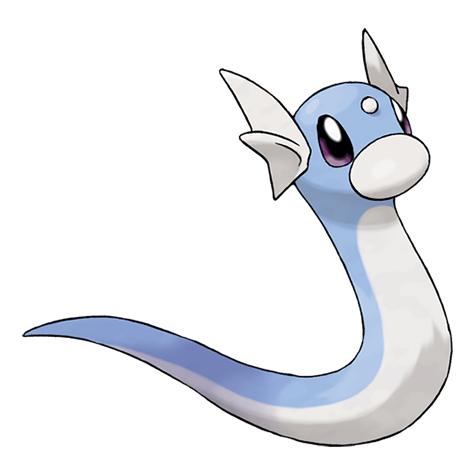
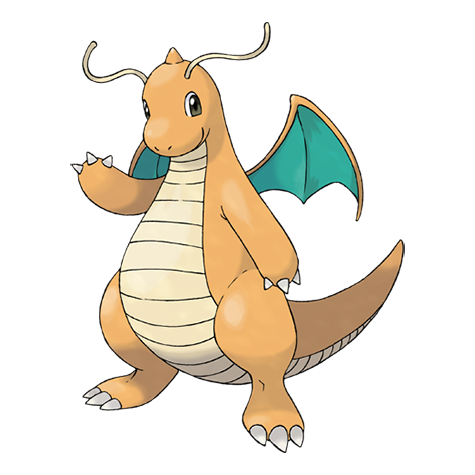
Dragonair is the second stage in a three-part evolutionary line. It develops from Dratini, the small, coil-bodied Tiny Dragon Pokémon, when that form gathers enough battle experience to reach level thirty, at which point the compact body elongates dramatically into Dragonair's characteristic serpentine shape. The line continues when Dragonair itself reaches level fifty-five, transforming into Dragonite, a large, winged, bipedal dragon of considerably greater power, marking a striking shift in body plan away from the aquatic grace of the earlier stages. All three members of this line were among the rarest encounters in the original Pokédex, accessible only through patient and deliberate effort, and that scarcity has contributed to their enduring prestige among trainers and collectors alike. For researchers, Dragonair remains of particular interest for its weather-influencing behaviour, which sits at the intersection of ecology, physiology, and phenomena that current science has not yet fully characterised.