Forretress
Bagworm Pokémon
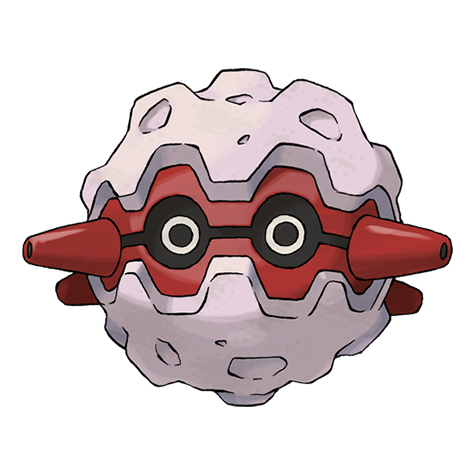
Its entire body is shielded by a steel-hard shell. What lurks inside the armor is a total mystery.
- Height
- 1.2 m
- Weight
- 125.8 kg
- Base XP
- 163
- Catch
- 75 /255
- Happy
- 70
- Hatch
- 20 steps
- HabitatForest
- Body shapeBall
- ColourPurple
- Growth rateMedium
- Egg groupsBug
- RarityStandard
Forretress is a Bug and Steel type Pokémon introduced in the second generation, classified under the Bagworm category. Its most immediately striking feature is the shape of its body, which is almost perfectly spherical and encased entirely within a shell of extraordinary hardness. The outer casing is a deep reddish-pink with brownish undertones, smooth and metallic in texture, and bears a single large circular opening at the front of its form. Through this aperture a faint purple darkness is visible, hinting at an interior that no researcher has ever clearly observed. Relative to a human, Forretress is roughly the size of a large beach ball, compact but densely heavy. No limbs or appendages extend from the shell under ordinary circumstances, giving the Pokémon the deceptive appearance of an inert, sealed sphere at rest. Its design draws from the real-world bagworm caterpillar, which constructs a protective casing from plant debris, though Forretress has replaced that organic material with something far more formidable.
Forretress inhabits dense temperate forests where mature trees offer sturdy branches for it to anchor itself. Its range is most firmly established in the forests of the Johto region, though it has been documented in wooded areas of several other regions wherever thick canopy cover and mild to cool conditions prevail. Once a Forretress selects a suitable branch, it remains there for extended periods, making it one of the more sedentary Pokémon found in forest environments. Population density within any given forest tends to be sparse, as Forretress is a solitary species that does not gather in groups. It shows no migratory tendencies and does not shift significantly in position across seasons or times of day. Trainers searching for this species must look carefully at the upper branches of older trees, where Forretress can be easy to overlook, resembling a clinging seed pod or an irregular growth on the bark rather than a living Pokémon.
The daily life of Forretress is defined by patience and concealment. It feeds on insects and organic matter accessible from its perch, though direct observation of this behavior is nearly impossible; the moment Forretress detects an approaching presence, it turns its opening away or seals it entirely, hiding whatever activity was taking place inside. Field researchers consistently report this experience: no matter how carefully one approaches, the interior is always hidden before it can be observed. When genuinely threatened, Forretress responds with a sudden explosive discharge of shell fragments, scattering sharp debris outward in all directions and using the resulting confusion to reposition or withdraw. This defensive burst is startling in its abruptness relative to the Pokémon's otherwise calm and passive temperament. Forretress does not behave aggressively toward humans without provocation, and trainers who have earned its trust describe it as steady and dependable, a Pokémon whose patience in difficult situations mirrors the stillness it displays in the wild.
In battle, Forretress functions as a defensive cornerstone, anchored by its remarkable physical resilience. Its standard ability, Sturdy, ensures that if Forretress enters a battle at full health, no single attack can knock it out in one blow; instead, the hit leaves it standing with one health point remaining, granting it one final opportunity to act. This ability also makes Forretress immune to moves specifically designed to guarantee a one-hit knockout regardless of level or health. Its hidden ability, Overcoat, protects it from the residual damage inflicted by harsh weather conditions such as sandstorm and hail, and additionally shields it against powder-based and spore moves. The combination of Bug and Steel typing grants Forretress numerous resistances, and its formidable physical Defense allows it to absorb blows that would overwhelm most other species. Its primary vulnerabilities fall against Fire, Flying, Rock, Fighting, and Ground type attacks, with Fire posing the most acute danger given that both of its types share that weakness. Its Special Defense is notably lower than its physical equivalent, making specially offensive opponents a genuine concern. Its low Speed means it almost always moves after opponents, but skilled trainers leverage this by using Forretress as a hazard setter, establishing Spikes and Stealth Rock to steadily erode opposing teams, and sometimes deploying it to remove existing hazards with Rapid Spin.
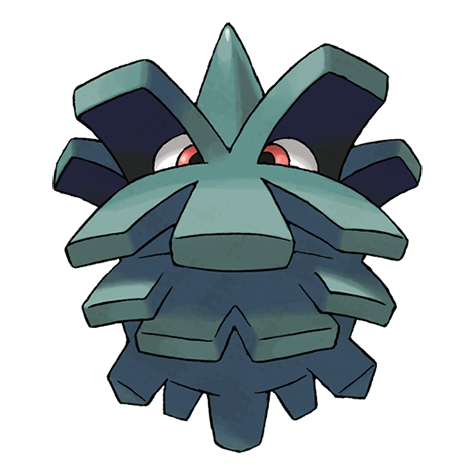
Forretress is the final stage of a two-member evolutionary line, evolving from Pineco, a smaller bagworm Pokémon that resembles a pinecone clinging to a branch. Pineco reaches this next stage upon attaining level thirty-one, at which point its modest outer casing hardens dramatically into the dense steel shell that defines Forretress. The line was introduced as part of the second generation Pokédex and represents a thematic pairing built around concealment and physical protection. Among trainers and competitive battlers, Forretress holds a respected position as one of the most reliable defensive supports available, prized for its extreme physical durability and its access to multiple entry hazard moves that can shift the momentum of a battle before a single offensive exchange takes place. Beyond its tactical value, Forretress continues to captivate researchers because of one simple, unresolved fact: despite extensive study, no one has confirmed what occupies the inside of that sealed shell. Every investigation has been met with the same result, the opening closes before anything can be seen. This persistent mystery ensures that Forretress remains one of the most quietly fascinating species in the entire Pokédex.