Pineco
Bagworm Pokémon
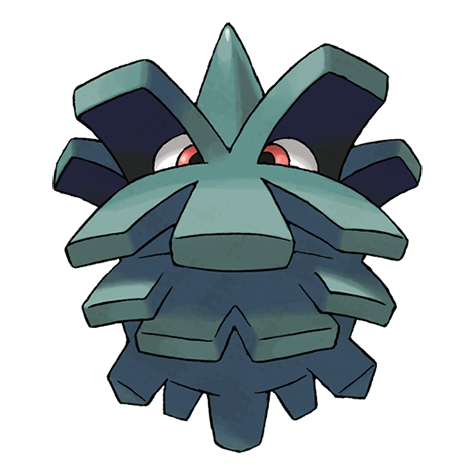
It likes to make its shell thicker by adding layers of tree bark. The additional weight doesn't bother it.
- Height
- 0.6 m
- Weight
- 7.2 kg
- Base XP
- 58
- Catch
- 190 /255
- Happy
- 70
- Hatch
- 20 steps
- HabitatForest
- Body shapeBall
- ColourGray
- Growth rateMedium
- Egg groupsBug
- RarityStandard
Pineco is a pure Bug-type Pokémon introduced in the second generation of games, originating from the Johto region. Classified as the Bagworm Pokémon, it takes both its appearance and its name from the behavior of real bagworm moths, whose larvae construct protective casings from fragments of bark and plant matter. Physically, Pineco looks like a small, densely layered pine cone, roughly the size of a large orange, and it hangs from tree branches with no visible limbs extending outward. Its outer surface is composed of overlapping segments of rough bark, predominantly gray-green in color, giving it a textured and almost architectural appearance. On what passes for its face, a simple cross-shaped pattern sits at the center, providing just enough definition to distinguish front from back. The overall silhouette is compact and spherical, with no protruding appendages, making Pineco one of the more self-contained and armor-like creatures at its stage of development.
Pineco makes its home in forested environments, preferring dense woodlands with a healthy population of mature trees. It is most commonly found in the forests of the Johto region, though it appears wherever the canopy is thick enough to provide both food and cover. The Pokémon favors the mid-level branches of large trees, where it hangs amid natural seed pods and pinecones, blending into the surroundings with impressive effectiveness. Pineco is a solitary creature by nature, and individuals rarely seek one another out except during the mating season. Its camouflage is so convincing that seasoned trainers have passed directly beneath one without suspecting its presence. The most reliable way to locate a Pineco in the wild is to strike the trunk of a likely tree firmly, which dislodges the Pokémon from its perch and reveals it.
Pineco is exceptionally passive for the vast majority of its life. It clings to its branch and feeds slowly on tree sap and organic material from the bark surrounding it, expending as little energy as possible. Its most distinctive behavioral trait is its compulsion to reinforce its shell: Pineco actively collects fresh bark fragments and adds them in layers around itself, steadily thickening its outer casing over time. The growing weight of the accumulated bark does not appear to cause it any discomfort or inconvenience. When disturbed or threatened, however, Pineco abandons its docile composure entirely. Rather than attempting to flee, it triggers a violent self-detonation, an explosive discharge powerful enough to startle or injure approaching threats. This tendency is well-documented among trainers and field researchers, who note that a Pineco startled from its branch is considerably more dangerous than one left undisturbed.
In battle, Pineco is designed for endurance rather than speed or raw offensive power. Its primary ability, Sturdy, provides a meaningful survival guarantee: when a single blow would otherwise knock it out from full health, Pineco instead endures with the smallest possible amount of vitality intact, refusing to go down in one hit. This same ability also protects it from the rare category of moves designed to knock a target out instantly regardless of remaining strength. Its hidden ability, Overcoat, shields it from the passive damage that weather phenomena such as sandstorms and hailstorms deal to unprotected Pokémon each turn. Physically, Pineco is considerably more resilient against direct strikes than it is capable of withstanding special attacks, making it better suited to absorbing physical blows. Its offensive output is modest, and its movement speed is among the slowest of any Pokémon, meaning it will almost always act after its opponent. Fire, Rock, and Flying moves represent its clearest weaknesses. The self-destruct family of moves provides Pineco with a devastating last resort, a powerful option that ends its participation in battle but that can be entirely decisive at the right moment.
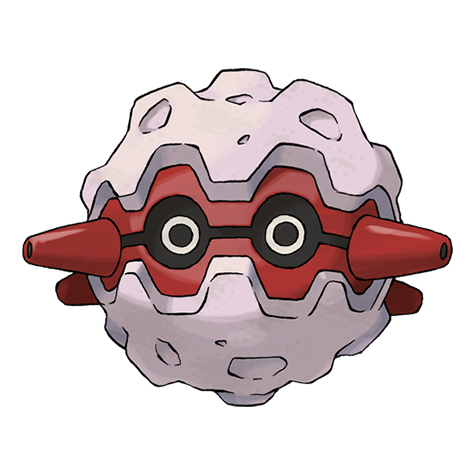
Pineco is the first stage in a two-member evolutionary line. As it grows and accumulates experience, it eventually evolves into Forretress, gaining Steel typing alongside its existing Bug heritage and becoming one of the most defensively capable Pokémon available. That transformation turns a humble, bark-coated cocoon into a nearly impenetrable fortress, and the contrast between the two stages makes Pineco a compelling subject for researchers studying evolutionary leaps in defensive adaptation. Scientists have noted that its shell-building behavior closely mirrors that of real-world bagworm moths, members of the family Psychidae, whose caterpillars construct portable cases from surrounding plant debris. Trainers prize Pineco for its Sturdy ability and its access to explosive moves, making it a tactically interesting choice even before it evolves. As a second-generation species, it remains a familiar and fondly remembered creature among those who explored the forests of Johto for the first time, and its distinctive pine cone silhouette has made it one of the more recognizable Bug-type Pokémon of its era.