Girafarig
Long Neck Pokémon
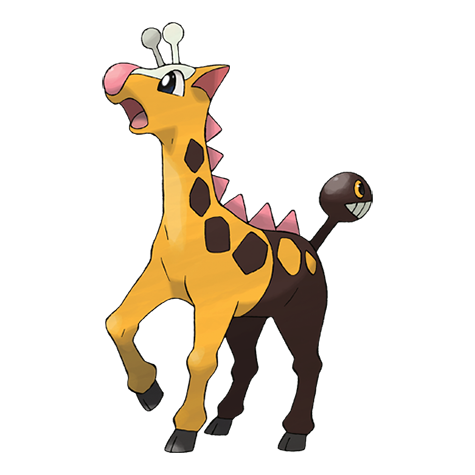
Its tail has a small brain of its own. Beware! If you get close, it may react to your scent and bite.
- Height
- 1.5 m
- Weight
- 41.5 kg
- Base XP
- 159
- Catch
- 60 /255
- Happy
- 70
- Hatch
- 20 steps
- HabitatGrassland
- Body shapeQuadruped
- ColourYellow
- Growth rateMedium
- Egg groupsGround
- RarityStandard
Girafarig is the Long Neck Pokémon, a dual Normal and Psychic type that originated during the second generation of Pokémon discovery and is native to the Johto region. Its height is roughly comparable to that of a large horse, and it presents a silhouette defined above all by its long, graceful neck and four sturdy legs suited to open terrain. Its body is a bright yellow, marked with irregular dark brown patches across the torso and hindquarters, and the forward-facing head is framed by a pair of short blunt horns and small rounded ears set above wide, alert eyes. The feature that defines this species above all others is its tail, which does not end in a simple tuft of fur but rather in a second, smaller head complete with its own eyes, a toothed mouth, and a rudimentary brain confirmed by researchers to be capable of independent processing. This secondary head perceives and reacts to the world on its own terms, making Girafarig one of the most biologically remarkable Pokémon on record.
Girafarig inhabits wide, open grasslands, favouring temperate plains where tall grasses and sparse trees supply both plentiful grazing and clear sightlines for detecting approaching threats. In Johto it is most reliably encountered along Route Forty-Three, the broad meadow corridor connecting Mahogany Town to the Lake of Rage, where small groups move through the tall grass during daylight hours. It requires areas with consistent rainfall and dependable vegetation cover, steering away from dense forest where its long neck would become a physical liability, and avoiding arid terrain where grazing is too scarce to sustain it. Girafarig is not a strictly solitary creature; it tends to move in loose, informal groups of three to six individuals. These associations are relaxed rather than tightly coordinated, with members remaining broadly aware of one another without forming the large, disciplined herds seen in some other grazing species. It is diurnal by nature, active through daylight, and settles into rest as darkness falls.
During waking hours Girafarig grazes methodically on grasses, low-growing plants, and the accessible branches of nearby trees, moving with a calm and unhurried rhythm and pausing frequently to survey its surroundings. The tail head, however, operates on an entirely independent schedule. It responds to stimuli, most reliably to nearby scent, without any input from the primary brain, meaning it may lunge and bite at anyone who approaches from behind even while the front of the Pokémon appears perfectly at ease. Field researchers consistently warn against approaching Girafarig from the rear for precisely this reason, as the bite arrives without warning and without any conscious decision from the primary mind. When the main body sleeps, the tail head is believed to remain fully wakeful, acting as a passive sentinel that monitors the environment through the night. This division of labour between two minds gives Girafarig a degree of continuous vigilance that few prey species can match.
In battle Girafarig can draw on two standard abilities and one hidden. Inner Focus prevents it from flinching under moves that would normally interrupt a Pokémon mid-action, lending reliable follow-through in close exchanges. Early Bird allows it to recover from sleep in roughly half the time most species require, a significant advantage given that forced sleep is one of the most disruptive status conditions in a competitive fight. Its hidden ability, Sap Sipper, converts incoming Grass-type attacks from sources of damage into a boost to physical strength, a useful edge against opponents who lean on those moves. Girafarig channels its strongest output through Psychic-type special attacks, and its speed is comfortably above average, letting it act before a wide range of opponents in any given exchange. Its defensive profile is moderate, and its typing leaves it exposed to Fighting, Bug, Dark, and Ghost-type moves, so it performs best deployed as a fast, forward-pressing attacker rather than a defensive anchor.
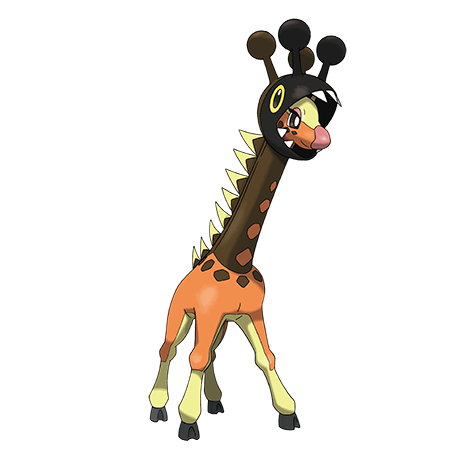
Girafarig arrives without any prior evolutionary stage, entering the world as a species in its own right rather than the starting point of a conventional chain. For a long period it was treated as a complete and terminal line with no further transformation expected or observed. That understanding shifted during ninth-generation research, when it was confirmed that Girafarig can evolve into a larger and more powerful form called Farigiraf. The transition occurs when Girafarig levels up while already having learned Twin Beam, a Psychic-type move that draws on the coordinated output of both its heads working in concert. Farigiraf represents the fullest biological expression of what makes Girafarig distinctive, taking its two-brained architecture to its natural conclusion. For researchers, the independently functioning tail brain continues to raise genuine and unresolved questions about the nature of individual consciousness in Pokémon biology. For trainers, Girafarig remains a frequently underestimated partner whose dual-minded nature, once properly understood, offers an approach to battle that few other species can replicate.