Hoothoot
Owl Pokémon
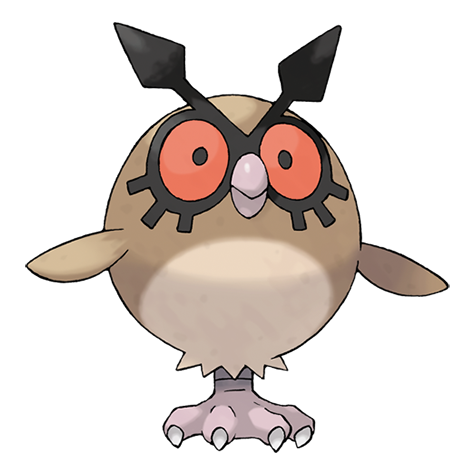
It always stands on one foot. It changes feet so fast, the movement can rarely be seen.
- Height
- 0.7 m
- Weight
- 21.2 kg
- Base XP
- 52
- Catch
- 255 /255
- Happy
- 70
- Hatch
- 15 steps
- HabitatForest
- Body shapeWings
- ColourBrown
- Growth rateMedium
- Egg groupsFlying
- RarityStandard
Hoothoot is a Normal and Flying type Pokémon that made its first appearance in the Johto region during the second generation of Pokémon discovery. Classified as the Owl Pokémon, it presents a small, rotund figure standing roughly knee-height to the average adult human. Its body is covered in soft brown plumage, with a pale cream-colored underbelly and face. Two large, striking red eyes dominate its round head, each ringed with a bold circular marking that lends the creature an almost hypnotic, clock-like appearance. Small tufted feathers form modest ear-like protrusions on the top of its head, and its stubby wings fold neatly against its sides when at rest. Perhaps the most immediately notable feature of Hoothoot is the peculiar way it carries itself: rather than standing on both feet as most Pokémon do, it perches perpetually on a single foot, swapping between the two so rapidly that the exchange is virtually imperceptible to the naked eye.
Hoothoot makes its home in forested regions, favoring dense woodlands with tall canopy cover where it can roost quietly during daylight hours. Its range extends across much of the Johto region, though it has been documented in forests throughout several other territories as well. It tends to occupy areas where old-growth trees provide ample perching spots at modest heights, and it gravitates toward forest interiors rather than woodland edges. Hoothoot is primarily a solitary creature, and individual specimens tend to claim and defend a particular roost tree within a small home range. Encounters between two Hoothoot in the wild are uncommon outside of breeding periods. As a nocturnal Pokémon, it is essentially inactive during daylight, becoming alert and active as evening falls. Trainers and naturalists who survey forest paths after dark report hearing its distinctive hooting call echoing through the trees with remarkable regularity.
Hoothoot's daily rhythm is governed by an extraordinarily precise internal clock, and experienced field observers have noted that this Pokémon begins calling at almost exactly the same time each night, regardless of season or weather conditions. This timekeeping instinct is so reliable that communities living near forested areas have historically used Hoothoot's call as an informal marker for the hour. Its diet consists mainly of small insects and invertebrates, which it hunts from an elevated perch by scanning the ground below with its wide, light-gathering eyes. When prey is spotted, it drops silently and with surprising accuracy. Hoothoot is generally unassuming in its interactions with humans and other Pokémon, preferring to observe from a distance rather than engage directly. Young individuals that have grown accustomed to human presence near forest settlements will sometimes allow a careful approach, though wild adults remain consistently cautious.
In battle, Hoothoot draws on two standard abilities and one hidden ability. Its most common ability is Insomnia, which renders it completely immune to the sleep condition, making it a dependable choice against opponents who rely heavily on moves that induce drowsiness. Its second standard ability, Keen Eye, prevents the accuracy of its own moves from being reduced by any external effect, ensuring consistent performance even against opponents who employ evasion tactics. The hidden ability, Tinted Lens, is the most strategically interesting of the three: it doubles the power of moves that would ordinarily be only partially effective against the target, dramatically broadening Hoothoot's offensive coverage in ways that can catch a careless opponent off guard. As a Normal and Flying type, Hoothoot resists Bug and Grass type moves and is entirely immune to Ground and Ghost type attacks. It carries weaknesses to Rock, Electric, Ice, and Fighting type moves, so trainers must manage those matchups carefully. Its defensive profile leans toward special durability rather than physical toughness, and while it is not a particularly swift battler, its immunity to sleep gives it a reliable edge in drawn-out exchanges.
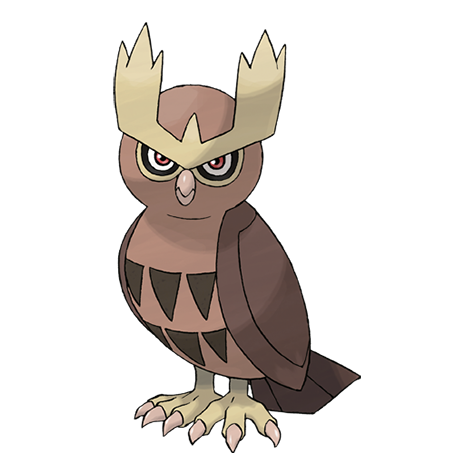
Hoothoot occupies the first stage of a two-stage evolutionary line. It evolves into Noctowl upon reaching level twenty, at which point it gains a considerably larger frame, improved defenses, and noticeably greater special attacking power. As one of the earliest Pokémon encountered on the forest routes of Johto, Hoothoot serves as an accessible introduction to the Normal and Flying type combination for beginning trainers exploring the region for the first time. Researchers have long been fascinated by the biological mechanisms behind Hoothoot's extraordinary sense of timing, and ongoing studies into its neurological structure have contributed to a broader understanding of circadian rhythms in Pokémon physiology. Its consistent nocturnal habits and measurable behavioral patterns make it a model subject for field research, and it continues to attract the attention of scientists and trainers who appreciate both its quiet reliability and its understated strategic potential.