Houndoom
Dark Pokémon
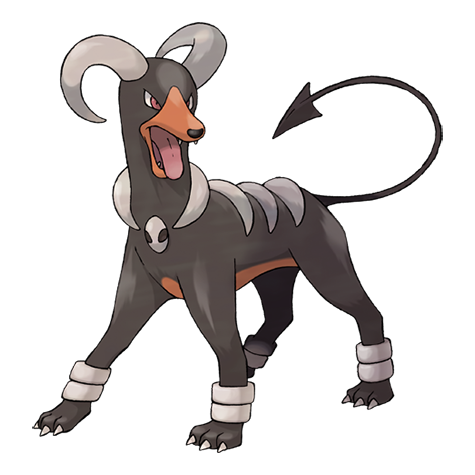
If you are burned by the flames it shoots from its mouth, the pain will never go away.
- Height
- 1.4 m
- Weight
- 35.0 kg
- Base XP
- 175
- Catch
- 45 /255
- Happy
- 35
- Hatch
- 20 steps
- HabitatRough Terrain
- Body shapeQuadruped
- ColourBlack
- Growth rateSlow
- Egg groupsGround
- RarityStandard
Houndoom is the Dark Pokémon, a dual Dark and Fire type that first appeared in the Johto region during the second generation of discovered species. It resembles a sleek, large canine, standing roughly at waist height on an average adult human and built with a lean, muscular frame suited for speed and sustained pursuit. Its body is coated in a deep, matte black, broken by bone-white rings that encircle its torso like exposed ribs visible through the skin. Two long, jagged horns curve sharply backward from its skull, and its tail terminates in a stylized skull-shaped tip that makes it unmistakable at a distance. The inner surface of its ears and the trim around its narrow muzzle glow a vivid orange-red, offering a striking contrast against its otherwise shadowy silhouette. This combination of skeletal motifs and dark coloration gives Houndoom an appearance that communicates danger without ambiguity, a presentation that reflects its temperament and its history as one of the most feared canine-type Pokémon in documented records.
Houndoom favors rough, arid terrain — rocky badlands, dry mountain foothills, and desolate canyon corridors where sparse ground cover provides both shelter and unobstructed sightlines for hunting. Its range spans multiple regions, with populations confirmed across the Johto highlands, stretches of Kalos with comparable climates, and scattered sightings in other areas that share the combination of heat and rocky elevation it prefers. While not exclusively nocturnal, Houndoom tends to increase its activity levels significantly at dusk and into the evening hours, when its dark coat blends naturally into low-light conditions and its fire-based attacks create a more disorienting visual effect on prey and rivals alike. The species is social, organizing itself into structured packs with established territorial boundaries, and solitary individuals are uncommon in the wild. The long, resonant howl Houndoom uses to signal pack members has been documented echoing across entire valleys, and field researchers note that it carries distinctly farther than the calls of most comparable species.
Within a pack, Houndoom observes a clear dominance hierarchy, with disputes over rank resolved through escalating threat displays — prolonged growling, bared fangs, and controlled bursts of flame — rather than sustained physical combat. As hunters, they operate with coordinated efficiency, using flanking patterns to cut off prey and driving targets toward other pack members waiting in the surrounding terrain. The flames Houndoom produces originate from a chemical process in its digestive system, involving compounds that produce a fire unlike ordinary combustion. Burns inflicted by these flames are reported to cause a persistent, deep aching pain that does not fade the way a conventional burn injury would, and this quality has generated considerable unease among people who encounter the species in wild areas. Houndoom that are raised from an early age alongside a trainer typically form close, loyal bonds and show a markedly different temperament from their wild counterparts. Folklore from rural communities in several regions holds that hearing Houndoom howl after nightfall is an omen of misfortune, and cautious travelers have historically taken the sound as a reason to alter their route.
In combat, Houndoom leans strongly toward special offense, with its Fire and Dark type moves forming the core of its attacking output. Its Early Bird ability allows it to wake from sleep status in roughly half the time required by most Pokémon, providing meaningful resistance to one of the most disabling conditions an opponent can inflict. Its Flash Fire ability is tactically more significant still: when a Fire type move connects with Houndoom, it absorbs the attack entirely, taking no damage and instead gaining a lasting boost to the power of its own Fire type moves for the remainder of the battle. This creates a counterintuitive situation where attempting to neutralize Houndoom with Fire attacks can actively strengthen it. Its hidden ability, Unnerve, prevents opposing Pokémon from consuming held Berries during the encounter, cutting off recovery options at moments of high pressure. Houndoom's Speed allows it to act before a wide range of opponents, giving it consistent first-strike capability with its strongest attacks. Its physical bulk, however, is limited, and it carries meaningful vulnerabilities to Fighting, Ground, Rock, Water, Bug, and Fairy type moves — a demanding defensive profile that rewards careful team construction around it.
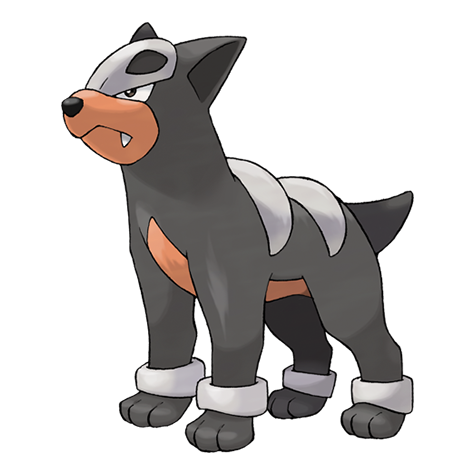
Houndoom is the final stage of a two-member evolutionary line, representing the developed form of Houndour, a smaller canine Pokémon that shares its dual typing, its skull-based markings, and its fire breath but lacks the fully grown horns and distinctive tail ornament. Houndour reaches Houndoom's stage through accumulated battle experience, gaining substantially in size, speed, and special attacking capability as part of that transition. In specific circumstances involving a particular held item, Houndoom can undergo Mega Evolution, a temporary transformation that further heightens its power and alters its physical appearance — elongating its horns, amplifying the intensity of its flames, and sharpening its attacking output to a considerably higher level. Researchers studying the relationship between typing combinations regard Houndoom as a clear demonstration of how Dark and Fire complement each other: the former applies pressure through psychological disruption and coverage against Psychic and Ghost types, while the latter provides raw power and an additional layer of threat. Its striking design and consistent competitive relevance across multiple game generations have secured it a prominent place among the recognized species of the second generation.