Houndour
Dark Pokémon
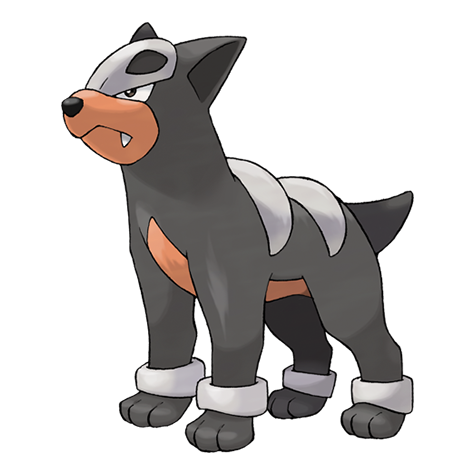
It uses different kinds of cries for communicating with others of its kind and for pursuing its prey.
- Height
- 0.6 m
- Weight
- 10.8 kg
- Base XP
- 66
- Catch
- 120 /255
- Happy
- 35
- Hatch
- 20 steps
- HabitatRough Terrain
- Body shapeQuadruped
- ColourBlack
- Growth rateSlow
- Egg groupsGround
- RarityStandard
Houndour is the Dark Pokémon, classified under both the Dark and Fire types, first introduced in the second generation of Pokémon games set in the Johto region. It is a small quadruped that immediately calls to mind a young, lean canine, standing roughly knee-height to an adult human. Its coat is a deep, uniform black, broken by rust-orange accents that trace rib-like bands across its torso, lending it a skeletal and almost branded appearance. A rounded crest resembling a carved bone sits on its forehead, and a small, blunted horn protrudes from the crown of its head. Its eyes carry a faint reddish glow that gives it a perpetually watchful, predatory expression. A thin, whip-like tail extends behind it, and its slender legs end in sharp claws well suited to rough, uneven ground. Taken together, Houndour presents the unmistakable silhouette of a creature shaped entirely for pursuit.
Houndour favors rough terrain, gravitating toward rocky hillsides, volcanic fields, and the sparse, sun-scorched outskirts of urban settlements where other Pokémon rarely linger. In the Johto region it is most reliably encountered along clifftop roads and barren highland paths after sunset, though comparable populations have since been documented in similarly harsh environments across other regions. It is a social species that travels and rests in tight, coordinated packs, with each group claiming a defined territory that is patrolled attentively through the night, when Houndour is most alert. During the hottest portions of the day, packs typically shelter in rocky hollows or near geothermal vents, drawing in residual heat. Houndour is rarely observed at high elevations or inside dense forest cover, preferring open, exposed ground where its senses of smell and hearing can operate at full advantage.
Houndour is a predator whose success depends less on individual strength than on the sophistication of its pack communication. It produces a wide range of distinct cries, each carrying a specific meaning for the group: some signal the presence and direction of prey, others announce alarm, and still others serve to maintain contact across open terrain at night. Trainers who have spent time near Houndour territory describe the experience of hearing these calls reverberate across bare rock in the dark as genuinely unsettling. Within the pack, loyalty runs deep, and individuals will actively cover for and support injured groupmates during a hunt. Toward unfamiliar humans or Pokémon, Houndour is guarded and territorial, preferring low warning growls and a tightening of pack formation over immediate aggression. Once a trainer earns genuine trust from a Houndour, however, that loyalty shifts fully to the trainer, and it becomes a steadfast and protective partner. It subsists primarily on small wild Pokémon driven down cooperatively by the group.
In battle, Houndour brings two standard abilities and one hidden ability, each offering a different kind of tactical edge. Early Bird cuts the duration of sleep in half, letting it recover from sleep-inducing moves far more quickly than most Pokémon and making it a frustrating target for hypnosis and rest strategies. Flash Fire is its most distinctive combat trait: any Fire-type move aimed at Houndour is completely nullified, dealing no damage, and the absorbed energy instead heightens the force of its own Fire-type attacks for the remainder of the battle, transforming an opponent's Fire users from a threat into an unintended resource. The hidden ability Unnerve prevents opposing Pokémon from eating their held Berries during battle, stripping away a common and often decisive recovery option. Offensively, Houndour relies chiefly on its special attack rather than raw physical power, making Fire-type moves and the broad coverage of Dark-type attacks its primary weapons. Its Dark typing grants a full immunity to Psychic-type moves, a meaningful edge in many matchups, though it must be kept away from Fighting, Ground, Rock, Water, Bug, and Fairy type attacks, all of which deal increased damage against it.
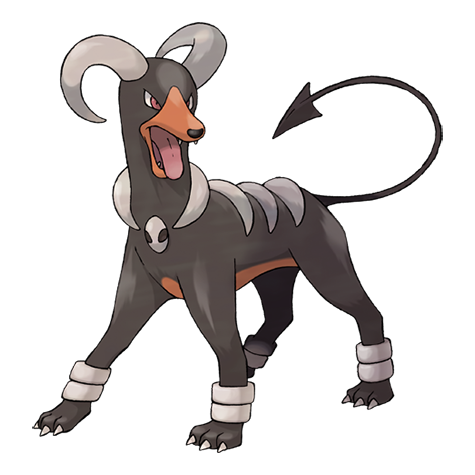
Houndour is the first stage of a two-member evolutionary line, with the considerably more imposing Houndoom waiting at the next step. After accumulating enough experience through battle, Houndour evolves into Houndoom, gaining a dramatic increase in stature and combat power alongside curved black horns and a jagged ring of bone-like spikes encircling its neck. This evolution transforms a coordinated pack hunter into one of the more threatening Dark and Fire type Pokémon available to a trainer in competitive settings. For researchers, Houndour itself is a subject of genuine interest, particularly for the complexity of its vocal communication system and the structured social behavior of its packs. Its dual typing, while not singular in the broader Pokédex, remains a potent and versatile combination, pairing the raw offensive power of Fire with the coverage and immunities that Dark provides. From rocky volcanic ridges to a trainer's side on the road, Houndour endures as one of the most memorable and well-defined species introduced in its generation.