Kabutops
Shellfish Pokémon
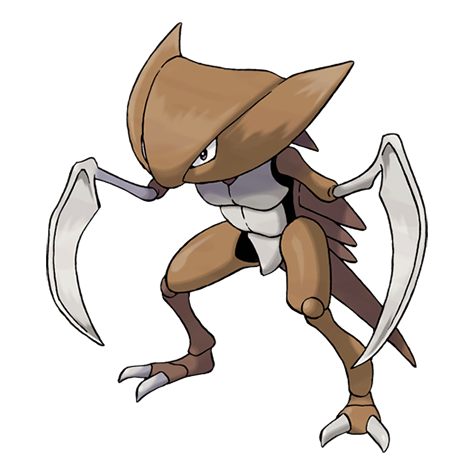
Its sleek shape is perfect for swim ming. It slashes prey with its claws and drains the body fluids.
- Height
- 1.3 m
- Weight
- 40.5 kg
- Base XP
- 173
- Catch
- 45 /255
- Happy
- 70
- Hatch
- 30 steps
- HabitatSea
- Body shapeUpright
- ColourBrown
- Growth rateMedium
- Egg groupsWater1, Water3
- RarityStandard
Kabutops is a Rock and Water type Pokémon classified as the Shellfish Pokémon, first documented among the original generation of discovered species. It is a creature restored from ancient fossil records, and it stands in an upright posture on two hind limbs, presenting a silhouette unlike almost any living Pokémon found today. The body is largely brown and features a broad, flat oval carapace covering the torso, beneath which a pale, segmented underbody is exposed. Two elongated, blade-like scythes extend from where forelimbs would be on a more conventional creature, and these curved cutting appendages are among its most immediately recognizable features. A narrow, insectoid head sits atop the carapace, with deep-set eyes that suggest acute sensory awareness. Standing at roughly the height of an average human child, Kabutops is compact yet imposing, its streamlined build reflecting millions of years of evolution optimized for predatory efficiency in ancient seas.
Kabutops is a sea-dwelling Pokémon by origin, and modern specimens restored from fossils retain a strong affinity for aquatic environments, particularly warm coastal shallows, rocky ocean floors, and tidal zones. In the wild, living populations are exceedingly rare, existing only where Dome Fossils have been revived through scientific restoration. Fossil evidence suggests ancestral populations ranged across prehistoric ocean basins, favoring environments with abundant prey and access to rocky crevices for concealment. Revived individuals tend to haunt areas near water, whether oceanic shorelines or deep lakebeds, and generally prefer to remain submerged or partially submerged during the brightest hours of the day. Kabutops is a solitary predator and does not form groups, with individuals maintaining wide territorial ranges to ensure adequate hunting grounds. Specimens are observed to become notably more active during overcast conditions and rainfall, which trainers attribute to the species' deep instinctual ties to its ancient marine origins.
Kabutops is an apex predator built entirely around the act of hunting. It pursues prey through the water with remarkable agility, its hydrodynamic body cutting through currents with minimal resistance. Upon closing on a target, it uses its scythe-like forelimbs to slash and immobilize prey, then draws out the body fluids directly, a feeding method that is both efficient and swift. This makes Kabutops particularly lethal against soft-bodied aquatic prey. On land, it moves in an upright, bipedal manner that is steady and deliberate, though it clearly favors water when giving chase. Toward humans, freshly revived Kabutops are often unsettled at first, requiring patient handling before they acclimate to a trainer's presence. Field researchers consistently note a fierce independence in temperament: Kabutops does not readily submit to external direction and tends to act on deep predatory instinct the moment it detects the movement or scent of prey nearby.
In combat, Kabutops operates as a powerful physical attacker with formidable natural armor. Its standard ability, Swift Swim, doubles its movement speed whenever rain falls over the battlefield, transforming it from a moderately quick combatant into a genuinely threatening sweeper capable of outpacing far faster opponents in wet conditions. Battle Armor, its alternative standard ability, prevents opponents from landing critical hits, providing a layer of defensive reliability during prolonged exchanges. Its hidden ability, Weak Armor, trades defensive integrity for raw speed: each time a physical blow connects, Kabutops sacrifices some of its natural plating resilience in exchange for greater swiftness, a high-risk approach that can shift momentum dramatically when timed correctly. Its Rock and Water dual typing allows for broad offensive coverage, and its considerable physical attack strength means well-trained specimens strike with devastating force. That same typing brings notable vulnerabilities to Fighting, Ground, Steel, Water, Grass, and Electric moves, so trainers must account carefully for matchup disadvantages, particularly in contests against Grass and Electric opponents.
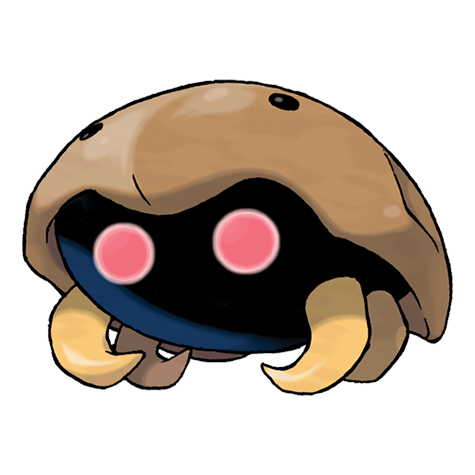
Kabutops is the final stage of a two-stage evolutionary line that begins with Kabuto, a smaller and more heavily armored arthropod that characteristically rests with its shell facing upward along the seafloor. Kabuto reaches sufficient maturity to evolve into Kabutops through leveling, at which point its body elongates, it rises onto two limbs, and its forelimbs develop into the distinctive bladed scythes that define the adult form. Both forms are revived exclusively from the Dome Fossil, an ancient artifact recovered from certain mountain cave environments. As one of the original fossil Pokémon recorded by researchers, Kabutops holds genuine paleontological significance: scientists study it to understand how ancient marine arthropods may have begun the transition from purely aquatic lifestyles toward amphibious and eventually terrestrial behavior. For trainers, Kabutops represents a demanding yet rewarding partnership, requiring specific team conditions to reach its potential but capable of exceptional performance, especially in rain-based compositions where Swift Swim allows it to reclaim its ancient identity as one of the prehistoric seas' most formidable hunters.