Kabuto
Shellfish Pokémon

A POKéMON that was resurrected from a fossil found in what was once the ocean floor eons ago.
- Height
- 0.5 m
- Weight
- 11.5 kg
- Base XP
- 71
- Catch
- 45 /255
- Happy
- 70
- Hatch
- 30 steps
- HabitatSea
- Body shapeArmor
- ColourBrown
- Growth rateMedium
- Egg groupsWater1, Water3
- RarityStandard
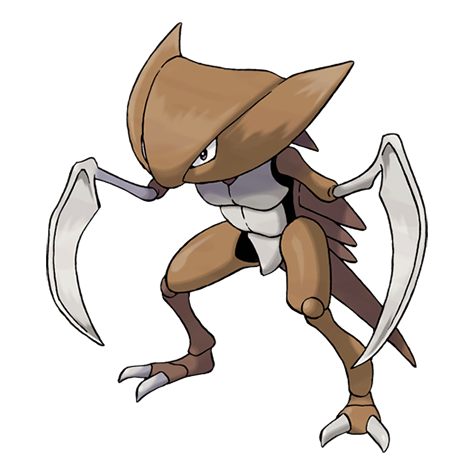
Kabuto is the Shellfish Pokémon, a dual Rock and Water type that originates from the first generation of discoveries in the Kanto region. It is a fossil Pokémon, meaning it does not occur in nature through ordinary reproduction but is instead brought back to life through advanced scientific techniques applied to ancient fossilized remains. Its body is dominated by a broad, domed carapace the color of dark earth, hard and slightly ridged across its surface. Viewed from above, Kabuto resembles a large rounded shield or helmet — the name itself echoes the Japanese word for a warrior's helmet — and when placed beside a human it would sit comfortably in an open palm, roughly the size of a large dinner plate. Flip it over, however, and the underside reveals a very different character: a pale underbelly equipped with small articulated legs, two sets of grasping appendages, and a pair of deep red compound eyes that glow faintly, giving the creature an otherworldly, ancient look that few Pokémon can match.
When Kabuto lived freely in the prehistoric world, it inhabited shallow coastal seas and tidal flats, clinging to rocky substrates along the ancient ocean floor. Today, the rare specimens that are revived and later released — or the even rarer wild populations that researchers claim have persisted unchanged in remote and unexplored stretches of sea — tend to seek out similar environments: rocky shorelines, shallow reefs, and the calm waters beneath tidal overhangs. The species appears most comfortable in cool, temperate marine zones, and it seems to prefer areas where the seafloor offers loose sediment in which it can partially bury itself. Kabuto is not a migratory Pokémon in any documented sense and does not form large schools or aggregations. Most field observations suggest it is a solitary creature outside of the brief pairing that occurs during the reproductive season, spending the bulk of its time foraging slowly across the substrate in low-light conditions.
Kabuto is primarily a bottom-dweller, most active during the dimmer hours of early morning and evening when the light filtering through shallow water is low enough to suit its large and sensitive eyes. It feeds by scraping algae and small invertebrates from rock surfaces and filtering organic matter from the sediment, a feeding strategy unchanged from the one employed by its prehistoric ancestors. When threatened, it pulls its legs and appendages underneath its shell and drops flat against the seafloor, presenting nothing but that impenetrable dome to whatever disturbs it. Trainers who have handled revived Kabuto note that the species is not aggressive toward humans, though it will pinch firmly if it feels cornered. Field researchers describe an instinctive wariness, a tendency to freeze and flatten that likely served the original population well against the large predators of its era. Young Kabuto are observed to stay very close to the rocky bottom, rarely venturing into open water.
In battle, Kabuto draws on one of two standard abilities depending on the individual. Swift Swim doubles the Pokémon's movement speed during rainfall, turning an otherwise moderate pace into a startling burst of agility that can catch opponents off guard, making Kabuto a natural partner for rain-oriented strategies where the weather field is kept active. Battle Armor, the alternative ability, ensures that no incoming strike can land as a critical hit, a quietly powerful defensive trait that adds consistency to extended engagements. Its hidden ability, Weak Armor, takes a different and riskier path: each time a physical blow connects, the integrity of the shell decreases slightly but the creature's limbs move faster, trading a measure of physical resilience for increasing speed. The Rock and Water typing together carry notable weaknesses to Grass, Electric, Fighting, Ground, Steel, and Water-based attacks, but they also grant meaningful resistance to Normal, Fire, Flying, Ice, and Poison moves. Kabuto's shell offers substantial physical defense and its claws carry genuine striking power, making it most effective as a physically oriented attacker that rewards careful positioning and weather support.
Kabuto occupies a singular position in the Pokédex as one of the original fossil Pokémon encountered in Kanto, obtained by presenting the Dome Fossil to the research facility on Cinnabar Island, where scientists use preserved genetic material to restore what would otherwise be lost forever. It has no pre-evolution; its story begins at revival and ends with transformation. Given sufficient experience and growth, Kabuto evolves into Kabutops, a far more imposing predator with elongated scythe-like forelimbs and a sleeker, more aggressive frame suited for active pursuit rather than passive defense. The relationship between the two illustrates one of the more dramatic physical transformations in the Pokédex, from armored opportunist to swift and formidable hunter. For researchers, Kabuto represents an invaluable window into prehistoric marine ecosystems, a living record of forms and survival strategies that flourished hundreds of millions of years before any known human civilization, and the subject of ongoing study into what early life in the Pokémon world truly looked like.