Omastar
Spiral Pokémon
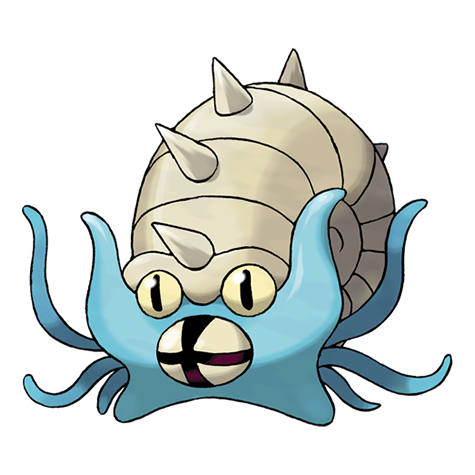
A prehistoric POKéMON that died out when its heavy shell made it impossible to catch prey.
- Height
- 1.0 m
- Weight
- 35.0 kg
- Base XP
- 173
- Catch
- 45 /255
- Happy
- 70
- Hatch
- 30 steps
- HabitatSea
- Body shapeTentacles
- ColourBlue
- Growth rateMedium
- Egg groupsWater1, Water3
- RarityStandard
Omastar is a dual Rock and Water type Pokémon that originates from the first generation, revived from ancient fossil remains. It belongs to the Spiral Pokémon category, and its design draws unmistakably from the prehistoric ammonite, a shelled cephalopod that once populated the ancient seas. The body of Omastar is a deep blue-gray, dominated by a massive coiled shell that spirals outward in heavy whorls of cream and tan. Beneath this enormous shell, a collection of tentacles fans outward, ten in total, each one flexible and strong, tipped with fine gripping points. At the center of the tentacle mass sits a sharp, fang-like beak capable of exerting tremendous crushing force. In terms of size, Omastar stands roughly at the height of a small child, though its shell makes it appear significantly larger and far more imposing. The sheer mass of that shell is one of the most defining features of this species, both structurally and ecologically, shaping nearly every aspect of how this Pokémon lives and moves.
Omastar inhabited ancient shallow seas during the prehistoric era, and fossils of this species have been recovered from marine rock strata across many regions of the known world. In the modern era, Omastar exists only because of fossil revival technology that reconstitutes living specimens from genetic material preserved within the Helix Fossil. Once revived, these Pokémon are best suited to coastal and deep-water marine environments, where they can anchor themselves to rocky seafloor terrain or move slowly through shallow reef formations. They tend not to range widely once they settle into a suitable location, preferring the stability of familiar rocky substrate over open water. Omastar is generally solitary, since competition for food in its preferred niche does not favor large groups. No migration behavior has been documented, and observations suggest that individuals are most active during cooler hours, moving less during warmer periods when the additional metabolic demands of sustained activity exceed the energy available from easily accessible prey.
Omastar is a slow but methodical predator. Its primary method of hunting involves using its tentacles to seize prey, typically shellfish, hard-bodied invertebrates, and smaller aquatic creatures, and then deploying its powerful beak to crush through shells and exoskeletons with precision. Early records note that Omastar once used this technique with great success in ancient ecosystems, but as its shell grew progressively heavier over the course of an individual's lifetime, the added mass made it increasingly difficult to pursue or capture mobile prey. This is the condition widely believed to have contributed to the original extinction of the species in the wild, a kind of evolutionary dead-end in which survival instincts favored shell growth while the capacity for locomotion steadily declined. Toward humans, revived Omastar specimens tend to be calm and somewhat indifferent, lacking the social conditioning of species raised across many generations in trainer relationships. Field observers note that these Pokémon communicate through subtle movements of their tentacles and deliberate shifts in posture, rather than through vocalizations.
In battle, Omastar brings a striking combination of very high Special Attack and exceptional physical Defense to the field. Its Rock and Water typing grants resistance to several common attack categories including Normal, Fire, Flying, Poison, and Ice, while leaving it vulnerable to Fighting, Ground, Steel, Electric, Grass, and opposing Water attacks. Its first standard ability, Swift Swim, doubles its movement speed during rainfall, transforming it from one of the slower competitors on the field into a genuinely threatening offensive presence. This makes Omastar a natural partner for rain-setting strategies, where weather support removes its speed disadvantage while its Special Attack allows it to fire devastating Water and Rock based moves. Its second standard ability, Shell Armor, prevents opponents from ever landing a critical hit, providing consistent and reliable defensive bulk over the course of a long battle. The hidden ability, Weak Armor, introduces a higher-risk dynamic: each physical hit absorbed triggers a drop in Defense alongside a boost to Speed, a calculated gamble that can shift momentum significantly under the right circumstances.
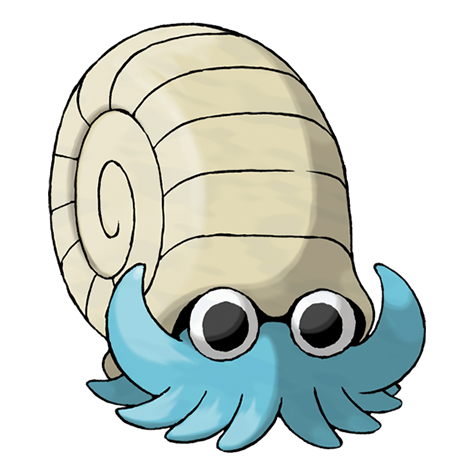
Omastar is the final evolved form of Omanyte, the small tentacled ammonite revived from the Helix Fossil. Omanyte evolves into Omastar upon reaching level forty through training, and the transition brings a marked increase in size, shell mass, and overall offensive power. No further evolution exists beyond Omastar. As a fossil Pokémon, Omastar holds considerable interest for researchers studying prehistoric ecosystems, because the biological data encoded in its genetic material offers clues about the aquatic environments and food chains of the deep past. The species also represents a compelling case study in evolutionary dynamics, illustrating how a single trait, in this case the progressive growth of a heavy protective shell, can develop in ways that ultimately undermine an organism's ability to survive in a changing environment. For trainers, Omastar remains a sought-after special attacker, prized for its unusual combination of high offensive power and solid physical durability. Its effectiveness in competitive settings tends to rise when rain support is available, and under those conditions, few fossil Pokémon rival the threat it poses.