Kangaskhan
Parent Pokémon
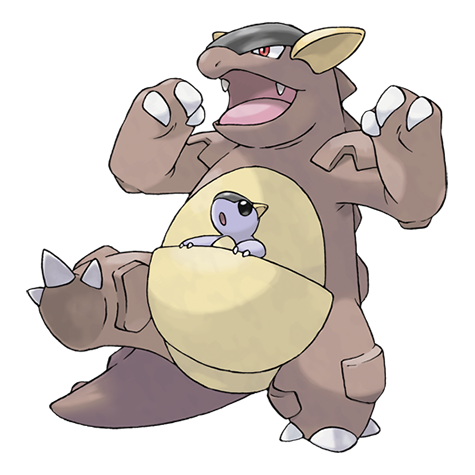
The infant rarely ventures out of its mother's protective pouch until it is 3 years old.
- Height
- 2.2 m
- Weight
- 80.0 kg
- Base XP
- 172
- Catch
- 45 /255
- Happy
- 70
- Hatch
- 20 steps
- HabitatGrassland
- Body shapeUpright
- ColourBrown
- Growth rateMedium
- Egg groupsMonster
- RarityStandard
Kangaskhan is a Normal-type Pokémon introduced in the first generation, officially classified as the Parent Pokémon. It is a large, bipedal species with a distinctly mammalian silhouette that evokes a kangaroo, standing roughly as tall as a grown adult human or a measure taller. Its body is covered in a warm, sandy-brown hide that fades to a paler, cream-toned surface across the belly and inner limbs. Two rounded ears sit atop its broad head, and a short blunt horn protrudes from its snout. Its most immediately recognizable feature is the deep abdominal pouch it carries at all times, which is never found empty — a small joey bearing its own tiny horn always peers out from within, making this species unique in that the infant is considered an inseparable part of every adult observed in the wild. A thick, muscular tail extends behind the body to provide balance during movement, while the forelimbs end in powerful, clawed hands suited equally for foraging and striking.
Kangaskhan makes its home in open grasslands and warm savanna-like territories where it can move freely and maintain clear sightlines across wide stretches of ground. It favors climates with steady warmth and enough low vegetation to support regular foraging, often settling near the edges of scrubland where sparse brush offers partial cover without obstructing the open space it prefers. In many regions it is considered a rare and elusive find; early trainers most commonly encountered this species within the protected grounds of the Safari Zone, where it roamed alongside other large and uncommon Pokémon under wildlife sanctuary conditions. Kangaskhan is broadly solitary by temperament, with each adult patrolling a loosely defined home range at an unhurried pace. Multiple individuals may share overlapping territories without significant conflict as long as no young are threatened. It is a diurnal species, most active during daylight hours when visibility is high and foraging most productive.
Kangaskhan is a forager that browses on grasses, leaves, roots, and low vegetation, occasionally supplementing its diet with insects or other small prey when plant matter is scarce. It is perhaps most famous for its parental bond, and the relationship between an adult Kangaskhan and the joey in its pouch is among the most studied parent-and-offspring connections in the field of Pokémon biology. The infant does not leave the pouch voluntarily until it is approximately three years old, spending that entire developmental period sheltered against the adult's body and learning to observe the world from a position of complete safety. When the adult senses danger, its first reflex is to press its forearms over the pouch and position itself firmly between the threat and the young. Despite this fierce protective instinct, Kangaskhan is not inherently aggressive toward humans or other Pokémon that keep a respectful distance. Field researchers consistently note that unprovoked attacks are rare, but any action that appears directed at the pouch will draw an immediate and forceful defensive response. Communication between individuals involves low rumbling vocalizations and deliberate posture displays rather than overt confrontation.
In battle, Kangaskhan relies on two standard abilities and one hidden ability, each meaningfully shaping its role. Early Bird causes any sleep-inducing effect placed on Kangaskhan to expire in roughly half the usual duration, making it considerably harder to neutralize through hypnotic moves or sleep-inducing spores. The second standard ability, Scrappy, removes the immunity that Ghost-type Pokémon normally hold against Normal and Fighting-type attacks, allowing Kangaskhan to land its physical strikes on targets that would otherwise be entirely untouchable by those move categories. Its hidden ability, Inner Focus, prevents Kangaskhan from flinching under any circumstance, ensuring that fast opponents relying on high-flinch-rate moves cannot disrupt its attacks mid-turn. As a purely Normal-type species it carries no offensive type advantages, but its defensive profile is largely neutral against the type chart, with its sole weakness being Fighting-type moves. Its combat strengths lie in substantial endurance paired with strong physical output, making it a durable frontline presence capable of absorbing punishment while dealing consistent damage. Its moderate speed positions it ahead of bulkier opponents but leaves it unable to reliably outpace the fastest offensive threats in a given field.
Kangaskhan occupies a singular position in its evolutionary line because it does not evolve from any prior form and does not progress further under standard conditions, standing alone as a complete species at every stage of a trainer's career. This places it among a small number of fully independent single-stage species present since the original generation, a status that has kept it both recognizable and somewhat enigmatic. The question of the joey's fate has long intrigued researchers, who continue to debate whether the infant in the pouch eventually grows into the next generation of adults or whether the two represent phases of a continuous individual life cycle. In the sixth generation, Kangaskhan gained access to a Mega Evolution form in which the joey emerges from the pouch to fight alongside the adult under the ability Parental Bond, striking twice with each attack it executes. This transformation briefly made Kangaskhan one of the most competitively prominent species in the entire game, bringing renewed attention to a Pokémon that had otherwise occupied a respected but understated place in the roster for decades. For trainers and researchers alike, this species remains a vivid study in parental instinct, and its unbroken presence in the franchise since its very first appearance reflects both the power of its design and the enduring resonance of the bond between a parent and its young.