Krabby
River Crab Pokémon
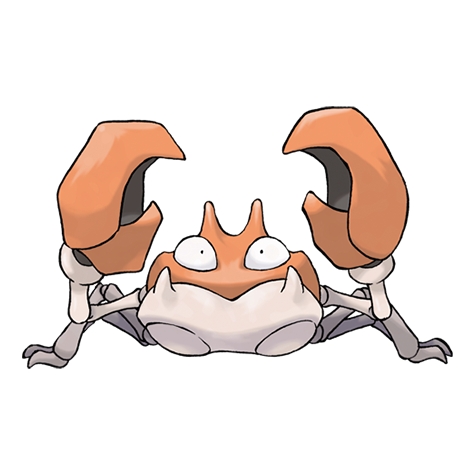
Its pincers are not only powerful weapons, they are used for balance when walking sideways.
- Height
- 0.4 m
- Weight
- 6.5 kg
- Base XP
- 65
- Catch
- 225 /255
- Happy
- 70
- Hatch
- 20 steps
- HabitatWaters Edge
- Body shapeArmor
- ColourRed
- Growth rateMedium
- Egg groupsWater3
- RarityStandard
Krabby is the River Crab Pokémon, a pure Water-type species first catalogued during the original generation of Pokémon research. Its body is enclosed in a hard, bright red exoskeleton common to crustacean life forms, with a broad, domed carapace resting above a cluster of jointed legs arranged for sideways movement. The most immediately striking feature is its pair of large pincers, which appear almost comically oversized against such a compact frame. Krabby stands only a small fraction of an adult human's height and could fit comfortably in two cupped hands, though trainers who attempt that without caution tend to regret it immediately. Its eyes sit on short stalks above a flat, forward-facing face, lending the species that alert and watchful expression that field researchers have come to associate with crustacean-type Pokémon in general.
Krabby favors the marginal zones where fresh or salt water meets land, making its home along shallow riverbeds, sandy beaches, tidal pools, and rocky shorelines. It is particularly well documented in the coastal routes and waterways of the Kanto region, where populations cluster wherever the water is clean and well-oxygenated and soft substrate is available for burrowing. Similar populations appear in other regions wherever comparable habitat exists, though density varies considerably with water quality and the availability of prey. Krabby is predominantly active during daylight hours, retreating to burrows dug beneath rocks or into sandy banks when night falls or when the tide drops sharply. Outside of the mating season it is a solitary creature, and individual adults hold and actively defend small feeding territories through pincer displays and brief physical contests with any rival that encroaches.
Krabby is an opportunistic omnivore, feeding on small aquatic invertebrates, algae, organic debris, and the occasional smaller fish that ventures too close to its hiding spot. It uses its pincers to crack open shellfish, grip struggling prey, and sift through sediment along the water's edge. Those same pincers serve a second and equally important function as counterweights and stabilizers for the sideways gait that defines Krabby's movement; an individual that has lost or badly damaged one pincer moves with visible difficulty, which explains the species' strong instinct to protect its claws above nearly everything else. In interactions with humans, Krabby is wary rather than aggressive, raising its pincers in a wide defensive display when approached but not initiating attacks without provocation. Trainers who earn one's trust report that Krabby channels its territorial instincts toward protecting its trainer with the same vigilance it normally directs at guarding its feeding ground.
Krabby's battle profile is defined by its exceptional physical attack strength, which far outpaces what most observers would expect from a Pokémon at this stage of development. Its first standard ability, Hyper Cutter, ensures that no opposing move or Pokémon can reduce its attack power, making it immune to intimidation effects and stat-lowering techniques that would otherwise blunt its offensive output. Its second standard ability, Shell Armor, prevents opponents from ever landing a critical hit, removing the random element of a lucky strike ending a match before Krabby can respond. The hidden ability Sheer Force takes a more aggressive approach, amplifying the raw power of moves that normally carry secondary effects to impressive levels while forfeiting those secondary effects entirely. As a Water type, Krabby is at a disadvantage against Grass and Electric opponents and takes increased damage from both. Its physical defense is solid, but its special defense and speed are limited, leaving it exposed to fast or specially oriented attackers. Trainers deploy it most effectively as a hard-hitting physical presence in situations where it can land powerful strikes before those vulnerabilities can be exploited.
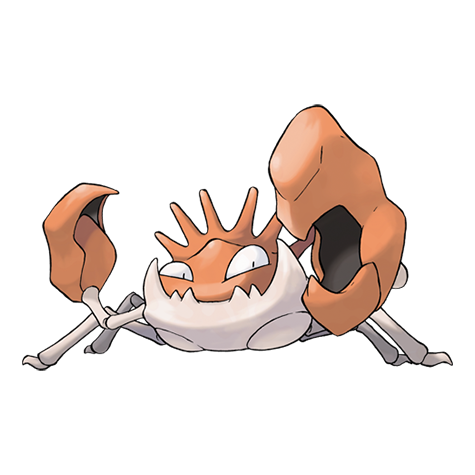
Krabby is the first stage of a two-part evolutionary line, growing into the considerably larger and more powerful Kingler once it accumulates sufficient battle experience, a transition that typically occurs around level twenty-eight. The change into Kingler brings dramatic increases in both size and combat capability, particularly in the pincers, which grow to an almost extraordinary scale that clarifies the direction the line was always heading. Within the broader Pokédex, Krabby holds a familiar position as an early Water-type encounter for trainers passing through coastal and riverine areas of Kanto and beyond, often among the first aquatic species a new trainer meets on their journey. Researchers studying crustacean Pokémon physiology have examined Krabby with particular interest because its pincer structure represents an unusually transparent example of a single appendage fulfilling dual roles in locomotion and combat at the same time. For trainers, it is a reliable early investment whose attack potential is quietly exceptional and whose evolutionary path rewards patience with one of the more formidable physical Water-types available in the earlier tiers of competition.