Magmar
Spitfire Pokémon
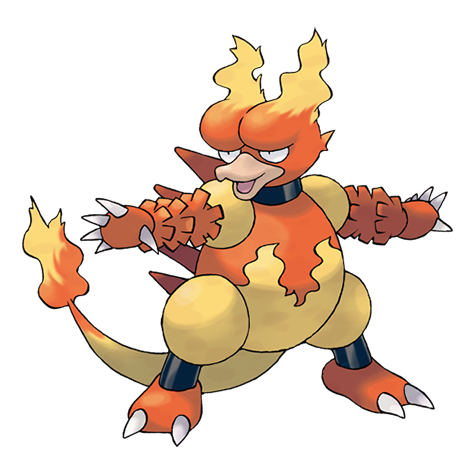
Its body always burns with an orange glow that enables it to hide perfectly among flames.
- Height
- 1.3 m
- Weight
- 44.5 kg
- Base XP
- 173
- Catch
- 45 /255
- Happy
- 70
- Hatch
- 25 steps
- HabitatMountain
- Body shapeUpright
- ColourRed
- Growth rateMedium
- Egg groupsHumanshape
- RarityStandard
Magmar is a pure Fire-type Pokémon classified as the Spitfire Pokémon, first encountered by trainers exploring the volcanic mountains of the Kanto region during the earliest generation of recorded Pokémon research. It stands at roughly the height of a compact adult human, with a stocky, upright bipedal build that places it comfortably in the humanoid silhouette class. Its body is a vivid red-orange, overlaid with bold yellow flame-shaped markings that streak across its limbs and torso, giving it the permanent appearance of something already on fire. The face is among its most recognizable features: a pronounced, rounded beak-like snout flanked by bright yellow coloring, and a spiked flame-shaped crest rising from the top of its head. Its forked tail ends in a living flame that burns continuously, and its entire surface radiates tremendous heat at all times. The Pokédex has long noted that Magmar's body glows with an orange luminescence so consistent and intense that the creature can vanish almost completely when standing inside an active fire.
Magmar makes its home in the steep and often inhospitable terrain of volcanic mountains, preferring areas where geothermal activity brings heat close to the surface. It favors the rocky slopes and lava-scarred foothills that form around active or dormant volcanic peaks, where vents and fissures in the earth release steady plumes of superheated gas. In the Kanto region it has historically been associated with the environs near Cinnabar Island and the fiery interior of Mount Ember in the Sevii Islands, though similar habitats across other regions host comparable populations. Magmar tends to be a solitary creature, claiming stretches of thermally active terrain as personal territory and showing little tolerance for trespassers of most species. It is more active during the hottest parts of the day and in low-light conditions near glowing lava flows, where its radiant body helps it remain effectively camouflaged. Population density varies considerably; areas with sustained volcanic output support loose concentrations, while dormant zones may house only isolated individuals separated by considerable distances.
In the wild, Magmar sustains its internal temperature by regularly absorbing ambient heat from volcanic vents and geothermal pools, behaviors that researchers believe are less about nutrition and more about thermal regulation. It breathes jets and gouts of flame both as a hunting tool and as its primary means of communication with others of its kind, modulating the intensity and rhythm of its fire breath to signal aggression, territory, or reproductive interest. Toward humans it is generally wary rather than immediately hostile, but it responds to perceived threats with fast and vicious fire attacks, and the heat radiating from its skin discourages any casual physical contact. Trainers who have worked with Magmar in the field report that it develops strong bonds with handlers who demonstrate patience and an understanding of its thermal needs, becoming a fiercely loyal partner once trust is established. Nesting behavior involves selecting naturally hot crevices in volcanic rock where ambient temperatures keep the nest warm without any additional effort from the parent.
In battle, Magmar is a special-oriented attacker whose strength lies in its exceptional special attack output and above-average speed, allowing it to strike hard and often before many opponents can respond. Its most commonly observed ability, Flame Body, is both a defensive deterrent and an offensive advantage: any Pokémon that makes direct physical contact with Magmar risks being burned by the intense heat radiating from its skin, punishing close-range fighters and discouraging repeated physical strikes. Some Magmar possess the rarer Vital Spirit ability as a hidden trait, which keeps them alert and immune to sleep-inducing moves — a meaningful advantage against opponents who rely on status conditions to swing a fight. As a pure Fire type, Magmar deals super-effective damage to Grass, Ice, Bug, and Steel opponents, while its own typing leaves it exposed to Water, Rock, and Ground attacks. Its relatively thin physical defense means it prefers to end confrontations quickly rather than sustain prolonged exchanges with physically dominant opponents.
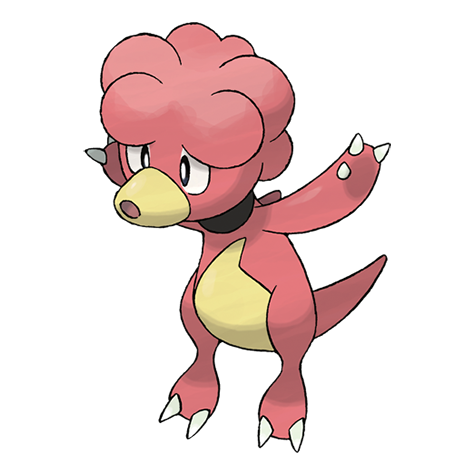
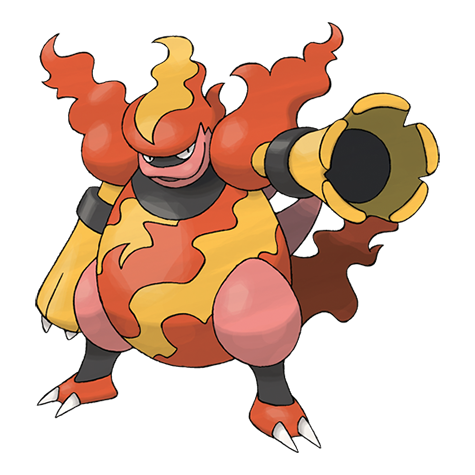
Magmar occupies the middle position in a three-stage evolutionary line. It develops from Magby, a small baby Pokémon introduced during the second generation of research, which matures into Magmar after reaching a sufficient level of growth and experience. Magmar itself can evolve further into Magmortar, a larger and significantly more powerful Fire-type introduced during the fourth generation of study; this final evolution requires Magmar to be traded to another trainer while holding a Magmarizer, a rare held item associated with intense heat amplification. Its place in the evolutionary line makes Magmar a subject of considerable interest to researchers studying how Fire-type biology scales and intensifies across developmental stages. For competitive trainers it represents a capable mid-evolution battler in its own right, valued for the combination of speed, special firepower, and the punishing contact deterrent of Flame Body before the additional power of its final form becomes available.