Magby
Live Coal Pokémon
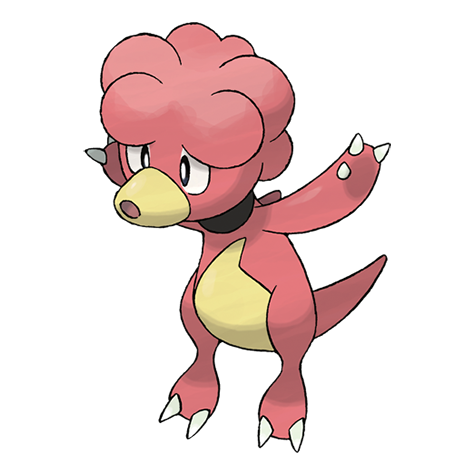
Each and every time it inhales and exhales, hot embers dribble out of its mouth and nostrils.
- Height
- 0.7 m
- Weight
- 21.4 kg
- Base XP
- 73
- Catch
- 45 /255
- Happy
- 70
- Hatch
- 25 steps
- HabitatMountain
- Body shapeUpright
- ColourRed
- Growth rateMedium
- Egg groupsNo Eggs
- RarityBaby
Magby is the Live Coal Pokémon, a pure Fire-type introduced during the second generation of the main series and belonging to the rare class of species designated as baby Pokémon. It stands upright on two stout legs, proportionally about the size of a small child relative to an average human, with a compact, rounded body coloured in deep red and orange, accented by yellow striping across the torso and upper limbs. Its head tapers to a slightly pointed crown, and its face is dominated by a broad, beak-shaped mouth that sits permanently agape. The most immediately striking feature of Magby is that its internal flame burns continuously, producing enough heat that glowing embers drift from both its mouth and nostrils with every single breath it takes. Even at rest, this thermal activity never fully subsides, making Magby a creature that is always, in the most literal sense, smouldering.
Magby makes its home in mountainous terrain, gravitating toward volcanic slopes, rocky ridges, and locations where geothermal heat vents naturally from the earth below. It is most reliably encountered in regions where active or recently active volcanic geology warms the surrounding rock and keeps the air dry, an environment that complements its fire-dependent physiology perfectly. As a baby Pokémon, Magby can only appear in the wild under very particular circumstances, which keeps wild populations sparse and encounters genuinely uncommon. Those individuals that do live freely tend to shelter in narrow rock crevices and lava-warmed caves close to parent Magmar, rarely venturing far without the company of a more experienced member of their line. Magby is most active during the cooler hours of morning, when the contrast between its radiant body heat and the colder mountain air is sharpest and most immediately apparent to observers.
Magby sustains itself by drawing energy from extreme heat, instinctively seeking out lava flows, sun-baked volcanic stone, and any environment where ambient temperatures climb well above what most living creatures could tolerate. It is an energetic and restless Pokémon by temperament, prone to fidgeting and bursts of movement that send embers scattering in unpredictable directions. Any surface that Magby rests against for more than a brief moment risks discolouration or scorching, and trainers who raise young Magby quickly learn to keep flammable materials at a safe distance. Toward humans, the species is not hostile, but its sheer exuberance and poor control over its own thermal output make it a handful for inexperienced handlers. Field researchers report that Magby communicate with one another through the rhythm and intensity of their ember bursts, functioning as a form of thermal signalling that conveys mood and alertness. Nesting occurs deep within rock formations and geothermal cavities, where consistent heat provides the conditions the young require.
In battle, Magby carries two notable abilities. Its standard ability, Flame Body, means that any opposing Pokémon making physical contact with Magby risks walking away with a burn, a condition that steadily saps the attacker's strength and whittles down their health over time. This turns Magby into a surprisingly punishing target for Pokémon that rely on direct physical strikes. Its hidden ability, Vital Spirit, renders Magby entirely immune to sleep-inducing moves, ensuring that techniques designed to put Pokémon to sleep have no effect on it whatsoever. As a pure Fire type, Magby resists the energy of Fire, Grass, Ice, Bug, Steel, and Fairy-type attacks, but Ground, Rock, and Water-type moves strike it with compounded force. Its speed for a Pokémon at its stage is notably quick, often allowing it to act before many opponents it faces. Its offensive tendencies lean modestly toward physical exchanges, though its special attack capability is not far behind. With limited defensive bulk, Magby performs best in short, aggressive encounters where Flame Body can deter physical attackers from pressing the advantage.
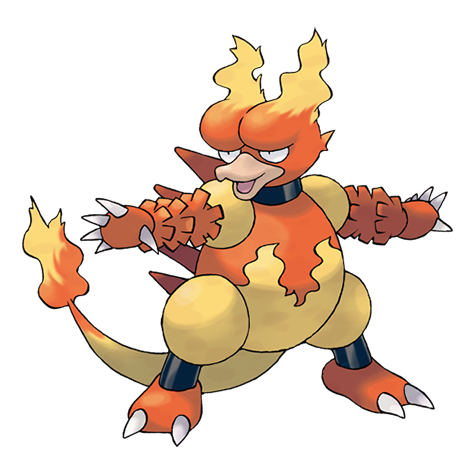
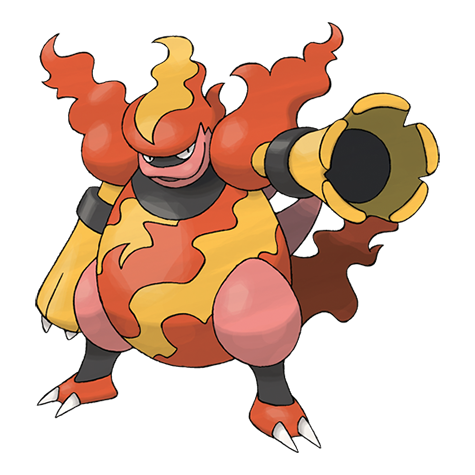
Magby anchors the beginning of a three-stage evolutionary line. It evolves into Magmar upon reaching level thirty, gaining substantially in size, power, and raw thermal output. Magmar itself can then evolve into Magmortar, the final and most formidable form in the line, but only when traded to another trainer while holding a held item called the Magmarizer, a mechanism that makes the final evolution a cooperative endeavour by design. This trading requirement has long made Magmortar a symbol of the social dimension of Pokémon training. Beyond its combat utility, Magby is particularly valued by breeders, because its Flame Body ability is known to accelerate the hatching of Pokémon eggs, making it a practical companion in any breeding programme. For researchers who study thermoregulatory biology and the development of Fire-type physiology, Magby offers a rare glimpse into the earliest and most formative stage of a line whose adults rank among the most thermally powerful Pokémon in the known world.