Muk
Sludge Pokémon
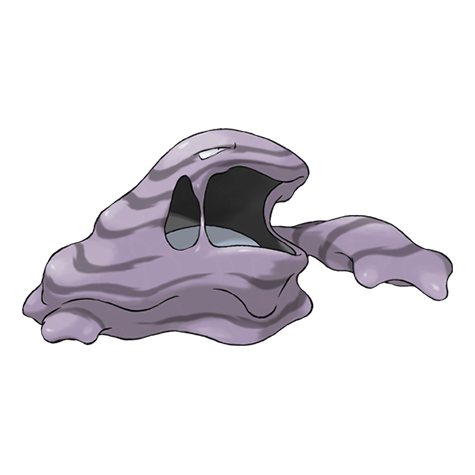
Thickly covered with a filthy, vile sludge. It is so toxic, even its footprints contain poison.
- Height
- 1.2 m
- Weight
- 30.0 kg
- Base XP
- 175
- Catch
- 75 /255
- Happy
- 70
- Hatch
- 20 steps
- HabitatUrban
- Body shapeArms
- ColourPurple
- Growth rateMedium
- Egg groupsIndeterminate
- RarityStandard
Muk is the Sludge Pokémon, a pure Poison-type species that was among the first generation of Pokémon formally catalogued. Its body is a massive, amorphous heap of toxic sludge with no fixed skeleton or rigid frame, allowing it to spread and shift across surfaces in a slow, oozing mass. Muk stands roughly as tall as an adult human when it rears its body upward, though at rest it tends to spread into a wide, low mound. Its coloration is a deep, mottled purple, darkening toward its center and lightening to a brighter violet at the edges, like an ink stain spreading across stone. Two round eyes sit near the top of its form, and thick, irregular appendages extend from its sides in place of arms. Every surface glistens with a continuously secreted toxic discharge, and the ground it passes over retains traces of venom long after the creature has moved away.
Muk is most commonly found in urban and industrial environments, gravitating toward locations where waste accumulates in large quantities, including sewers, refuse dumps, polluted riverbanks, and the outskirts of heavily populated cities. In Kanto, where it was first documented, it is well established across industrial zones and neglected urban areas. It has since been observed in similarly degraded environments in other regions wherever large human populations generate significant runoff and refuse. Muk does not migrate and typically maintains a loose territory around a dependable source of waste. It is generally solitary but will share a particularly rich site with other individuals without displaying open aggression. It can be active at any hour, though it appears more frequently after dark when foot traffic in industrial areas drops off.
Muk sustains itself by absorbing and metabolizing organic matter and chemical compounds directly from its surroundings, making it an effective, if grim, scavenger of polluted environments. It does not hunt other Pokémon as prey but instead moves slowly across waste-laden ground, drawing nutrients through passive contact. Its temperament is sluggish and generally indifferent toward humans, though it reacts aggressively when cornered. The fumes it continuously emits are potent enough to wilt nearby vegetation and distress trainers working in enclosed spaces. Muk appears entirely unaware of, or indifferent to, the toxic trail it leaves behind, and even its footprints are saturated with enough venom to be hazardous to the unwary. Field researchers report no evidence of complex social behavior or nesting rituals in wild populations, and communication between individuals seems limited to slow, incidental proximity.
In battle, Muk functions as a physically oriented tank built to absorb punishment and wear down opponents steadily. Its substantial health pool and strong special defense allow it to endure attacks from a wide range of opponents, while its powerful physical attack enables heavy blows through moves such as Poison Jab, Gunk Shot, and Fire Punch. The Stench ability causes its attacks to carry a chance of making the target flinch, disrupting the opponent's rhythm without requiring a dedicated flinch move. Its secondary ability, Sticky Hold, prevents any outside force from stripping Muk of its held item, making it a reliable carrier for recovery tools like Black Sludge. Poison Touch, its hidden ability, gives every physical contact move a meaningful chance to inflict poison on the target, turning each strike into a potential source of ongoing residual damage. As a Poison type, Muk resists Grass, Fairy, Fighting, Bug, and Poison moves, but Ground and Psychic attacks expose its vulnerabilities. Its low speed means it typically acts after most opponents, so it relies on bulk and residual damage rather than offensive initiative.
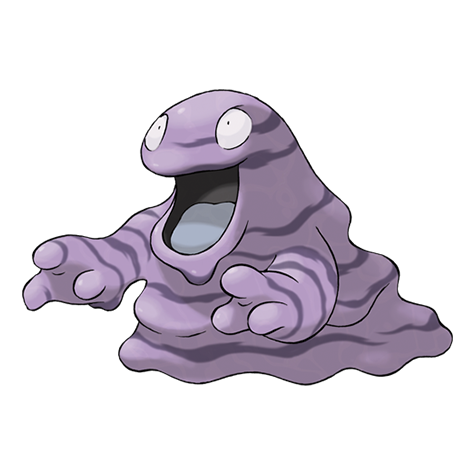
Muk is the evolved form of Grimer, the smaller Poison-type that inhabits the same polluted landscapes. Grimer reaches this stage through accumulated battle experience, transforming into Muk at around the level researchers designate as thirty-eight, at which point its toxic mass grows considerably in size, density, and lethality. Within the broader Pokédex, Muk stands as one of the original Poison-type benchmarks identified during the earliest surveys of the Kanto region, and it remains a reference species in environmental research focused on Pokémon adaptation to human-altered habitats. Scientists continue to study its biology in hopes of understanding how it safely metabolizes substances lethal to nearly every other organism. For trainers, Muk's combination of durability, passive poisoning, and physical power makes it a dependable team member and living proof that an unglamorous appearance can conceal a genuinely formidable battler.