Shellder
Bivalve Pokémon

Its hard shell repels any kind of attack. It is vulnerable only when its shell is open.
- Height
- 0.3 m
- Weight
- 4.0 kg
- Base XP
- 61
- Catch
- 190 /255
- Happy
- 70
- Hatch
- 20 steps
- HabitatSea
- Body shapeBall
- ColourPurple
- Growth rateSlow
- Egg groupsWater3
- RarityStandard
Shellder is a Water-type Pokémon classified as the Bivalve Pokémon, first introduced in the original generation of the series alongside the earliest companion Pokémon. It takes the form of a small bivalve mollusk, sitting comfortably in the palm of a human hand, though some larger specimens grow large enough to cover a human fist entirely. Its most defining feature is a rough, asymmetrical outer shell, deep purple in color and lined along its outer rim with sharp, conical spines. The two shell halves are unequal in size and clamp together with remarkable force, giving the creature a nearly spherical silhouette when fully closed. A small, pale tongue peeks out from between the shell halves when Shellder is relaxed, and its dark eyes can just be glimpsed through the narrow gap when the shell opens slightly. The interior face of the shell is smooth and creamy white, a sharp contrast to the rough and spiny surface outside.
Shellder makes its home exclusively in saltwater environments, favoring shallow coastal seabeds and rocky ocean floors where it can anchor itself among coral formations and submerged boulders. It has been encountered in the waters surrounding many regions, from the coastlines of Kanto to the coves and bays of Hoenn and Sinnoh. Population density is highest where rocky underwater terrain provides natural crevices for shelter. While primarily a bottom-dweller, Shellder occasionally drifts toward tidal zones during warmer seasons. It is not strictly solitary, as groups are frequently observed clustered on the same rock formation, though they do not coordinate behavior or communicate in any complex way. During nighttime hours activity slows considerably, and Shellder clamps its shell fully shut, resting motionless against the seafloor until daylight returns.
Shellder feeds by filtering seawater and using its extendable tongue to snatch small organisms, algae, and organic debris passing nearby. The tongue is deceptively quick and sticky, capable of latching onto drifting prey before they can escape. When not feeding, Shellder tends toward passivity, clamping its shell tightly closed at the approach of larger or unfamiliar creatures. Trainers who have worked with wild individuals consistently report that once Shellder decides to clamp onto something, it holds with astonishing grip and resists release until it feels completely safe. This tenacious instinct translates effectively to training, as the Pokémon proves persistently determined once it commits to battle. Communication between individuals is minimal, consisting of faint gurgling sounds produced when the shell is partially open, which researchers interpret as rudimentary proximity signals between nearby members of the species.
In battle, Shellder is defined primarily by its exceptional physical Defense, which ranks among the highest of any unevolved Pokémon in the series. Its Shell Armor ability prevents opponents from ever landing a critical hit against it, making it a consistent and dependable wall against physically oriented attackers. Some individuals carry the Skill Link ability instead, which causes multi-hit moves to always strike the maximum possible number of times rather than a random count. While Skill Link shows limited impact at this stage of development, it becomes an extraordinary asset after evolution. A hidden ability called Overcoat offers protection from the gradual damage caused by hailstorms and sandstorms, granting passive resilience in harsh weather. As a pure Water type, Shellder resists Fire, Ice, Steel, and Water moves, but it suffers sharply from Grass and Electric attacks. Its Speed is quite modest and its Special Defense is notably low, so fast special attackers using those types represent a serious threat. Shellder functions best as a physical tank, absorbing blows steadily while it waits to strike.
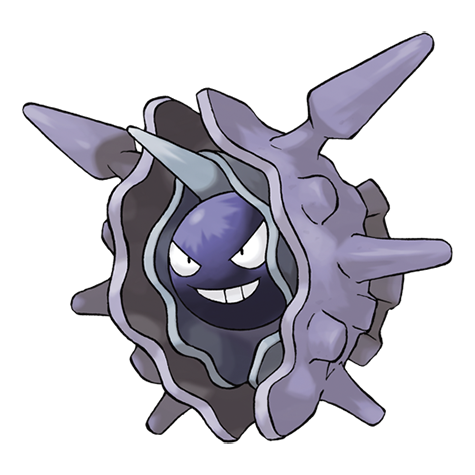
Shellder has no pre-evolutionary form and evolves into Cloyster through exposure to a Water Stone. The transformation is dramatic: the original purple shell becomes a face-like inner structure enclosed within a massive dark outer shell ringed with long, jagged spines. Cloyster gains Ice as a secondary type and reaches a level of physical Defense considered extraordinary even among fully evolved Pokémon. Beyond its own evolutionary line, Shellder occupies a unique and much-studied place in Pokémon biology because of its role in the development of two other species. When a Shellder attaches itself to the tail of a Slowpoke, the chemical exchange that follows transforms that Slowpoke into Slowbro. When a similar attachment occurs at the head of a Slowpoke under different circumstances, the result is Slowking instead. This relationship, at once parasitic and symbiotic, is one of the most unusual evolutionary mechanisms documented across all regions, and it continues to attract the attention of researchers studying both Shellder's remarkable biological chemistry and the broader implications of one species serving as a developmental catalyst for another.