Cloyster
Bivalve Pokémon
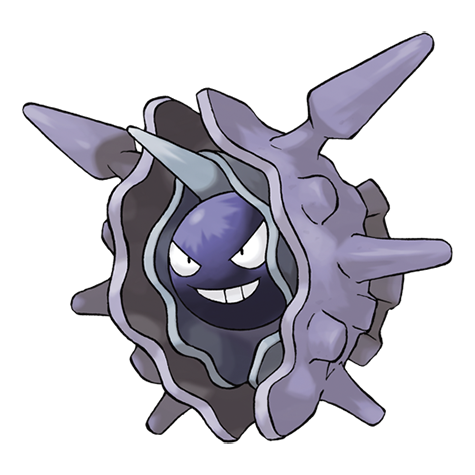
When attacked, it launches its horns in quick volleys. Its innards have never been seen.
- Height
- 1.5 m
- Weight
- 132.5 kg
- Base XP
- 184
- Catch
- 60 /255
- Happy
- 70
- Hatch
- 20 steps

- HabitatSea
- Body shapeBall
- ColourPurple
- Growth rateSlow
- Egg groupsWater3
- RarityStandard
Cloyster is the Bivalve Pokémon, a dual Water and Ice type species that originated in the first generation of the Pokédex. Its most immediately striking feature is its shell, which is actually two shells: a pale, rounded inner shell that cradles the creature's face and forms the visible silhouette of its body, and a large dark purple outer shell covered in thick, jagged spikes that extend outward in every direction. The outer shell is renowned for its extreme density and hardness, considered one of the most resistant natural materials known to researchers. What lies inside that outer shell has never been recorded; no observer has managed to see Cloyster's inner workings, and even advanced instruments have produced no clear picture of its anatomy. Its face, framed by the opening of the inner shell, is pale and expressionless, with wide, unblinking eyes. Cloyster reaches approximately to the chest of an average standing adult in height, but its weight is considerably greater than its rounded proportions would suggest, a reflection of the dense material composing its shell.
Cloyster is strictly a saltwater species, spending its life in cold ocean environments along coastal regions and open sea floors. It is most commonly associated with the waters surrounding Kanto, though populations have been documented in similar cold-water coastal zones in other regions as well. It gravitates toward deeper, darker portions of the sea floor, where rocky formations and low temperatures provide ideal conditions. Cloyster is predominantly solitary, maintaining territories on the sea bed and avoiding extended contact with other individuals outside of brief seasonal interactions. It does not follow any well-defined migratory pattern, preferring to remain anchored to a chosen stretch of ocean floor for extended periods. It surfaces rarely and is almost never observed from land or near beaches, which means that trainers typically encounter it only through deep-water fishing or diving expeditions.
Cloyster is a patient, opportunistic predator that feeds on smaller marine creatures. It drifts near the sea floor with minimal movement, drawing prey within range before snapping its shell closed with immense force. The pressure generated by this action is powerful enough to crush most materials that become caught between its two halves. When undisturbed, Cloyster is largely still and unobtrusive, but the moment it perceives a threat it shifts immediately into active defense, firing the spikes from its outer shell in rapid, successive bursts. These projectile spikes can pierce stone and represent a genuine hazard to anyone nearby. Field researchers consistently note that wild Cloyster offers almost no visible warning before launching this response, making close observation risky even for experienced trainers. With patient, dedicated handling, however, Cloyster does develop stable bonds with its trainer and becomes a reliable partner.
Cloyster's combat identity is anchored in its physical defense, which is one of the most formidable of any Pokémon ever catalogued. Its Shell Armor ability prevents critical hits entirely; attacks that would normally carry bonus damage due to precision or timing simply connect at their base level, making Cloyster a deeply frustrating target for physically oriented opponents. Its Skill Link ability ensures that any move capable of striking multiple times always connects the full number of times, turning attacks like Icicle Spear and Rock Blast into reliable, high-output tools rather than the variable-damage gambles they can be for other Pokémon. A third ability, Overcoat, serves as a hidden talent that blocks damage from weather conditions, allowing Cloyster to function in hailstorms without wearing down from residual ice damage. Offensively, its Water and Ice typing covers Ground, Flying, Dragon, and Grass targets effectively, but the same typing creates weaknesses against Electric, Grass, Fighting, Rock, Steel, and Fire. Its special defense is low enough that opponents relying on special attacks can break through what physical attackers cannot.
Cloyster evolves from Shellder, a small bivalve Pokémon, through exposure to a Water Stone. The change is striking: Shellder's compact, hinged clam shape gives way to Cloyster's fortress-like construction, gaining its enormous spiked outer shell in the process. No further evolution exists beyond Cloyster, establishing it as the final member of its line. As one of the original species documented in the Kanto region, Cloyster has a long history in both competitive training and academic research. The extraordinary hardness of its outer shell has drawn particular interest from materials scientists and biologists studying natural armor. Among competitive trainers, Cloyster is most noted for its capacity to combine Shell Smash, a technique that trades away its exceptional defenses for sudden and dramatic increases in speed and offensive power, with the Skill Link ability, producing a concentrated burst of multi-hit damage that few opponents are prepared to handle. This combination of extreme defensive capability and surprising offensive potential continues to make Cloyster a species worth studying and worth raising.