Nidoking
Drill Pokémon
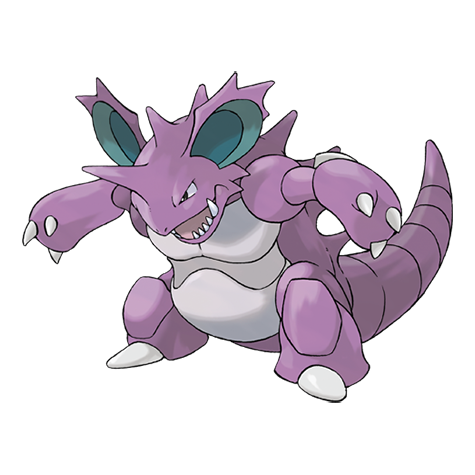
It uses its powerful tail in battle to smash, constrict, then break the prey's bones.
- Height
- 1.4 m
- Weight
- 62.0 kg
- Base XP
- 227
- Catch
- 45 /255
- Happy
- 70
- Hatch
- 20 steps
- HabitatGrassland
- Body shapeUpright
- ColourPurple
- Growth rateMedium Slow
- Egg groupsMonster, Ground
- RarityStandard
Nidoking is the Drill Pokémon, a dual Poison and Ground type that first appeared in the original generation of Pokémon. Standing roughly the height of an adult human, it carries a powerfully built, upright frame covered in tough purple hide studded with rows of rigid spines along the back and sides. Its most defining feature is the single long horn rising from its forehead, though the thick, heavily muscled tail, capable of toppling trees with a single swing, rivals that horn in sheer destructive presence. Broad shoulders, dense forelimbs tipped with sharp claws, and a pale lavender underside contrasting its darker purple outer armor complete a silhouette that communicates dominance without ambiguity. Nidoking stands noticeably heavier than its compact dimensions might suggest, and the density of its hide and spines gives it a layered, armored quality that reinforces the impression of a creature built above all else to hold its ground.
Nidoking inhabits open grasslands, scrublands, and the edges of dry plains, preferring firm, open terrain where it can patrol and defend a wide territory with freedom of movement. It favors temperate to warm climates and is rarely encountered at significant elevation or deep within dense forest, where its considerable bulk and methodical patrol style would be impeded by the terrain. Each individual claims a substantial stretch of land as its own and drives off intruders with force when necessary, which keeps wild population density relatively low despite the species being broadly distributed across suitable grassland habitats. Nidoking is primarily solitary and becomes most active around dusk, intensifying its patrols into the early hours of the night. Sightings cluster most heavily where grassland meets rocky outcroppings or sparse woodland, and trainers moving through such areas at twilight should anticipate the possibility of an aggressive territorial encounter.
Nidoking is an opportunistic predator that feeds on prey it can reliably overpower, including large insects, smaller wild Pokémon, and whatever else the terrain makes available. Its primary hunting tool is its tail, which it deploys to pin, constrict, and ultimately break the bones of captured prey before consuming them, a technique the species has refined across countless generations. Field observers consistently describe its approach as methodical rather than impulsive: Nidoking stalks its quarry with patience and selects its moment carefully before committing to an attack, rarely overextending in the pursuit. Toward humans it is strongly territorial and generally hostile to uninvited proximity, though individuals raised from hatching by a dedicated trainer are known to develop genuine and lasting loyalty. The spines covering its hide carry a low-grade venom sufficient to cause real harm on accidental contact. During breeding season, male Nidoking intensify their patrols and engage in direct combat with rival males until a dominant individual has been firmly established.
In battle, Nidoking leans most heavily into physical offense while maintaining a respectable Special Attack score that prevents opponents from safely assuming a single defensive approach will contain it. Its first standard ability, Poison Point, functions as a passive deterrent: any opponent that makes direct physical contact with Nidoking risks leaving the exchange with a poisoning condition steadily draining its stamina, which discourages the sustained close-range trading that would otherwise neutralize a slower, bulkier attacker. Its second standard ability, Rivalry, shifts its damage output depending on the gender of the opposing Pokémon, amplifying attacks against same-gender rivals while reducing them against those of the opposite gender, a modifier useful in specific matchups but too situational for consistent competitive deployment. Most experienced trainers instead unlock its hidden ability, Sheer Force, which strengthens any move that carries a secondary effect at the cost of those effects not activating. Given the breadth of compatible move types available to Nidoking, this turns it into a versatile and hard-hitting mixed attacker. Its Poison and Ground typing grants immunity to Electric-type moves and resistance to several additional types, though Water, Grass, Ice, Psychic, and opposing Ground all represent genuine vulnerabilities that require careful management.
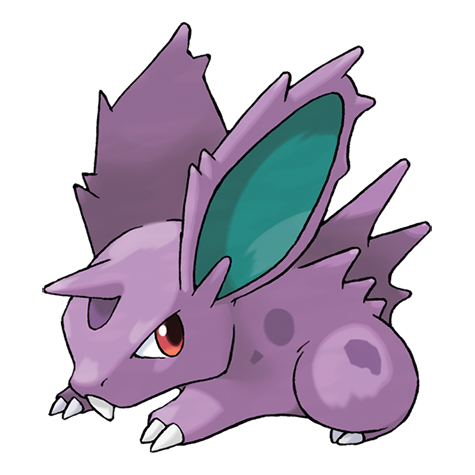
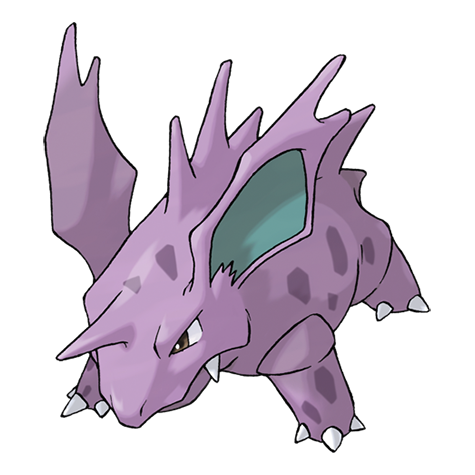
Nidoking occupies the final stage of a three-part evolutionary line that opens with Nidoran Male, a small, horned Pokémon unassuming in appearance relative to what it will become. Nidoran Male evolves into Nidorino upon reaching a certain level of maturity, gaining a more pronounced horn and a noticeably more aggressive temperament. Nidorino then completes the line by evolving into Nidoking upon exposure to a Moon Stone, placing this sequence among the few in its generation that reach a final form through a stone item rather than continued leveling alone. The structural parallel with the Nidoran Female line, which culminates in Nidoqueen by the same Moon Stone method, makes the two lines a well-documented subject of study for researchers examining gender-differentiated evolution. Trainers value Nidoking for the combination of wide type coverage and Sheer Force, and it has maintained a reputation across every generation as one of the most rewarding and versatile final-stage evolutions a trainer can obtain through the deliberate use of an evolution stone.