Nidorino
Poison Pin Pokémon
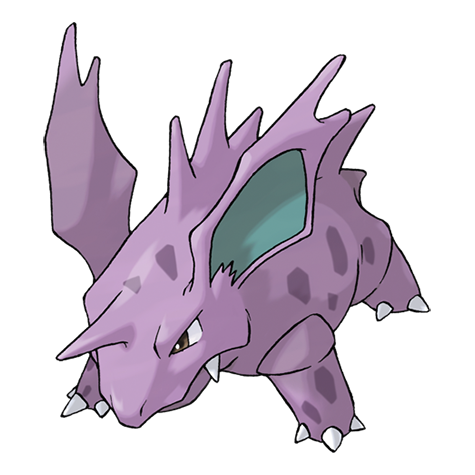
An aggressive POKéMON that is quick to attack. The horn on its head secretes a powerful venom.
- Height
- 0.9 m
- Weight
- 19.5 kg
- Base XP
- 128
- Catch
- 120 /255
- Happy
- 70
- Hatch
- 20 steps
- HabitatGrassland
- Body shapeQuadruped
- ColourPurple
- Growth rateMedium Slow
- Egg groupsMonster, Ground
- RarityStandard
Nidorino is a Poison-type Pokémon introduced in the first generation of the series and classified officially as the Poison Pin Pokémon. It presents as a sturdy, four-legged creature covered in light purple hide, with a robust build that places it roughly at knee-to-hip height on an average adult human. Its most distinctive feature is the single horn projecting forward from its forehead — larger and more pronounced than the one carried by its pre-evolution — which serves both as a weapon and as the delivery mechanism for a potent toxin produced in special glands within its skull. Rows of rigid spines run along its back from neck to hindquarters, giving Nidorino a bristling silhouette that communicates threat at a distance. Its ears are tall and pointed, its eyes alert and forward-facing, and its stout tail tapers to a blunt tip, completing the image of a creature shaped by evolution for confrontation.
Nidorino favors open grassland and savanna-type terrain, where it has ample room to roam and where low-growing vegetation provides both concealment and clear sightlines. It is found across multiple regions, appearing with particular frequency in warm, temperate zones where prey is plentiful and territorial boundaries can be maintained without the obstruction of dense forest. Nidorino tends toward crepuscular activity, being most alert at dawn and dusk, though individuals encountered in the wild show little hesitation about moving through daylight hours if threatened or hungry. Outside the breeding season it is largely solitary, maintaining a personal territory it will defend vigorously against intruders of any species. Population clusters do appear in certain protected grassland reserves, but even within these loose aggregations individual Nidorino keep a wary distance from one another, tolerating proximity only reluctantly.
Nidorino is among the more aggressive Pokémon a trainer is likely to encounter in the wild. It does not wait to assess whether an approaching entity poses a genuine threat; its instinct is to charge first and evaluate afterward. Field researchers note that the horn is kept perpetually sharpened against rocks and hard surfaces, a grooming behavior that maintains its venom-delivery tip and also serves as a territorial display when performed in the open. In terms of diet it is an omnivore, consuming grasses, berries, and small prey, with feeding habits that are largely opportunistic. Communication between individuals involves a combination of short vocalizations and postural signals, particularly the raising and lowering of dorsal spines to signal mood and intent. During mating season, male Nidorino engage in spirited horn-clashing contests, and trainers working in grassland zones consistently report a marked uptick in unprovoked charges during this period.
In battle, Nidorino benefits from two standard abilities and one hidden ability, each shaping its role in a different way. Poison Point causes contact-based attacks aimed at Nidorino to carry a meaningful chance of leaving the attacker poisoned, making opponents hesitant to rely on direct physical strikes. Rivalry adjusts the force of Nidorino's own moves depending on the gender of the opposing Pokémon, amplifying its damage output against a same-gender foe while diminishing it against an opposite-gender one, a factor that informed trainers account for when selecting matchups. The hidden ability, Hustle, dramatically increases the power of Nidorino's physical attacks at the cost of reduced accuracy, transforming it into a harder-hitting but less reliable attacker in extended exchanges. As a pure Poison type, Nidorino resists Poison, Grass, Fairy, Fighting, and Bug-type moves but carries clear vulnerabilities to both Ground and Psychic-type attacks. Its offensive profile leans physical, and its speed is reasonable without being exceptional, meaning it performs best when given setup support or when facing opponents it can outpace and overwhelm with sustained pressure.
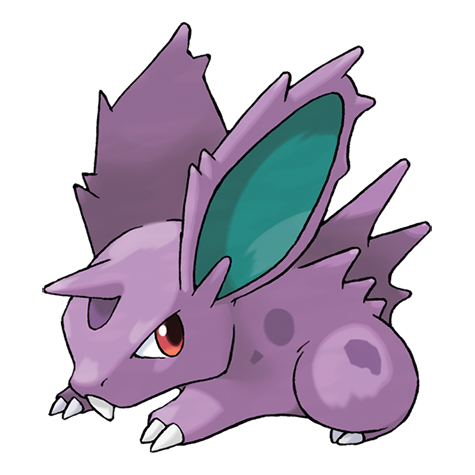
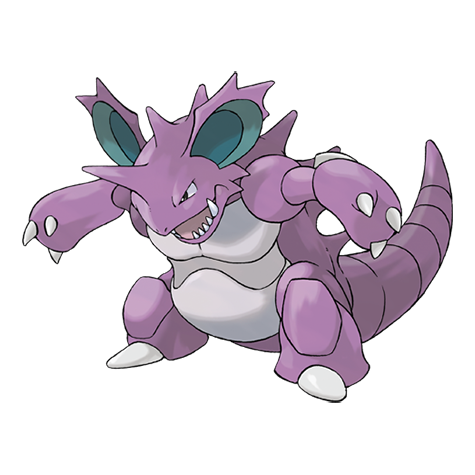
Nidorino occupies the middle position in a three-stage evolutionary line that begins with Nidoran male. It evolves from Nidoran male upon reaching a sufficient level of maturity, specifically around the sixteenth level of growth, gaining a notably larger horn, increased body mass, and a sharper competitive edge. The line concludes with Nidoking, which Nidorino reaches not through continued leveling but through exposure to a Moon Stone, one of the elemental evolutionary items introduced alongside the original Pokédex. This makes the step from Nidorino to Nidoking a deliberate choice for the trainer rather than an automatic milestone, and many competitive trainers delay the evolution to retain access to certain level-up moves unavailable to Nidoking. Researchers have studied Nidorino's venom-secreting horn with particular interest, as the compound it delivers differs chemically from the passive toxins produced by most other Poison-type species and has attracted ongoing attention in the field of Pokémon biochemistry. Its pairing with the female Nidorina line, a distinct species that nevertheless shares evolutionary mechanics and egg group compatibility, makes the Nidoran family one of the more biologically unusual groupings in the known Pokédex.