Onix
Rock Snake Pokémon
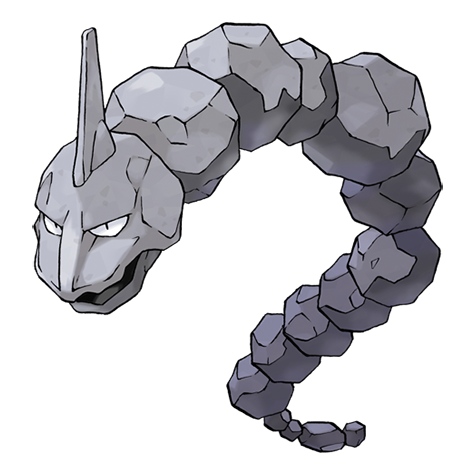
As it grows, the stone portions of its body harden to become similar to a diamond, but colored black.
- Height
- 8.8 m
- Weight
- 210.0 kg
- Base XP
- 77
- Catch
- 45 /255
- Happy
- 70
- Hatch
- 25 steps
- HabitatCave
- Body shapeSquiggle
- ColourGray
- Growth rateMedium
- Egg groupsMineral
- RarityStandard
Onix is the Rock Snake Pokémon, a dual Rock and Ground type introduced in the first generation of Pokémon. It is one of the most visually striking creatures in the Pokédex, with a massive serpentine body composed of a chain of enormous spherical boulders stacked end to end, tapering from a broad head down to a pointed tail tip. The entire structure can reach lengths that dwarf most large vehicles, making Onix one of the longest Pokémon by raw dimension. Its coloration is a deep, muted gray throughout, though over time the stone segments that form its body grow harder and darker, eventually approaching the hardness of black diamond. Atop its head sits a single pointed horn, and its face carries small, dark eyes that give it a surprisingly alert expression despite its rocky composition.
Onix is found almost exclusively underground and in cave systems. It appears throughout mountainous regions across multiple generations of the Pokémon world, from the rocky corridors of Pewter City's surrounding hills in Kanto to the caverns of Johto and beyond. It bores through the earth using its hard body as a drill, carving out tunnels that can run dozens of meters into bedrock. Onix tend to be solitary creatures, and encounters with more than one at a time are uncommon unless a trainer has stumbled into a nesting area. Population density is highest in regions with abundant mineral-rich rock, and the species shows a strong preference for dry cave environments over damp or flooded passages.
Onix sustains itself by consuming large quantities of boulders and earthen material as it tunnels, grinding the rock through its body and extracting the minerals it needs. This constant drilling behavior also serves as a form of territorial marking, as the tunnels Onix leaves behind are recognizable to other members of the species. Though imposing in appearance, Onix in the wild are not inherently aggressive toward humans and will often retreat deeper into their tunnels when disturbed rather than immediately attack. However, a cornered or startled Onix can be extraordinarily dangerous given its size and momentum. Young Onix are known to be more skittish, while older and larger individuals, their segments darkened and toughened by decades of mineral absorption, may stand their ground with considerable force.
In battle, Onix is defined by its extraordinary physical defensive capability, which ranks among the highest of any Pokémon. Its Rock Head ability allows it to use powerful recoil-inducing moves without suffering the usual self-inflicted damage, making moves like Double-Edge viable tools in its kit. Its Sturdy ability ensures that it cannot be knocked out in a single blow from full health, and it also provides complete protection against one-hit knockout moves regardless of the target's remaining health. A hidden ability called Weak Armor causes Onix to trade defensive footing for speed each time a physical hit lands, which can turn an otherwise passive Pokémon into a faster offensive threat. Its Rock and Ground dual typing offers broad coverage and makes it resistant to Normal, Flying, Poison, and Rock type moves, but it carries significant vulnerabilities to Water, Grass, Ice, Fighting, Ground, and Steel type attacks. Its speed is respectable for a creature of its scale, though its offensive output in both physical and special categories is modest. Onix functions best as a wall, absorbing hits and wearing down opponents, rather than as an offensive force.
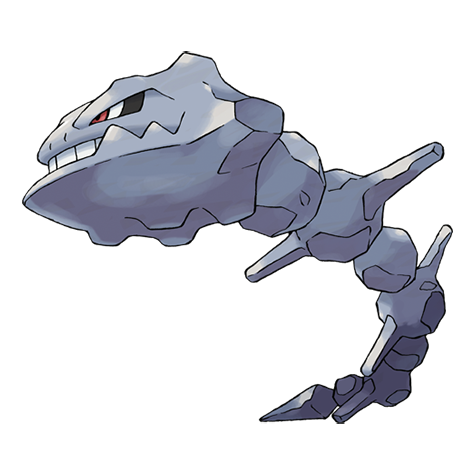
Onix does not evolve from any earlier form and begins its evolutionary journey as the base stage. It evolves into Steelix when traded while holding a Metal Coat, a process that transforms its rocky segments into a steel exoskeleton and dramatically elevates its defensive profile. This evolution was introduced in the second generation, making Onix one of the original Pokémon to receive a new evolutionary path after its debut. Within the broader Pokédex, Onix holds a notable place as one of the very first Pokémon many players remember facing in an early Gym battle, and it remains a touchstone of early Pokémon challenge design. Researchers are particularly interested in the gradual mineral hardening process of its body segments, which is considered a natural analogue to extreme geological compression, and the study of older Onix specimens has yielded insights into how biological systems can achieve diamond-comparable hardness through sustained mineral intake over a lifetime.