Parasect
Mushroom Pokémon
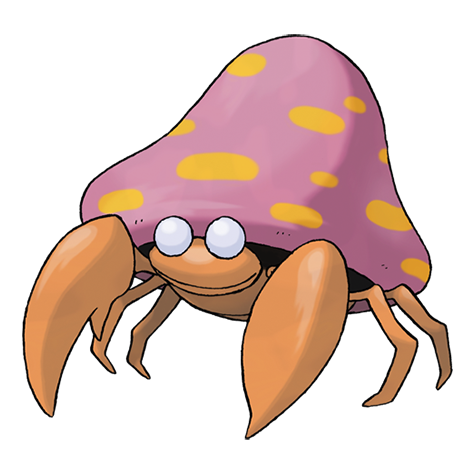
A host-parasite pair in which the parasite mushroom has taken over the host bug. Prefers damp places.
- Height
- 1.0 m
- Weight
- 29.5 kg
- Base XP
- 142
- Catch
- 75 /255
- Happy
- 70
- Hatch
- 20 steps
- HabitatForest
- Body shapeArmor
- ColourRed
- Growth rateMedium
- Egg groupsBug, Plant
- RarityStandard
Parasect is the Mushroom Pokémon, a dual Bug- and Grass-type species that first appeared in the original generation of Pokémon. What makes Parasect immediately striking is that it is, at its core, not one creature but two locked in a biological relationship of complete dominance. The host body is an insectoid form roughly the size of a large dog, with six stubby legs, a rounded shell-like body, and pale yellowish limbs that move with a slow, lurching gait. Above and covering most of the upper body sits an enormous red-and-orange mushroom cap, mottled with white spots, that has so thoroughly taken root in the insect beneath it that the two organisms share a single silhouette. The eyes of Parasect are blank and white, entirely devoid of pupils, a visual signal that the original creature's consciousness has been completely subsumed by its fungal occupant.
Parasect makes its home in damp, shaded forest environments where moisture clings to the air and the forest floor stays cool and wet throughout the year. It is found in temperate woodland regions across many parts of the world, typically in areas with dense tree cover that prevents direct sunlight from reaching the ground. Populations tend to cluster around decomposing logs, mossy rock formations, and the banks of slow-moving streams where the humidity remains persistently high. Parasect is a solitary creature by nature and does not form groups, though multiple individuals may occupy the same forest if the territory is sufficiently rich in nutrients. It shows no particular preference for day or night, moving and feeding at roughly the same slow, methodical pace regardless of the hour, as the mushroom that controls it requires no true sleep cycle of its own.
The behavior of Parasect is almost entirely dictated by the fungal organism on its back. The mushroom extends its mycelium throughout the host body, including the brain and nervous system, directing the insect toward nutrient-rich soil and decaying organic matter from which the fungus draws sustenance. Parasect scrapes at the earth and gnaws at tree roots and fallen wood, but it does not feed in any meaningful sense of individual will or appetite. Researchers who observe wild Parasect report that it shows no startle response, no social signaling, and almost no reaction to environmental stimuli beyond slowly orienting toward food sources. Toward humans and other Pokémon it is neither aggressive nor friendly, simply indifferent, drifting across the forest floor with a blank and purposeful persistence. The spores released passively from the mushroom cap function as a form of chemical dispersal, though mycologists continue to debate whether this constitutes meaningful biological communication or is simply an accidental byproduct of the fungus reproducing.
In battle, Parasect leans heavily on its physical attack strength and defensive bulk, though its extremely low speed means it almost never moves before the opponent. Its most common ability, Effect Spore, turns direct contact with Parasect into a gamble, as any Pokémon that strikes it physically risks being inflicted with paralysis, poison, or sleep at random, making physical attackers hesitate before committing. An alternative ability, Dry Skin, creates an entirely different dynamic: Parasect recovers health when struck by Water-type moves and during rainy weather, but it suffers accelerated damage under harsh sunlight and takes additional punishment from Fire-type attacks. Its hidden ability, Damp, suppresses explosive moves entirely, preventing any opposing Pokémon from using self-destruct or explosion while Parasect remains on the field. Its Bug and Grass typing together leave it exposed to a wide range of opposing types including Fire, Flying, Rock, Ice, Poison, and Bug, making defensive positioning and teammate support critical to its survival. Under rain conditions in particular, Parasect can function as a durable presence capable of spreading status conditions and absorbing Water-type attacks directed its way.
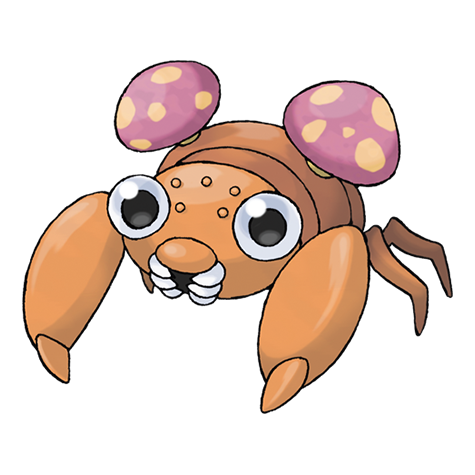
Parasect evolves from Paras, which carries two small tochukaso mushroom growths on its back from an early stage. When Paras reaches a sufficient level of maturity through experience in battle and the wild, the fungi accelerate their growth dramatically and the evolutionary process produces Parasect, at which point the fused mushroom cap has achieved complete dominance over its host. Parasect is the final form of this two-member evolutionary line. Among researchers in the fields of mycology and parasitology, Parasect is regarded as one of the most biologically remarkable species in the known Pokémon world, representing a documented case of a parasitic organism achieving total behavioral control over a host of a different species entirely. Its tochukaso mushroom has been studied for potential medicinal properties, and traditional lore in forested rural communities holds that dried spores from the cap carry restorative qualities, a claim that remains under active investigation. For trainers, Parasect fills a niche but rewarding role, and its unusual ability interactions and capacity for spreading status effects have earned it a dedicated following among those who favor unconventional team strategies.