Paras
Mushroom Pokémon
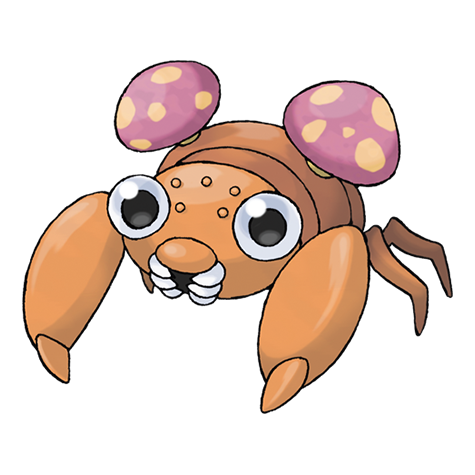
Burrows to suck tree roots. The mushrooms on its back grow by draw ing nutrients from the bug host.
- Height
- 0.3 m
- Weight
- 5.4 kg
- Base XP
- 57
- Catch
- 190 /255
- Happy
- 70
- Hatch
- 20 steps
- HabitatForest
- Body shapeArmor
- ColourRed
- Growth rateMedium
- Egg groupsBug, Plant
- RarityStandard
Paras is the Mushroom Pokémon, a dual Bug and Grass type that made its debut in the first generation of Pokémon. Its body resembles that of a small, crab-like insect, round and segmented, covered in a pale orange-red chitinous shell. Six slender, pointed legs carry it close to the ground, and its wide, dull eyes give it a passive, almost vacant expression. What most immediately sets Paras apart are the two large mushrooms growing directly from its back. Known as tochukaso, these fungi display vivid orange caps marked with white spots, and they grow considerably larger relative to the host as the Pokémon matures. The entire creature fits comfortably in a human hand, placing it among the smaller Bug types in the original dex, yet its peculiar silhouette, an insect body crowned by twin fungi, makes it one of the most recognizable designs from that generation.
Paras favors dense, humid forest environments where the soil is rich and tree roots run deep. It has been documented throughout the Kanto and Johto regions, clustering near old-growth woodland where ancient trees provide extensive underground root networks. Populations tend to gather around particularly large or decaying trees, spending much of their time burrowing into earth in search of root systems to feed from. It is a largely solitary species with little apparent need for group dynamics or territorial establishment. Encounters are common in cave systems adjacent to forested areas, where Paras retreats to cooler and darker conditions during the warmer parts of the day. Its preference for dim, sheltered environments means it rarely ventures into open terrain, and its unhurried pace suits the confined, low-light passages it tends to inhabit.
The most remarkable aspect of Paras's daily existence is its nutritional arrangement with the tochukaso fungi. The mushrooms are not incidental growths but parasitic organisms that have taken root inside the Pokémon's body, embedding filaments into the host and drawing nutrients from it continuously. Paras compensates by burrowing beneath trees and feeding on root sap, ensuring a steady supply of organic material that sustains both insect and fungus alike. Researchers have noted that the fungi appear to influence the host's behavior to some degree, which may account for the Pokémon's unhurried, almost directionless movement patterns as it drifts toward nutrient-rich zones. Paras displays little in the way of aggression or complex communication, moving through forest undergrowth with quiet, single-minded persistence. Trainers who raise Paras often describe it as placid and easy to handle, though it shows minimal interest in its surroundings beyond the root systems that happen to lie nearby.
In battle, Paras is best understood as a status-infliction utility rather than a damage-dealing threat. Its primary ability, Effect Spore, functions as a passive deterrent: when an opposing Pokémon makes direct physical contact with Paras, there is a meaningful chance the attacker will be struck with paralysis, poison, or sleep at random, creating genuine risk for physical attackers that press in close. Its second ability, Dry Skin, introduces weather dependency into its performance, allowing Paras to absorb water-type moves and recover health during rain while simultaneously increasing its vulnerability to fire and causing it to lose health under harsh sunlight. The hidden ability Damp carries a situational but absolute effect, preventing any explosive move from functioning while Paras remains on the field. Offensively, Paras relies on its physical attack, which stands as the strongest figure among its base statistics, but its very low speed means it typically acts last in most exchanges. Its dual typing brings a broad spread of weaknesses, including Flying, Rock, Fire, Poison, Bug, and Ice, so careful positioning and opponent selection matter considerably when fielding this Pokémon.
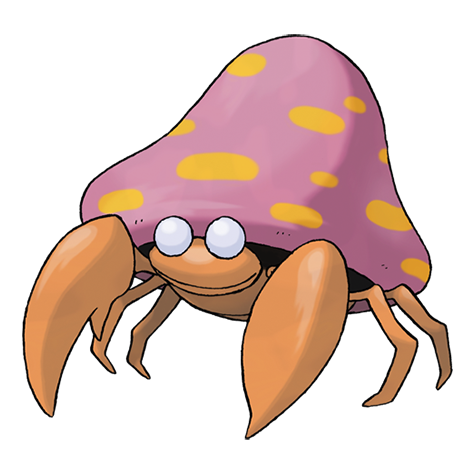
Paras occupies the first stage of a two-Pokémon evolutionary line, progressing into Parasect at level twenty-four. The transformation is among the more striking in the original roster: what was already an unusual relationship between insect and fungus becomes, in Parasect, something closer to full fungal dominance, with a single enlarged mushroom appearing to have subsumed the host entirely. Paras holds the distinction of being the first Grass and Bug dual type introduced in the franchise, a pairing that remains rare across later generations. For researchers interested in parasitology and interspecies dependency, this Pokémon draws direct comparisons to real-world fungi that colonize and redirect insect hosts, making it a subject of genuine biological interest well beyond the training circuit. Trainers tend to seek out Paras primarily for its early access to Spore and other powder-based status moves, which make it a reliable tool for weakening wild Pokémon before capture.