Vileplume
Flower Pokémon
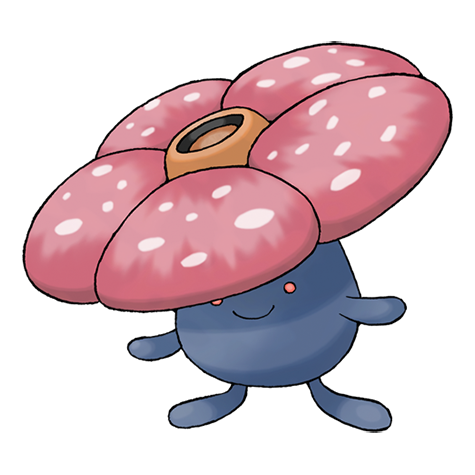
It has the world’s largest petals. With every step, the petals shake out heavy clouds of toxic pollen.
- Height
- 1.2 m
- Weight
- 18.6 kg
- Base XP
- 221
- Catch
- 45 /255
- Happy
- 70
- Hatch
- 20 steps
- HabitatGrassland
- Body shapeHumanoid
- ColourRed
- Growth rateMedium Slow
- Egg groupsPlant
- RarityStandard
Vileplume is the Flower Pokémon, a dual Grass and Poison type that traces its origins to the first generation. Standing roughly chest-height on an average adult, Vileplume has a compact, vaguely humanoid build with a stout blue-green body, short stubby arms, and rounded feet. Its face is simple and largely expressionless. The most arresting feature, the one that defines this species entirely, is the colossal flower that rests atop its head. The petals are a deep, vivid crimson, each one broad and rounded and marked with scattered white spots. Those petals are described in field research as among the largest of any flowering organism documented in the Pokémon world, so wide and heavy that Vileplume visibly sways and stumbles as it walks, the flower rocking with each labored step. This combination of unassuming body and spectacular floral crown makes Vileplume one of the more immediately recognizable Pokémon of the grassland biome.
Vileplume is native to warm, humid grasslands and the transitional zones at the edges of dense tropical forest. In the Kanto region, populations are most reliably encountered in protected areas such as the Safari Zone, where rich soil and stable humidity support the enormous metabolic demands of its floral crown. Beyond Kanto, Vileplume has been documented in other regions sharing similar climates. It is a solitary species that carves out a territory within dense undergrowth, relying on the visual cover of the surrounding plant life. Vileplume is strictly diurnal, remaining active through the daylight hours when photosynthesis can sustain it and retreating into stillness at dusk. Travelers who frequent grassland trails are warned that accidental encounters are far more common than deliberate ones, as a motionless Vileplume partially hidden by foliage can be nearly invisible until a person has already walked into the haze of pollen drifting from its petals.
Vileplume is a passive creature by temperament, posing no active threat to those around it and yet representing a genuine hazard through simple existence. During the day it photosynthesizes, drawing energy directly from sunlight rather than feeding on other organisms. As it moves, and even when it merely shifts its weight, the large petals release dense clouds of toxic pollen into the surrounding air. Field researchers and travelers describe a distinctively sweet but faintly unpleasant scent as the first sign that a Vileplume is nearby. At low concentrations the pollen causes irritation; at higher densities it can paralyze, poison, or induce sudden sleep in affected creatures. Despite this, Vileplume does not release pollen aggressively or in response to threats. When disturbed, its first response is simply to move away. It does not maintain social bonds with others of its kind, and observed interactions between individuals tend to be brief and unremarkable. Trainers who have kept Vileplume describe it as calm and unhurried, content to stand in full sunlight for extended periods.
In battle, Vileplume functions primarily as a special attacker with a strong preference for sun-based strategies. Its principal ability, Chlorophyll, causes it to move with markedly greater speed when sunlight is intensified by field conditions, transforming what would otherwise be a slow and methodical combatant into a genuine offensive threat. The hidden ability, Effect Spore, punishes opponents that strike Vileplume with direct contact, giving those attackers a random chance of being afflicted with paralysis, poison, or sleep, a passive deterrent that mirrors the species' natural behavior with notable accuracy. Grass and Poison typing together grant Vileplume solid resistance to Water, Electric, Grass, and Fighting moves. However, it faces meaningful pressure from Fire, Ice, Flying, and Psychic attacks, and trainers building around it take care to address these vulnerabilities. Its strongest moves lean heavily on special offense, with Solar Beam, Petal Blizzard, and Sludge Bomb serving as primary tools, and it frequently doubles as a status spreader through moves such as Sleep Powder and Stun Spore.
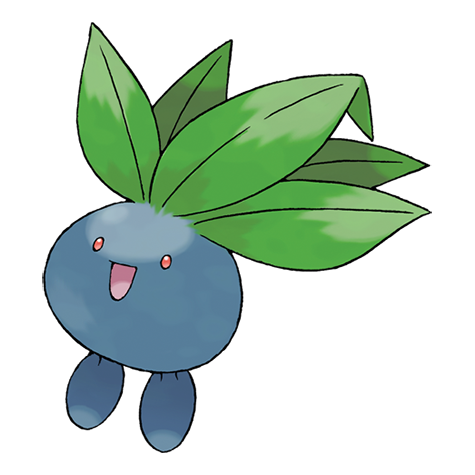
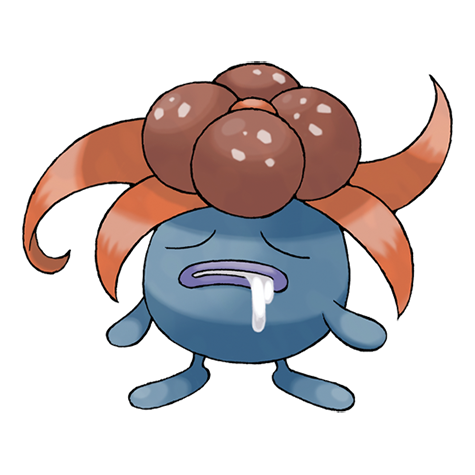
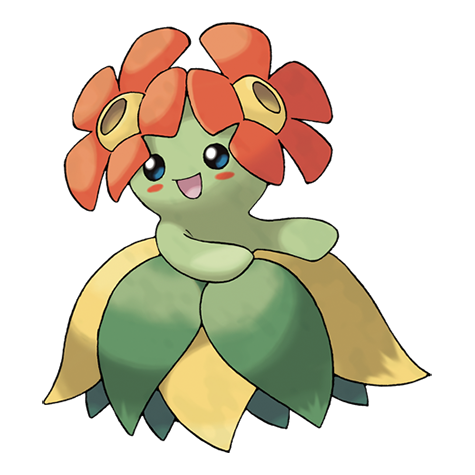
Vileplume represents one of two final evolutionary paths available to Gloom, the second stage of the Oddish line. Oddish begins its evolutionary journey at level twenty-one, transforming into Gloom, and from there exposure to a Leaf Stone completes the change into Vileplume. A second path exists in which a Sun Stone transforms Gloom into Bellossom instead, a form that diverges sharply in both appearance and battle role and was made available beginning in the second generation of games. This branching offers trainers a meaningful choice between two distinct approaches to the same mid-stage Pokémon. Researchers regard Vileplume as significant largely because of the biochemical complexity of its pollen, which has provided meaningful insight into naturally occurring toxic compounds among plant-type species. As one of the original one hundred fifty-one Pokémon, it carries a lasting legacy, remaining a recognizable and consistently relevant presence in both competitive and casual play across multiple generations.