Qwilfish
Balloon Pokémon
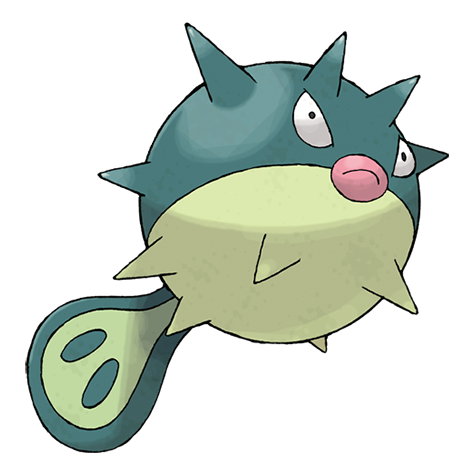
To fire its poison spikes, it must inflate its body by drinking over 2.6 gallons of water all at once.
- Height
- 0.5 m
- Weight
- 3.9 kg
- Base XP
- 88
- Catch
- 45 /255
- Happy
- 70
- Hatch
- 20 steps
- HabitatSea
- Body shapeFish
- ColourGray
- Growth rateMedium
- Egg groupsWater2
- RarityStandard
Qwilfish is the Balloon Pokémon, a dual Water and Poison type that made its debut in the second generation of Pokémon games. Its design draws unmistakably from the pufferfish family of real-world marine life, capturing the creature's most iconic trait: the ability to inflate into a sphere bristling with sharp defensive spines. Qwilfish's body is compact and nearly spherical, covered across most of its surface by pointed quills that can appear shorter at rest or visibly elongated when the creature feels threatened. Its coloration is a muted blue-gray across the upper body and sides, transitioning to a pale cream or yellowish hue along the belly. Small, round yellow eyes sit near the front of its face, and its wide, downturned mouth gives it a perpetually stern expression. Despite its somewhat intimidating silhouette, Qwilfish is quite small, roughly the size of a human head, and its rounded shape means it tends to bob gently in the water when at rest.
Qwilfish makes its home in saltwater environments, favoring the open sea and coastal ocean waters over rivers or freshwater lakes. It has been recorded in the waters surrounding several regions, typically preferring temperate to warm ocean zones where prey is abundant and currents are steady. Qwilfish tends to congregate near the surface or in the shallower portions of the open ocean rather than in deep trenches, though it is perfectly capable of descending to moderate depths when pursuing food or fleeing danger. Populations are relatively sparse and scattered, making chance encounters with wild Qwilfish notable enough that coastal fishing communities have developed a degree of lore around them. They are largely solitary creatures, each individual maintaining its own loose territory within a stretch of water, and they do not appear to form schools the way many other sea-dwelling Pokémon do. Sightings tend to increase during overcast weather, and some reports from sailors suggest that Qwilfish become markedly more active during rainstorms.
Qwilfish is an opportunistic predator that feeds primarily on smaller fish and invertebrates that share its habitat. It uses short, precise bursts of speed to ambush prey, relying on the element of surprise rather than prolonged pursuit. When not hunting, it drifts slowly through the water, conserving energy. Its most distinctive behavior, however, is its inflation response: when it perceives a threat, it rapidly gulps enormous quantities of seawater, swelling its body to a taut, near-spherical shape. This inflation serves two purposes simultaneously — it makes Qwilfish far more difficult to swallow, and it builds up the internal pressure needed to launch its toxic spines outward with considerable force. The spines themselves are laced with a potent venom, and the act of firing them requires a full-body pressurization that takes only a few seconds to complete. Toward humans, Qwilfish is wary rather than outright aggressive, typically preferring to retreat or warn before it escalates. Field researchers note that repeatedly startling one can train it to inflate preemptively, making handling without proper protective gear genuinely hazardous.
In battle, Qwilfish can draw on two standard abilities and one hidden ability, each suited to different tactical roles. Poison Point causes any opponent that strikes Qwilfish with a direct physical attack to risk being poisoned in return, essentially punishing overly aggressive physical attackers and discouraging sustained contact. Swift Swim, by contrast, dramatically increases Qwilfish's speed whenever rain falls on the battlefield, transforming it from a moderately quick Pokémon into a genuinely fast threat capable of moving before many opponents can respond. Its hidden ability, Intimidate, allows it to enter the field and immediately lower the attacking strength of opposing Pokémon, giving Qwilfish and its allies breathing room from the outset. As a Water and Poison type, it resists a notable range of incoming attack types including fire, ice, and several others, but carries weaknesses to ground, grass, electric, and psychic moves that skilled opponents will seek to exploit. Qwilfish's physical attack and defensive stats are its strongest suits, and it excels as a hazard-setter and physical attacker in rain-oriented strategies. Its comparatively low special attack means it relies on physical moves and utility options rather than special offense.
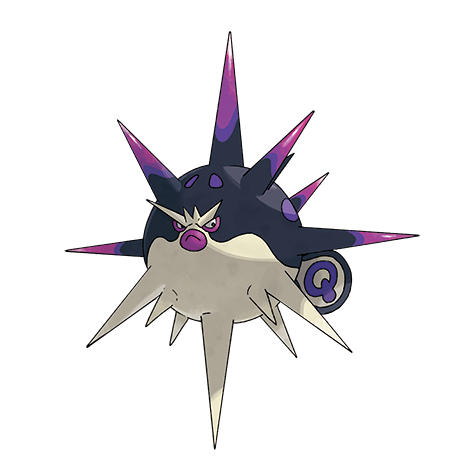
Qwilfish stands alone in its evolutionary line in its standard form, neither emerging from a prior stage nor advancing into a later one. It represents a relatively self-contained niche in the Pokédex, a mid-tier sea Pokémon that fills the ecological role of a venomous ambush predator in ocean habitats. Researchers have taken particular interest in Qwilfish because of the mechanics behind its inflation system, which involves a muscular network surrounding its spine sacs capable of generating remarkable internal pressure in a matter of moments. The same biological principle that allows it to swell with water also enables the forceful ejection of its quills, making it one of the more anatomically specialized Water-type Pokémon of its generation. Trainers who value utility in competitive play often prize Qwilfish for its ability to lay poison spike traps across the opposing field, steadily wearing down incoming Pokémon over the course of a battle. Though it lacks the prestige of rarer or more powerful species, Qwilfish has remained a reliable and genuinely compelling part of the ocean-going roster since its introduction, and both marine researchers within the Pokémon world and competitive battlers have ample reason to study it closely.