Scyther
Mantis Pokémon

With ninja-like agility and speed, it can create the illusion that there is more than one.
- Height
- 1.5 m
- Weight
- 56.0 kg
- Base XP
- 100
- Catch
- 45 /255
- Happy
- 70
- Hatch
- 25 steps

- HabitatGrassland
- Body shapeBug Wings
- ColourGreen
- Growth rateMedium
- Egg groupsBug
- RarityStandard
Scyther is known as the Mantis Pokémon, a Bug and Flying type species that made its debut in the first generation of Pokémon. It takes the form of a large bipedal praying mantis standing roughly at chest height on an adult human, though it can rear up taller when threatened or in a display posture. Its body is predominantly a vivid, saturated green that serves as natural camouflage in grassland and forest-edge environments, with a pale cream underbelly and similarly light wings folded flat against its back. The defining features of Scyther are its forearms, which have evolved entirely into long, razor-edged scythes rather than conventional limbs with hands. These blades are reportedly hard enough to split stone and move with such blinding speed in combat that observers frequently report the illusion of multiple Scyther attacking simultaneously. Its compound eyes are wide and alert, positioned to grant exceptional peripheral vision across open terrain.
Scyther makes its home in temperate to warm grasslands, savannas, and the open margins where meadow meets forest. Within the Kanto region it is most famously associated with the Safari Zone, where its green coloration allows it to disappear into tall grass with ease. Populations have also been documented in similar biomes across other regions, wherever a combination of dense ground cover, warm climate, and abundant prey exists. It is primarily a solitary species, with each individual claiming and defending a wide personal territory against rivals and intruders alike. Scyther is diurnal, most active from dawn through midday and again in the late afternoon, resting hidden within thick vegetation during the hottest hours of the day. There is no strong evidence of seasonal migration, though field researchers have reported population shifts in response to changes in prey availability.
Scyther is an apex predator among insect-type Pokémon, subsisting on a diet of smaller insects and quick-moving prey that it ambushes from concealment or runs down in short bursts of extreme speed. It approaches prey with a near-perfect silence that strikes observers as incongruous with its size, controlling each footfall to avoid disturbing the vegetation around it. Wild Scyther are proud and highly territorial, challenging intruders with a series of rapid slashing motions designed to intimidate as much as to injure. They do not generally initiate conflict with humans unprovoked, but they will not retreat from a confrontation once it has begun. Trainers who raise Scyther from an early age report that it develops strong loyalty while retaining a fierce competitive instinct that must be channeled productively through disciplined training. During breeding season, rival males perform high-speed dueling displays, matching each other blade for blade in tests of reflex that rarely result in serious injury.
Scyther is built for the opening moments of a battle, where its exceptional speed allows it to strike before most opponents can respond. It is a physically oriented fighter, relying on raw attack power delivered through its scythe arms rather than on special or elemental techniques. Its Swarm ability causes its Bug-type moves to hit with noticeably greater force when it has sustained heavy damage, making it a dangerous opponent even in the later stages of a fight when it appears close to defeat. Technician, its second standard ability, amplifies the power of moves that would otherwise deal modest damage, rewarding a trainer who builds a strategy around precise and well-chosen techniques rather than purely overwhelming force. The hidden ability Steadfast converts any moment of flinching into a burst of additional speed, giving Scyther a path back into a confrontation where it has briefly been rattled. Its Bug and Flying typing leaves it vulnerable to Fire, Rock, Electric, Ice, and Flying moves, so trainers must be selective about the matchups they bring it into.
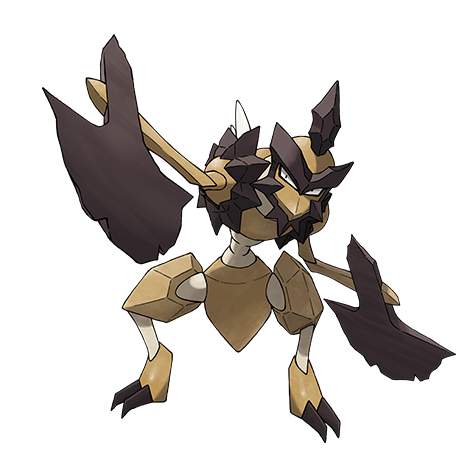
Scyther has no pre-evolved form, entering its evolutionary line as the first and foundational stage. It evolves into Scizor when traded between trainers while holding a Metal Coat, a transformation that replaces its Flying typing with Steel and reshapes its characteristic blades into reinforced, claw-like pincers marked with a wing pattern on their surface. Discoveries in the ancient Hisui region revealed an alternative evolutionary path: exposure to a Black Augurite transforms Scyther into Kleavor, a Rock and Bug type whose forearms become heavy axes of raw stone rather than refined blades. Scyther holds a notable place in Pokémon history as one of the earliest Bug types to be taken seriously as a competitive battler, helping to elevate the reputation of its typing among trainers and researchers alike. The species continues to be studied for its remarkable biomechanics, particularly the way its natural blades are formed, maintained, and moved at speed, making Scyther a frequent subject in research on naturally evolved weaponry among Pokémon.