Seadra
Dragon Pokémon

Capable of swim ming backwards by rapidly flapping its wing-like pectoral fins and stout tail.
- Height
- 1.2 m
- Weight
- 25.0 kg
- Base XP
- 154
- Catch
- 75 /255
- Happy
- 70
- Hatch
- 20 steps

- HabitatSea
- Body shapeBlob
- ColourBlue
- Growth rateMedium
- Egg groupsWater1, Dragon
- RarityStandard
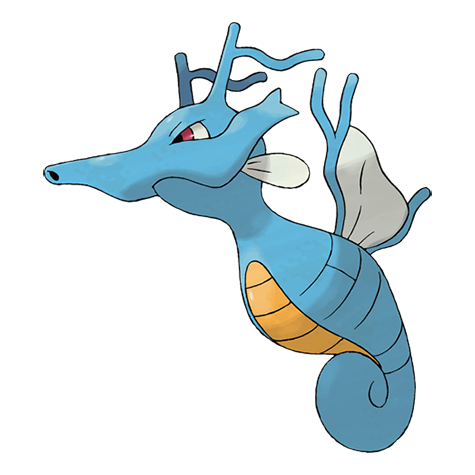
Seadra is the Dragon Pokémon, a pure Water-type species introduced in the first generation. Despite its category name, it carries no Dragon typing of its own — a distinction that sets it apart from its final evolved form. Seadra resembles a seahorse scaled up to an imposing size, with a body that reaches roughly half a meter in height, though its hunched posture makes it appear compact and tightly wound. Its scales are a deep, vivid blue, and its snout extends into a long, rigid tube used both for feeding and for firing pressurized streams of water. Two prominent backward-curving spines flank its neck and crest, giving it a fierce, armored silhouette. Its pectoral fins are broad and wing-like, spread wide to either side, and its thick, coiled tail is dense with muscle. The entire frame projects a sense of contained power — streamlined enough for bursts of speed yet armored enough to absorb significant punishment.
Seadra lives exclusively in salt water, favoring warm coastal seas and reef environments where currents are strong and prey is plentiful. It is most commonly encountered in the waters around Kanto and Johto, though individual specimens turn up along any temperate oceanic route where deep-water channels meet shallow reef shelves. It tends to station itself in zones where rocks, coral formations, or dense sea grass provide both cover and ambush positions. Seadra is a largely solitary creature; adults claim and defend territories against rivals of the same species, engaging in display contests that involve spreading their spines wide and blasting jets of water to assert dominance. The species is most active during daylight hours, retreating to deeper, calmer water after dusk. Young Horsea, its pre-evolved form, gather in loose groups near the shallows, but by the time a specimen matures into Seadra, the instinct for solitary territory has fully taken hold.
Seadra feeds primarily on small fish, crustaceans, and zooplankton, drawing prey into its tubular snout with a rapid suctioning action. Field research suggests it is an ambush predator, hovering almost motionless among coral or kelp beds and then striking with a sudden lunge. When agitated, it spins its body rapidly, generating a powerful vortex capable of capsizing small watercraft — a behavior documented in nautical folklore and confirmed by modern researchers. Despite this capacity for disruption, Seadra is not inherently aggressive toward humans who give it space; most unprovoked encounters end with the Pokémon retreating rather than attacking. Trainers who earn its trust describe it as watchful and proud, capable of forming deep if reserved bonds once it accepts a trainer as worthy of its loyalty. No elaborate mating ritual has been documented; courtship among Seadra appears to involve extended parallel swimming and synchronized fin displays that can continue for many hours.
In battle, Seadra presents a profile built around strong special offense and exceptional physical bulk. Its Special Attack rivals the output of many fully evolved Pokémon, and its Defense stands among the strongest in its weight class, allowing it to absorb physical strikes that would overwhelm comparable Water-types. Its speed is solid, enabling it to outpace a broad range of opponents without requiring dedicated investment. Its Poison Point ability — the one most commonly encountered — activates when an opponent makes direct physical contact, giving Seadra a meaningful chance of inflicting poison on melee attackers and creating a passive deterrent that punishes contact-reliant strategies. Its alternate ability, Sniper, amplifies the damage of critical hits significantly beyond the normal bonus, rewarding strategies built around high critical-hit rates. Its hidden ability, Damp, suppresses self-destructing moves entirely, neutralizing that threat from battle altogether. As a pure Water-type, Seadra resists Fire, Ice, Steel, and Water attacks, but must be protected against Grass and Electric moves, which strike it with doubled force.
Seadra is the middle stage of a three-part evolutionary line. It evolves from Horsea, a small and relatively fragile seahorse Pokémon, upon reaching a moderate level of growth. Seadra itself does not evolve through further leveling; instead, it must hold a Dragon Scale and then be traded to another trainer, at which point it transforms into Kingdra, a dual Water and Dragon type of considerably greater power. This trade-based evolution makes Seadra one of the few Pokémon whose final form requires cooperation between two trainers, giving the line a social dimension rarely seen in the first generation. Among researchers, Seadra holds a notable position in the study of convergent morphology: its Dragon Pokémon category predates any Dragon typing in its biology, suggesting the classification reflects cultural and behavioral perception rather than strict elemental taxonomy. For competitive trainers, it functions as a capable mid-game battler and a transitional form worth developing carefully, since the effort invested carries directly into Kingdra. Its combination of special power, physical resilience, and the passive threat of contact-triggered poison makes it one of the most tactically layered single-type Water Pokémon the first generation produced.