Seaking
Goldfish Pokémon
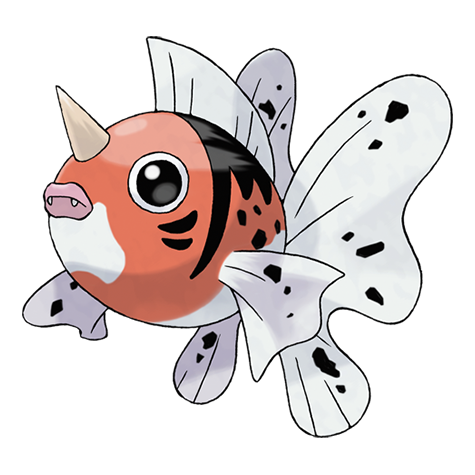
In the autumn spawning season, they can be seen swimming powerfully up rivers and creeks.
- Height
- 1.3 m
- Weight
- 39.0 kg
- Base XP
- 158
- Catch
- 60 /255
- Happy
- 70
- Hatch
- 20 steps
- HabitatWaters Edge
- Body shapeFish
- ColourRed
- Growth rateMedium
- Egg groupsWater2
- RarityStandard
Seaking is a pure Water-type Pokémon introduced in Generation One and classified as the Goldfish Pokémon. It is the evolved form of Goldeen and represents the fully mature stage of that line. Seaking has the body plan of a large ornamental fish, broadly comparable in length to a human child, with a vivid scarlet body marked by bold white patches and black accents that give it the look of a prize-winning koi. Its most immediately striking feature is the single tall horn that curves upward from its forehead, polished to a sharp point and used as both a tool and a weapon. Large rounded fins flare from its sides and a broad, powerful tail propels it through the water with authority. The overall impression is of something grand and purposeful, a fish that has grown into a creature of genuine presence.
Seaking is found throughout the world wherever clean, flowing freshwater exists. It favours rivers, wide streams, and the shores of cold mountain lakes, particularly the kinds of clear, well-oxygenated waters that flow down from elevated terrain. It tends to inhabit the middle and deeper sections of rivers rather than the shallows, keeping to stretches where the current runs strong. Population density is highest in temperate regions with seasonal rainfall, and the species is closely associated with the autumn months, when large numbers can be observed moving upstream in spawning runs that draw the attention of both trainers and researchers. Outside of those seasonal gatherings Seaking is largely solitary, maintaining loose personal territories in its preferred stretches of river and tolerating the presence of other members of its kind only during the breeding season.
In day-to-day life Seaking is an active and vigorous feeder, using its horn to bore into riverbeds and expose aquatic plants, roots, and small invertebrates sheltering beneath rocks. This drilling behaviour is efficient and methodical, and the horn does not blunt easily even against stone substrates. Toward humans, Seaking is generally wary rather than aggressive, retreating into deeper water when approached, though individuals that have lived near fishing communities for generations can become accustomed to human presence. It communicates with others of its kind largely through subtle changes in body posture and the angle of its fins. During the autumn spawning run the species becomes noticeably bolder, driven upstream by powerful instinct regardless of obstacles in its path, and trainers who encounter migrating Seaking report that the fish seem almost indifferent to human activity during this period.
In battle, Seaking leans toward physical offense, with a stronger attack than either its special attack or its speed would suggest it needs to rely on. Its two standard abilities shape how a trainer chooses to deploy it. Swift Swim doubles its movement speed during rain, transforming what is otherwise a modestly paced combatant into something genuinely threatening under those weather conditions and making it a strong candidate for rain-oriented teams. Water Veil prevents the Pokémon from being burned, which protects its physical attack stat from one of the most common forms of passive damage and harassment used in competitive play. Its hidden ability, Lightning Rod, redirects incoming single-target Electric moves toward Seaking and then absorbs that energy to raise its special attack, giving it a niche role as a team support piece that can cover teammates weak to Electric moves. Defensively, Seaking is vulnerable to Grass and Electric attacks, meaning trainers must be thoughtful about when they commit it to a matchup. It performs best in sustained physical exchanges or in weather-controlled environments where Swift Swim is active.
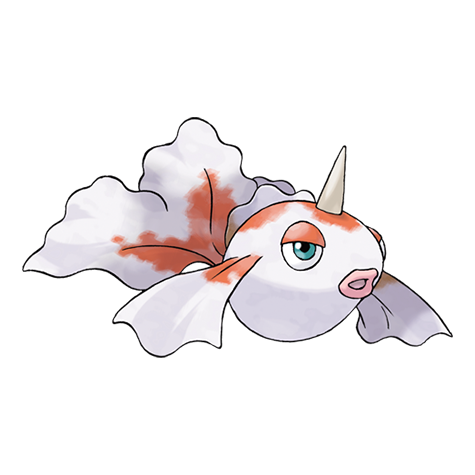
Seaking evolves from Goldeen upon reaching a sufficient level of maturity, completing a two-stage evolutionary line that traces back to one of the original one hundred and fifty-one Pokémon. It does not evolve further, representing the final and largest form of that lineage. Within the broader Pokédex, the Goldeen line holds a quiet but consistent place as one of the most recognisable Water-type families from the earliest generation of the series, drawing on the deep cultural affinity for ornamental goldfish and koi that runs through much of the tradition behind Pokémon design. Researchers studying aquatic Pokémon study Seaking both for its seasonal migration behaviour and for the structural properties of its horn, which proves to be harder and more resilient than the materials of most biological structures of comparable size. Trainers prize it for its reliability in rain-oriented strategies and for the nostalgic significance it carries as one of the foundational Water-types of the original game.