Togepi
Spike Ball Pokémon
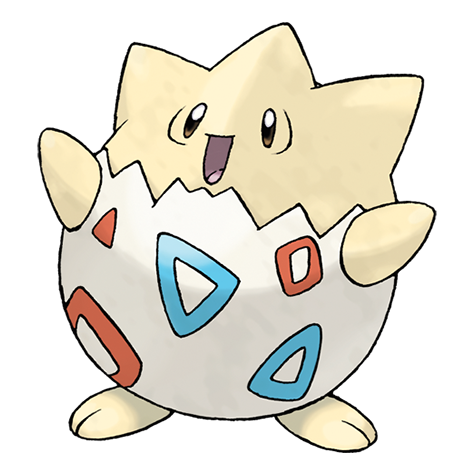
The shell seems to be filled with joy. It is said that it will share good luck when treated kindly.
- Height
- 0.3 m
- Weight
- 1.5 kg
- Base XP
- 49
- Catch
- 190 /255
- Happy
- 70
- Hatch
- 10 steps


- HabitatForest
- Body shapeHumanoid
- ColourWhite
- Growth rateFast
- Egg groupsNo Eggs
- RarityBaby
Togepi is the Spike Ball Pokémon, a pure Fairy-type species introduced in the second generation. It is classified as a Baby Pokémon, representing the earliest stage of its evolutionary line and among the smallest Pokémon known to exist. Standing well below the knee of an average adult human, Togepi has a small, egg-shaped body that is still cradled from below by the broken remains of the eggshell it hatched from. That shell is pale cream with triangular patches of red and blue arranged across its surface, giving the lower half of Togepi's body a distinctly patchwork appearance. The upper body is smooth and white, topped by a round head from which several short, blunt spikes protrude — these are the namesake spikes that define its species category. Its face bears large, round eyes and a small rounded mouth that lend it an expression of perpetual contentment. Togepi's tiny arms and legs barely extend beyond the rim of its eggshell cradle, and it moves with a characteristic toddling gait that reflects both its size and the weight of the shell it carries everywhere it goes.
In the wild, Togepi favors forested environments where the canopy is dense and the forest floor offers plentiful cover in the form of undergrowth, fallen logs, and thick vegetation. It is found in temperate woodland regions and tends to settle in the quietest corners of these habitats, far from human activity and the disturbances that larger Pokémon create. Wild Togepi are genuinely rare; even within forests known to support small populations, encounters are uncommon, and the Pokémon's diminutive size makes it easy to overlook among roots and leaf litter. It is a non-migratory species and typically remains close to the location where it first emerged from its egg, showing little inclination to range widely. Togepi is most active during daylight hours, particularly in the warmer parts of the morning and early afternoon, and it tends to withdraw into shelter as temperatures drop toward evening. It is largely solitary in adulthood, displaying no meaningful territorial behavior and making no aggressive claims on space or food.
Togepi feeds primarily on soft plant matter — ripe berries, tender shoots, and small seeds — sourcing food from the low undergrowth of its forest habitat. It is one of the more docile Pokémon encountered in the wild, displaying little wariness toward humans and tending to approach unfamiliar creatures with curiosity rather than alarm. This openness has given rise to a widespread piece of folklore: that Togepi's eggshell is filled with happiness, and that it shares that happiness freely with those who treat it with genuine kindness and care. Field observers have noted that Togepi emits soft, melodic calls and often seeks out patches of sunlight in the forest, tilting its head as though drawn to warmth and brightness. When frightened or cornered, it does not typically fight back; instead it attempts to fold itself inward, pressing the rounded back of its eggshell outward as a modest physical barrier. Researchers in the field describe it as a creature defined by emotional sensitivity, one that appears to absorb and reflect the emotional states of those around it.
Togepi possesses two standard abilities and one hidden ability. The first, Hustle, increases the power of all its physical attacks substantially but simultaneously reduces their accuracy, a tradeoff that serves Togepi poorly given its very low physical attack and near-zero speed. Its second and significantly more valuable standard ability, Serene Grace, doubles the probability that any move with a secondary effect will trigger that effect on a given use. This means moves that might cause paralysis, flinching, or confusion become far more reliably disruptive, giving Togepi a subtle strategic identity as a status applicator. Its hidden ability, Super Luck, elevates the critical hit rate of its moves by one stage, making each attack somewhat more likely to deal bonus damage. As a pure Fairy type, Togepi is naturally resistant to Fighting, Bug, and Dark-type attacks and is entirely immune to Dragon-type moves, one of the most powerful type categories in battle. It is, however, vulnerable to Poison and Steel-type moves. Its low speed means it rarely acts first, and its modest offensive values limit direct damage output. Its real competitive value lies in what it hints at: the abilities and typing it will carry forward into evolution.
Togepi is the first stage in a three-member evolutionary line. It evolves into Togetic through a bond of friendship — when its happiness with its trainer reaches a sufficient level, the transformation is triggered, reflecting the Pokémon's thematic emphasis on emotional connection and trust. Togetic then evolves once more into Togekiss upon exposure to a Shiny Stone, yielding a large, swift, and formidable Fairy-type with substantially improved stats across the board. Because Togepi belongs to the No Eggs group, it cannot be bred through standard methods, and obtaining one typically requires hatching a special egg or receiving one as an in-game gift from a non-player character. Among researchers, Togepi holds historical significance as one of the first Baby Pokémon introduced to the Pokédex, helping establish the concept of pre-evolutionary stages tied to high happiness thresholds. It was also among the earliest Pokémon to exhibit what are now recognized as classic Fairy-type characteristics, though it was originally catalogued under a different typing before that category was formally introduced to the series. For trainers, Togepi is a reminder that some of the most rewarding partnerships begin not with power, but with patience and genuine care.